
Home / Blog / Buying guide
How to buy rooftop solar for your home in Tricity, step by step
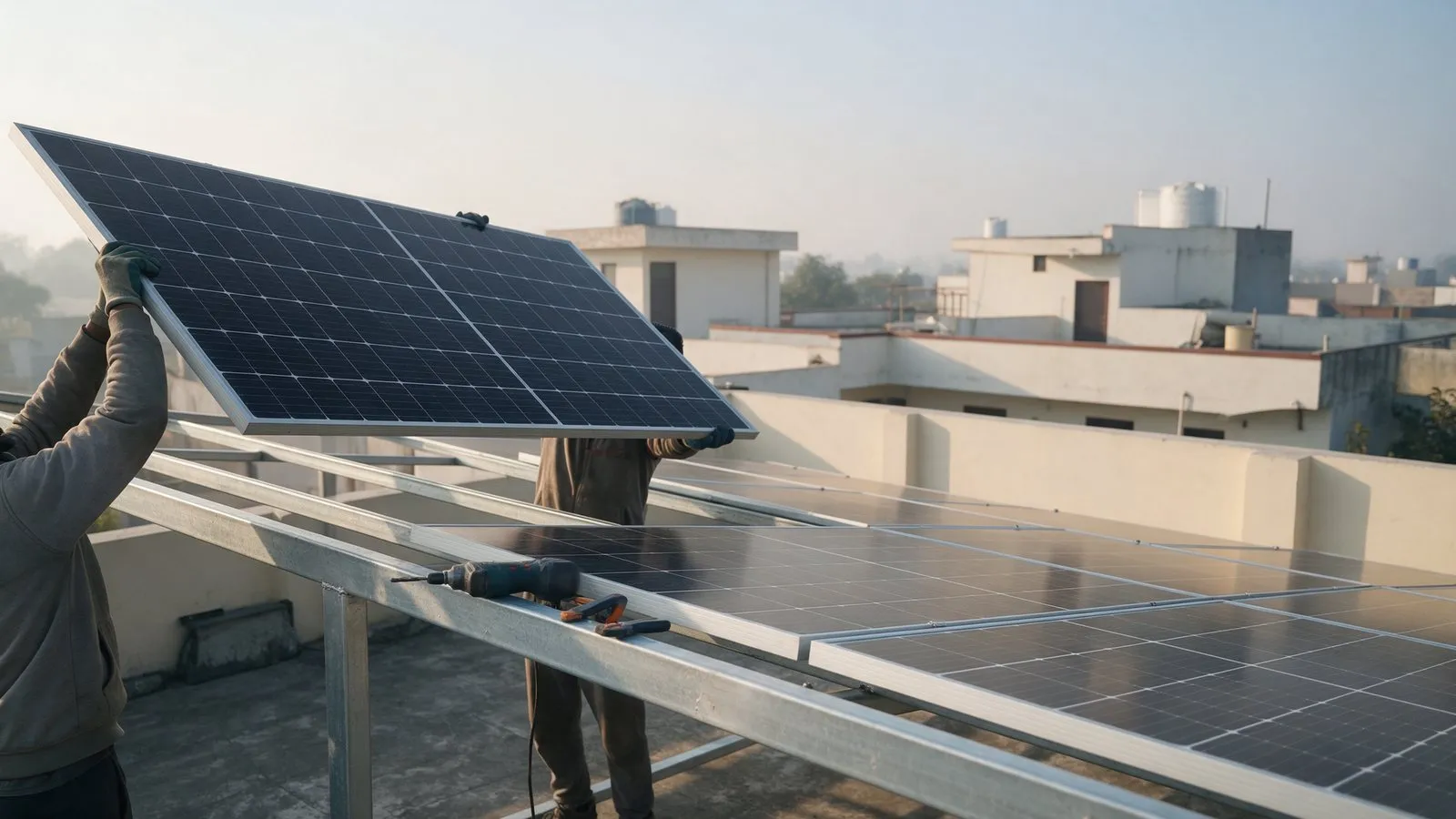 Representative image
Buying rooftop solar is a decision you make once for 25 years, and most of the mistakes people regret happen before anything reaches the roof. This guide sets out the whole process for a home in Mohali, Zirakpur, Kharar, New Chandigarh, Chandigarh or Panchkula, in the order it happens, with a link at each step to the guide that covers it in detail.
1. Start from a year of bills
Everything about the right system comes from your electricity use, so collect twelve months of bills first. PSPCL customers can download them from the PSPCL website or app. From the bills, note:
Punjab homes get 300 free units a month, which changes how a system should be sized. Our guide to whether solar is worth it with the 300 free units explains when it pays, and what size system your home needs works through the arithmetic. The savings calculator does both from a single bill.
2. Decide whether you need a battery
An on-grid system, without a battery, gives the biggest saving for the money and is the type the PM Surya Ghar subsidy supports. It switches off in a power cut. A hybrid system adds a battery for essential loads, at a much higher cost. Many homes in Tricity already have an inverter and battery that can carry on alongside an on-grid system. Our guide to on-grid or hybrid solar helps you decide.
3. Look at your roof
Each kW of panels needs roughly 80 to 100 sq ft of shade-free roof. Look for the shadows of water tanks, stair rooms, parapets, trees and neighbouring buildings, especially on winter mornings, when they are longest. Decide whether you want to keep using the roof, because that decides between a low frame, a raised frame and a canopy. The structures we build are on the home page, and the tilt angle and direction guide explains how the panels should face.
4. Decide on the subsidy
Homes can claim up to ₹78,000 under PM Surya Ghar, on the first 3 kW of a system, if the panels are DCR, made with Indian cells. DCR panels cost more, so for larger systems the subsidy does not always pay for the difference.
When the subsidy is worth taking
The subsidy is paid only on systems built with DCR panels, made with Indian solar cells, which cost about ₹9,000 more for every kW installed. The subsidy stops at ₹78,000 on 3 kW, but the extra panel cost keeps growing with size.
| System size | Extra cost of DCR panels | Subsidy | Cheaper route |
|---|---|---|---|
| 3 kW | ₹27,000 | ₹78,000 | DCR with the subsidy, about ₹51,000 better |
| 5 kW | ₹45,000 | ₹78,000 | DCR with the subsidy, about ₹33,000 better |
| 8 kW | ₹72,000 | ₹78,000 | About the same (DCR ₹6,000 better) |
| 10 kW | ₹90,000 | ₹78,000 | Non-DCR without the subsidy, about ₹12,000 better |
Up to about 8 kW, take the subsidy. From about 9 kW, non-DCR panels without it cost less, an option homes have until 31 March 2027. More on the subsidy page.
The subsidy rates are set only until 31 March 2027, as our post on the PM Surya Ghar deadline explains, and homes giving up the subsidy may use non-DCR panels until the same date.
5. Get two or three quotations
For a home system with DCR panels, 2026 prices run at roughly ₹52,000 to ₹66,000 per kW installed, including GST. Divide each quote by its size in kW to compare, then compare the parts line by line: panel make and model, inverter, structure, cables, protection boxes, earthing and what is excluded.
- How to compare solar quotations, with a worked example of two “5 kW” offers
- Parts of a rooftop solar system, and what to check in each
- The quotation checklist, 20 points on one page
6. Have the roof surveyed
A proper survey measures the roof, checks shade through the day and through the year, inspects the slab or shed for the structure, and checks the sanctioned load and the route for cables to the meter. The final size and price should come after the survey, not before it.
7. Sign, and pay in stages
The contract should name the make and model of every part, the structure height, the warranties, who files the net-metering application and a timeline. Pay in stages linked to delivery and commissioning. Never pay the full amount in advance, and avoid paying most of it before the electricity board has accepted the application.
8. Apply to the electricity board
Subsidy homes apply on the national PM Surya Ghar portal, which passes the application to PSPCL. Others apply to PSPCL directly, or to CPDL in Chandigarh and UHBVN in Panchkula. For PSPCL, an application for a system of up to 10 kW is treated as accepted once it is complete. Do not install before approval if you are claiming the subsidy. The documents PSPCL asks for are listed stage by stage, and the subsidy application guide covers the portal.
9. Installation
The roof work for a home system usually takes a few days: the structure, the panels, the cabling, the inverter, the protection boxes and the earthing. Be at home for the first day to agree where the inverter and cables will go. The installer then uploads the installation documents and photographs for the electricity board.
10. Inspection, net meter and commissioning
The electricity board inspects the system, fits the bi-directional net meter and commissions it. This is usually the slowest step, because it runs on the board’s schedule. Billing on the net meter starts from the next cycle, and our guide to net metering in Punjab explains how to read the new bill.
11. The subsidy payment
For subsidy homes, bank details go on the portal after commissioning, and the subsidy is paid into the applicant’s account, usually within a few weeks. The name on the bank account must match the electricity connection.
12. Handover and the first year
At handover you should receive the serial numbers of the panels and inverter, the warranty cards, the test readings including earthing, and access to the monitoring app. Check the app every week or two in the first months, so that you know what normal output looks like. Panels need a rinse with plain water every couple of weeks in dusty months, and our guide to cleaning panels in dust and smog covers the rest. Every home system from us includes the 4-Year Care Shield, with four seasonal visits a year.
How Maya Green Power fits in
We manage the whole process for homes across Tricity: the bill assessment, the survey, the design, the quotation, the application, the installation by our own team to our written specification, the inspection, the net meter and the subsidy steps. Subsidy systems are installed through a registered vendor named in your proposal, and we stay your single point of contact throughout.
Common questions
How long does it take to get rooftop solar on a home?
The roof work itself usually takes a few days. Most of the time goes on the electricity board's steps, especially the inspection and the net meter, which depend on its schedule in your area. Applying with complete documents, in the right order, is the best way to avoid delays.
Do I need the electricity board's approval before installing solar?
Yes. A grid-connected system needs an application to PSPCL, CPDL or UHBVN before installation, and the net meter is fitted only after their inspection. For homes claiming the PM Surya Ghar subsidy, installing before approval can cost you the subsidy.
Should I wait for solar prices to fall?
Waiting has costs too. The PM Surya Ghar subsidy rates are set only until 31 March 2027, and every month without solar is a month of full bills. Panel prices change slowly, and the panels are only part of the installed price.
Can I buy rooftop solar if I live in a flat?
You will need the housing society's approval to use the common roof. Since 1 July 2026, PSERC's virtual net metering lets the residents of a building in Punjab set up one shared plant and divide the credits between them, which is the most practical route for most flats.
Our home systems
Each one is sized to your own bills. See the price per kW and what each kW makes.
Core
Small home
Usually 1 to 3 kW
Ask about CoreComfort
Family home
Usually 4 to 5 kW
Ask about ComfortGrand
Kothi or large home
Usually 6 kW and above
Ask about Grand