
Home / Blog / Home solar
Is rooftop solar worth it with Punjab's 300 free units?
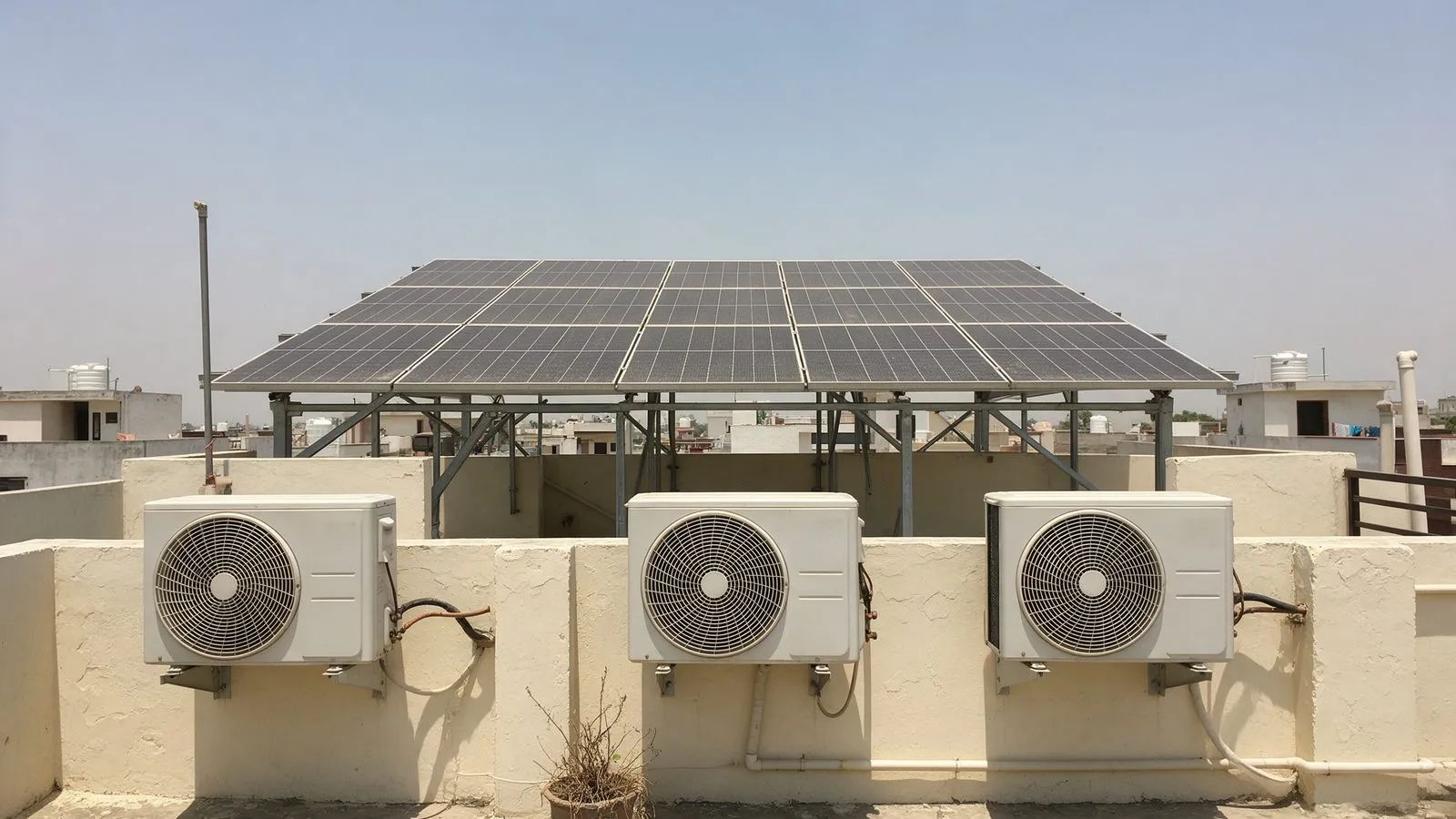 Representative image
Every domestic PSPCL connection in Punjab gets 300 free units of electricity a month. If your bill is already zero, rooftop solar can look pointless. For some homes it is. For many others, especially those running air conditioners through the summer, solar is what keeps the free units in place. This guide explains how to tell which group you are in.
How the 300 free units work
- Domestic connections get 300 free units a month. PSPCL bills every two months, so the limit on your bill is 600 units.
- For a general-category home, the limit is all or nothing. Stay within it and the energy charges are zero. Cross it, even by a few units, and you pay for every unit on the bill, not only the units above the limit.
- Sources indicate that SC, BC, BPL and freedom-fighter households pay only for the units above 300. Check the category printed on your bill.
- Within the limit, PSPCL also waives fixed charges, meter rent and electricity duty, so the bill is zero. Above it, those are billed as well.
From April 2026, PSPCL’s energy charge for a typical home is ₹4.25 a unit up to 300 units and ₹7.05 a unit above that, for a sanctioned load between 2 and 7 kW. So a general-category home using 400 units a month in summer pays about ₹1,980 a month, where a home using 300 pays nothing.
How solar changes the calculation
With net metering, PSPCL fits a meter that counts in both directions. Units your panels send to the grid during the day are set against units you take from it at night, and your bill is based on the net figure. The free-unit limit is applied to that net figure. In other words, solar does not compete with the free units. It keeps your net use under the limit.
June, without solar: 520 units
Energy charges ₹0Over the limit, so every unit is billed: ₹2,826
The same home with 3 kW of panels
Energy charges ₹0Over the limit: ₹2,826About 360 units from the panels bring net use to 160: ₹0
That gives three kinds of home.
1. Homes that stay under the limit all year: solar is usually not worth it
If your bills stay under 600 units every two months, including May and June, your energy charges are already zero. Solar would save you very little, and we will tell you so. The exception is a home expecting its use to rise soon, for example with a new air conditioner, an electric vehicle or more family members.
2. Homes that cross the limit in summer: solar can be very worthwhile
This is the most common situation in Mohali, Zirakpur and Kharar. Bills are zero from October to March, then two or three air conditioners push the summer bills over 600 units, and the whole bill becomes payable.
Take a general-category home using 250 units a month in winter and 800 a month in summer. Each summer month costs about ₹4,800, or about ₹9,600 on every two-month bill.
A 5 kW system makes at least about 540 units a month, even in a hazy month. That brings net use down to about 260 units, safely inside the limit, and the summer energy charges fall to zero. Over a four-month summer that is around ₹19,000 saved, and more in a long, hot year.
For homes like this, the right size is the smallest system that keeps your summer net use under the limit, with a margin for hotter years. A larger system adds cost without adding much saving, because surplus units carried to the end of the year are paid for at a much lower rate.
3. Homes always above the limit: solar saves from the first bill
A home using 600 units a month or more all year already pays every month. Here solar works the way it does anywhere else: each unit the panels make is a unit not bought at ₹4.25 to ₹7.05. A general-category home using 600 units a month saves about ₹3,390 a month with a 3 kW system. Our guide to what a 5 kW system costs in Mohali works through the payback.
SC, BC and BPL households
If you only pay for units above 300, solar has less to save, because the first 300 units are free whatever happens. A small system that covers the units above 300 is usually enough. With the PM Surya Ghar subsidy of ₹30,000 for each of the first 2 kW, a 1 or 2 kW system can still pay back in a few years.
How to check your own bills
- Collect your last six bills, or download them from the PSPCL website or app.
- Note the units consumed on each. Halve each figure to get the monthly use.
- Mark the bills over 600 units. Those are the cycles solar needs to bring down.
- Check the sanctioned load and category printed on the bill.
Our savings calculator does this arithmetic for you, using Punjab’s 2026-27 rates and the free-unit rule. Or send a photograph of your summer bill on WhatsApp and we will work out the size for you.
The rules can change
The 300 free units are a Punjab government scheme, and the rules and rates can change from year to year. Your proposal should state the free-unit rule and tariff it assumes, so you can see how the figures depend on them.
Common questions
Will I lose my 300 free units if I install solar?
No. The free units belong to your domestic connection, not to how you use power. With net metering, the free-unit limit is applied to your net use after solar, so a correctly sized system helps you stay within it.
My bill is zero most of the year. Should I still install solar?
Only if some bills cross 600 units, usually in summer. If every bill stays under the limit, solar will save you very little, and we will advise you not to install it unless your use is about to rise.
What size system do I need to keep my bill at zero in summer?
Enough to bring your summer net use under 300 units a month. As a rough guide, each kW makes at least about 108 units a month here, so a home using 800 units a month in summer needs about 5 kW. We size it from your actual bills.
Do SC and BC households get the same free units?
They also get 300 free units a month. Sources indicate they pay only for units above 300, rather than the whole bill, so solar is sized to cover just those extra units. Check your category on the bill.
Our home systems
Each one is sized to your own bills. See the price per kW and what each kW makes.
Core
Small home
Usually 1 to 3 kW
Ask about CoreComfort
Family home
Usually 4 to 5 kW
Ask about ComfortGrand
Kothi or large home
Usually 6 kW and above
Ask about Grand