
Home / Blog / Subsidy and net metering
Rooftop solar in Panchkula: UHBVN net metering explained
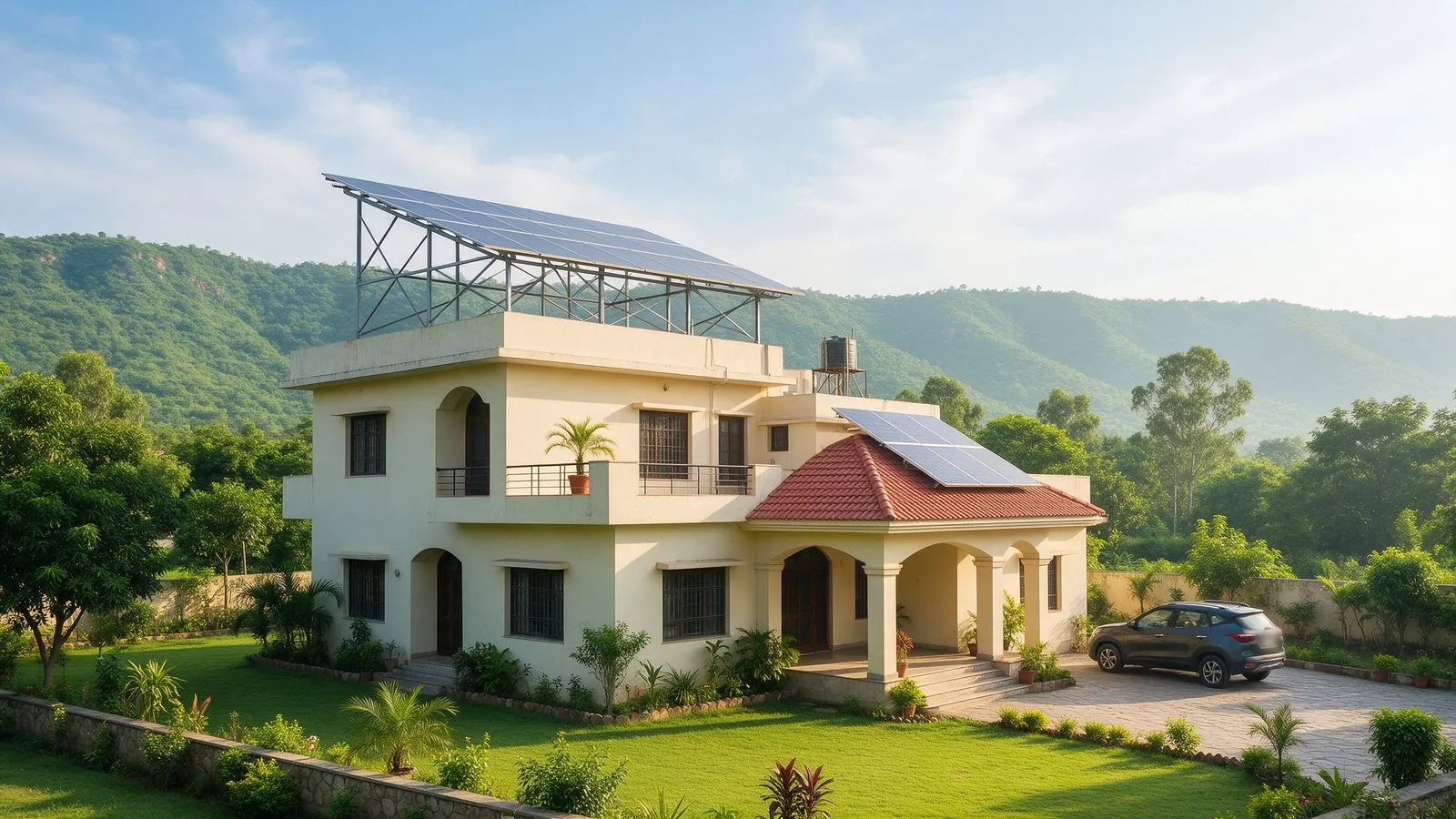 Representative image
Panchkula is in Haryana, so rooftop solar here follows Haryana’s rules, not Punjab’s or Chandigarh’s. The power company, the regulator and the tariff are all different, and there are no free units. This guide explains how rooftop solar works for a Panchkula home or business and what it saves on a UHBVN bill.
Who is who in Panchkula
What solar saves on a UHBVN bill
HERC set new domestic tariffs from April 2025 and kept them unchanged for 2026-27, as UHBVN’s tariff schedule for the year shows. For homes using more than 100 units a month, the energy charges depend on the load on your connection:
| Load on your connection | Units in the month | Rate per unit |
|---|---|---|
| Up to 5 kW | First 150 | ₹2.95 |
| 151 to 300 | ₹5.25 | |
| 301 to 500 | ₹6.45 | |
| Above 500 | ₹7.10 | |
| Above 5 kW | First 500 | ₹6.50 |
| 501 to 1,000 | ₹7.15 | |
| Above 1,000 | ₹7.50 |
There is also a fixed charge. Homes with a load up to 5 kW pay none in a month of up to 300 units, and ₹50 per kW of load above that. Homes with a load above 5 kW pay ₹75 per kW every month. The slabs are telescopic, so solar removes your highest-priced units first. Homes with a load above 5 kW pay at least ₹6.50 for every unit, which is why larger homes in Panchkula save the most from solar.
Two worked examples.
At 2026-27 prices, both pay for themselves in roughly four to seven years after the ₹78,000 subsidy. Our savings calculator works it out for your own bill: choose Panchkula.
Net metering under HERC
Net metering in Panchkula follows HERC’s regulations for rooftop solar, made in 2021 and amended in 2024. Units your panels export are set against units you import, so the meter only bills you for the difference.
How long surplus units are carried forward, and what is paid for any left over at the end of the year, are set by those regulations and your net-metering agreement with UHBVN. Ask UHBVN for the current terms before sizing a system much larger than your own use.
For homes under PM Surya Ghar, UHBVN lets you pay the cost of the net meter, and the security deposit for any increase in load, either when you apply or in your first bill after the system is commissioned.
The subsidy in Panchkula
Panchkula homes can claim the central PM Surya Ghar subsidy of up to ₹78,000 on the first 3 kW, on the same terms as anywhere else: DCR panels, a registered vendor and a domestic connection in your name.
Haryana’s own help: Saur Urja Protsahan Yojana
On top of PM Surya Ghar, UHBVN runs Haryana’s Saur Urja Protsahan Yojana (SUPY) for homes, under circulars of February and July 2026. It works out the help from a benchmark cost of ₹55,000 per kW.
In UHBVN’s own example, a 3 kW system at the benchmark cost of ₹1.65 lakh works out as ₹16,500 upfront, ₹78,000 central subsidy, ₹58,500 interest-free from UHBVN repaid through bills, and ₹12,000 more from the homeowner. If the system costs more than the benchmark, the homeowner pays the difference.
You check your eligibility on UHBVN’s solar portal, apply on the national portal, and link the two. The installation is done by a vendor empanelled for the scheme.
How to apply
Homes apply on the national portal, pmsuryaghar.gov.in, choosing Haryana and UHBVN. The documents are much the same as in Punjab: a recent bill, identity proof, proof of ownership, roof photographs and, for the subsidy, bank details in the applicant’s name. Our list of documents for PSPCL net metering is a useful guide, though UHBVN’s forms are its own.
How Maya Green Power works in Panchkula
From our office in Zirakpur, a short drive away, we take on commercial projects and hybrid systems with battery backup in Panchkula now. Subsidy applications for Panchkula homes go through Haryana’s own approval route, which we are setting up, so for now we survey and size home systems and tell you how to apply. Our commercial solar page and battery backup page have more detail.
Common questions
Do Panchkula homes get free electricity units?
No. Punjab's 300 free units a month apply to PSPCL connections only. Panchkula homes on UHBVN pay for every unit at slab rates, so rooftop solar saves money every month of the year.
Is there a Haryana subsidy on top of PM Surya Ghar?
Yes, through the Saur Urja Protsahan Yojana. Most homes can install up to 5 kW by paying 10% upfront, with UHBVN lending up to ₹19,500 per kW interest-free, repaid through bills. Antyodaya families with an income up to ₹3 lakh also get a state grant for up to 2 kW.
Is there a fixed charge on a UHBVN home bill?
For a home with a load up to 5 kW, not in a month when you use up to 300 units. Above 300 units, ₹50 per kW of load is added. Homes with a load above 5 kW pay ₹75 per kW every month.
How much does rooftop solar save in Panchkula?
A home with a load up to 5 kW using 500 units a month saves roughly ₹2,300 to ₹2,500 a month with a 4 kW system at 2026-27 rates. A large home using 1,000 units a month saves roughly ₹5,900 to ₹6,800 a month with 8 kW.
Our home systems
Each one is sized to your own bills. See the price per kW and what each kW makes.
Core
Small home
Usually 1 to 3 kW
Ask about CoreComfort
Family home
Usually 4 to 5 kW
Ask about ComfortGrand
Kothi or large home
Usually 6 kW and above
Ask about Grand