
Home / Blog / Subsidy and net metering
Solar for housing societies in Punjab: common areas and shared plants
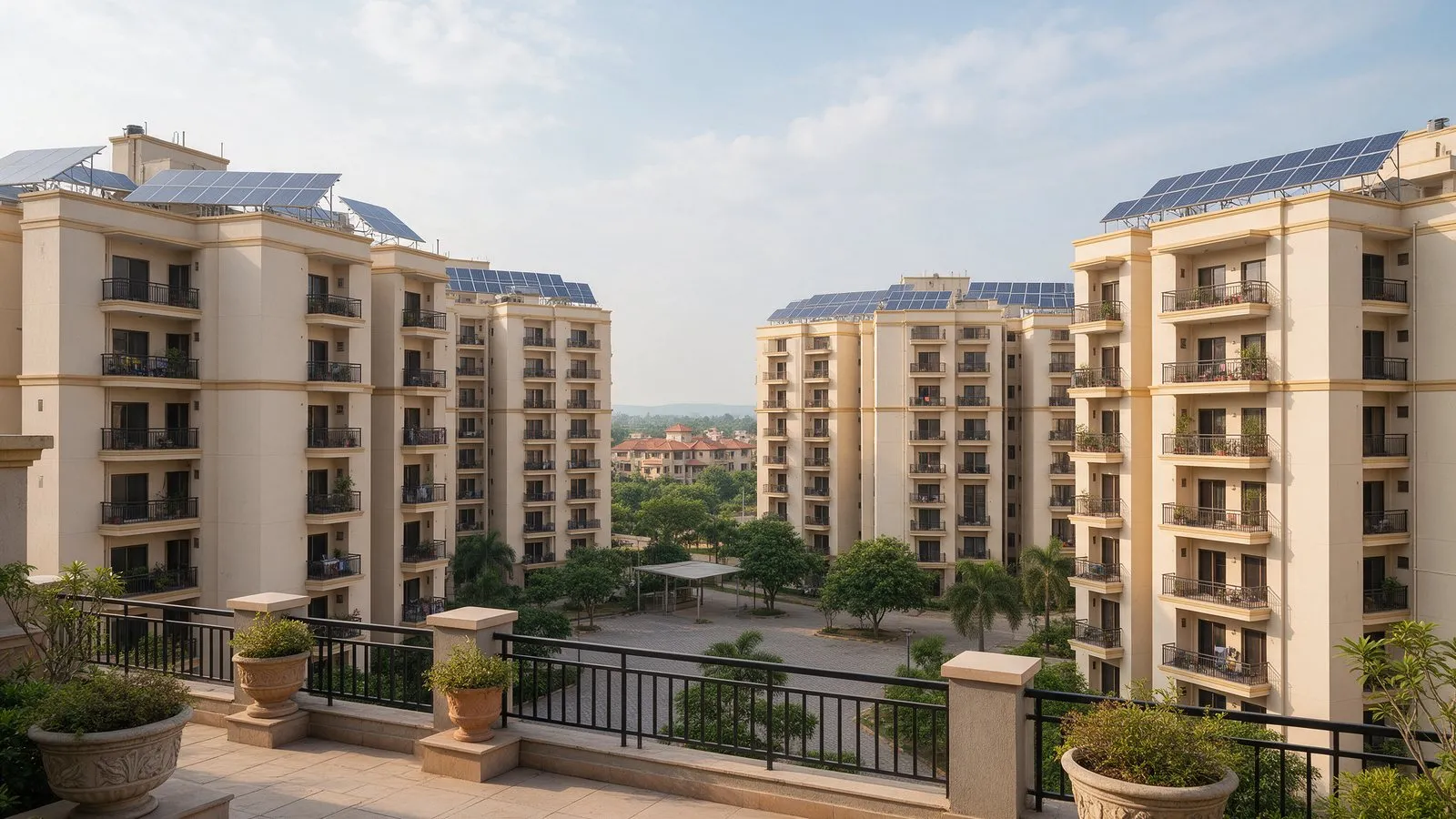 Representative image
A family in a flat cannot put solar on the roof the way a family in a kothi can. The roof is shared, it is small for the number of homes below it, and it usually belongs to everyone. Since 1 July 2026, Punjab’s rules offer two practical routes for societies in Mohali, Zirakpur and New Chandigarh: solar for the common areas, and a shared plant whose units are divided between the flats. This guide explains both.
Route 1: solar for the common areas
Lifts, water pumps, corridor and street lighting, the gym and the clubhouse run on the society’s common connection, and that connection can have its own net-metered rooftop system, like any other. The units the panels make are set against the common-area bill, which is shared among the residents through maintenance charges.
The society subsidy. Under PM Surya Ghar, a group housing society or resident welfare association can receive ₹18,000 per kW for a system serving common facilities, including EV charging, up to 500 kW. The limit is counted at 3 kW per house, and includes any systems residents have already installed on their own connections. The connection must be used only for common facilities, not to supply individual flats, and the panels must be DCR, made with Indian cells. The subsidy is paid to the society or association.
Route 2: a shared plant under virtual net metering
PSERC’s amendment of April 2026 brought in virtual net metering, which took effect on 1 July 2026. It lets several domestic consumers, such as the residents of a building or colony, set up one rooftop plant together and share its output.
How it works under the regulations:
One check before you plan. Virtual net metering credits each member’s own PSPCL connection. If your society takes power at a single point and the developer or association bills residents itself, ask PSPCL how the arrangement applies to you before going further.
Which route suits your society
| Common-area system | Shared plant (virtual net metering) | |
|---|---|---|
| Who benefits | The common-area bill, shared through maintenance | Each member’s own electricity bill |
| Size | Up to the common connection’s sanctioned load | 5 kW to 500 kW, within members’ combined load |
| Who signs | The society or association | The members, through a lead member |
| Best for | Societies with high lift and pumping loads | Residents who want lower bills at home |
Many societies will do both: a system for the common areas on part of the roof, and a shared plant for members who join.
The decisions a society has to make
- Roof space. Each kW needs roughly 80 to 100 sq ft of shade-free roof. Water tanks, lift rooms and solar water heaters take much of a tower roof, so measure what is really free.
- Who joins and in what share. For a shared plant, agree the shares in writing, along with what happens when a member sells or moves out.
- Approval. Work on the common roof needs the society’s consent, so check what your bye-laws require, such as a general body resolution.
- Structure. A raised frame lets the roof stay usable for tanks, maintenance and residents underneath.
How we work with societies
We survey the roof, read the common-area and members’ bills, and size each route against them. For the common-area subsidy, the system is installed through a registered vendor, named in the proposal. Our guides to net metering in Punjab and increasing your sanctioned load cover the rules that apply to every connection, and our commercial solar page covers larger systems.
Common questions
Can I install solar for my own flat?
Only with roof space you are allowed to use, which in most societies needs the association's approval. Since 1 July 2026, PSERC's virtual net metering lets residents set up one shared plant and divide its units between their own bills, which is the more practical route for most flats.
Is there a subsidy for housing societies?
Yes, for common facilities. PM Surya Ghar pays a group housing society or resident welfare association ₹18,000 per kW for a system serving lifts, pumps, lighting and EV charging, up to 500 kW, counted at 3 kW per house. The panels must be made with Indian cells.
How large can a shared society plant be?
Under virtual net metering, from 5 kW up to the members' sanctioned loads added together, with a cap of 500 kW. Plants of up to 100 kW connect at low tension and larger ones at high tension.
What happens to my share if I sell my flat?
The members agree this in their own arrangement, which PSPCL is not part of. Shares can be changed at the start of each financial year with three months' notice through the lead member, so write the rule for leaving members into the agreement from the start.
Our home systems
Each one is sized to your own bills. See the price per kW and what each kW makes.
Core
Small home
Usually 1 to 3 kW
Ask about CoreComfort
Family home
Usually 4 to 5 kW
Ask about ComfortGrand
Kothi or large home
Usually 6 kW and above
Ask about Grand