
Home / Blog / Subsidy and net metering
Rooftop solar in Chandigarh: CPDL net metering and what is different
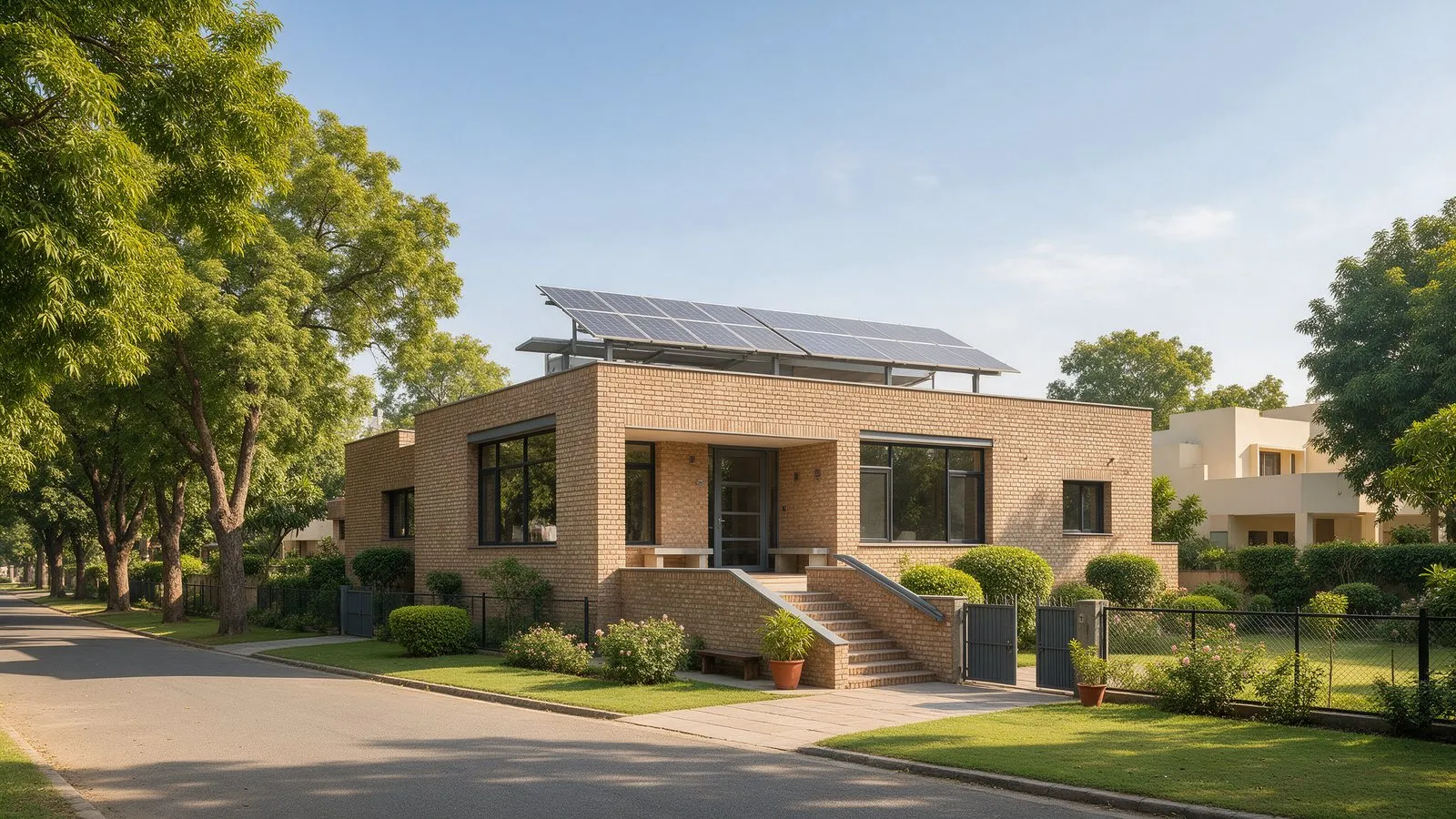 Representative image
Chandigarh sits next to Mohali, but rooftop solar works differently on each side of the boundary. The power company is different, the regulator is different, there are no free units, and the city has its own building rule for rooftop solar. This guide sets out what is different in Chandigarh, what a system saves on a Chandigarh bill, and how the subsidy and net metering work here.
Who is who in Chandigarh
What solar saves on a Chandigarh bill
Chandigarh homes pay for every unit, at telescopic slab rates that are lower than Punjab’s top rate. These are the domestic energy charges for 2026-27 in JERC’s tariff order for CPDL:
| Units in the month | Rate per unit |
|---|---|
| First 100 | ₹2.95 |
| 101 to 200 | ₹3.75 |
| 201 to 300 | ₹4.80 |
| 301 to 400 | ₹5.00 |
| Above 400 | ₹5.40 |
A fixed charge of ₹30 per kW of load a month comes on top. Because the slabs are telescopic, solar removes your highest-priced units first.
A worked example. A home using 500 units a month pays about ₹2,190 in energy charges. A 4 kW system makes roughly 430 to 500 units a month, which brings the energy charges down to between zero and about ₹60. At 2026-27 prices, a 4 kW system with DCR panels costs roughly ₹1.3 lakh to ₹1.86 lakh after the ₹78,000 subsidy, and pays for itself in roughly five to eight years.
How this differs from Mohali. Across the boundary, a Punjab home within 300 units a month pays nothing for energy, so solar saves money mainly in the summer months. In Chandigarh there are no free units, so solar saves money every month of the year, but at lower rates. Our savings calculator works out both: choose Chandigarh and enter your bill.
Net metering under JERC
Net metering in Chandigarh follows JERC’s regulations for grid-connected solar under net metering, made in 2019 and amended in August 2024. The main rules:
Charges waived for homes under PM Surya Ghar. In August 2025 JERC waived three charges for homes installing rooftop solar under PM Surya Ghar: the cost of the meter CPDL installs, the charges for testing, installing and maintaining it, and the registration fee. The net-metering agreement with CPDL is still required.
The subsidy in Chandigarh
Chandigarh homes can claim the central PM Surya Ghar subsidy of up to ₹78,000 on the first 3 kW, on the same terms as anywhere else: DCR panels, a registered vendor and a domestic connection in your name.
The 500 sq yd rule
Under a UT notification of May 2016, rooftop solar is compulsory on residential houses of 500 square yards (one kanal) and above in Chandigarh, and the Estate Office has issued notices to owners who have not installed it. If you are not sure whether the rule covers your house, ask CREST or the Estate Office.
How to apply
Homes apply on the national portal, pmsuryaghar.gov.in, choosing Chandigarh and CPDL. The documents are much the same as in Punjab: a recent bill, identity proof, proof of ownership, roof photographs and, for the subsidy, bank details in the applicant’s name. Our list of documents for PSPCL net metering is a useful guide, though CPDL’s forms are its own.
How Maya Green Power works in Chandigarh
From our office in Zirakpur we take on commercial projects and hybrid systems with battery backup in Chandigarh now. Subsidy applications for Chandigarh homes have their own approval route, which we are setting up, so for now we survey and size home systems and tell you how to apply. Our Chandigarh page sets out what we take on in the city, and the commercial solar page and battery backup page have more detail.
Common questions
Is rooftop solar compulsory in Chandigarh?
For residential houses of 500 square yards (one kanal) and above, yes, under a UT notification of May 2016. If you are not sure whether the rule covers your house, ask CREST or the Estate Office.
Do I pay CPDL for the net meter?
Not if you install rooftop solar on your home under PM Surya Ghar. In August 2025 JERC waived the meter cost, the meter testing and installation charges and the registration fee for these homes.
Does Chandigarh have free electricity units like Punjab?
No. Punjab's 300 free units a month apply to PSPCL connections only. Chandigarh homes pay for every unit at slab rates, so rooftop solar saves money every month, not only in summer.
How much does a 4 kW solar system save in Chandigarh?
For a home using about 500 units a month, roughly ₹2,000 to ₹2,200 a month in energy charges at 2026-27 rates, or ₹24,000 to ₹26,000 a year. After the PM Surya Ghar subsidy, a 4 kW system typically pays for itself in five to eight years.
Our home systems
Each one is sized to your own bills. See the price per kW and what each kW makes.
Core
Small home
Usually 1 to 3 kW
Ask about CoreComfort
Family home
Usually 4 to 5 kW
Ask about ComfortGrand
Kothi or large home
Usually 6 kW and above
Ask about Grand