
Home / Blog / Home solar
How much does a 3 kW solar system cost in Mohali in 2026?
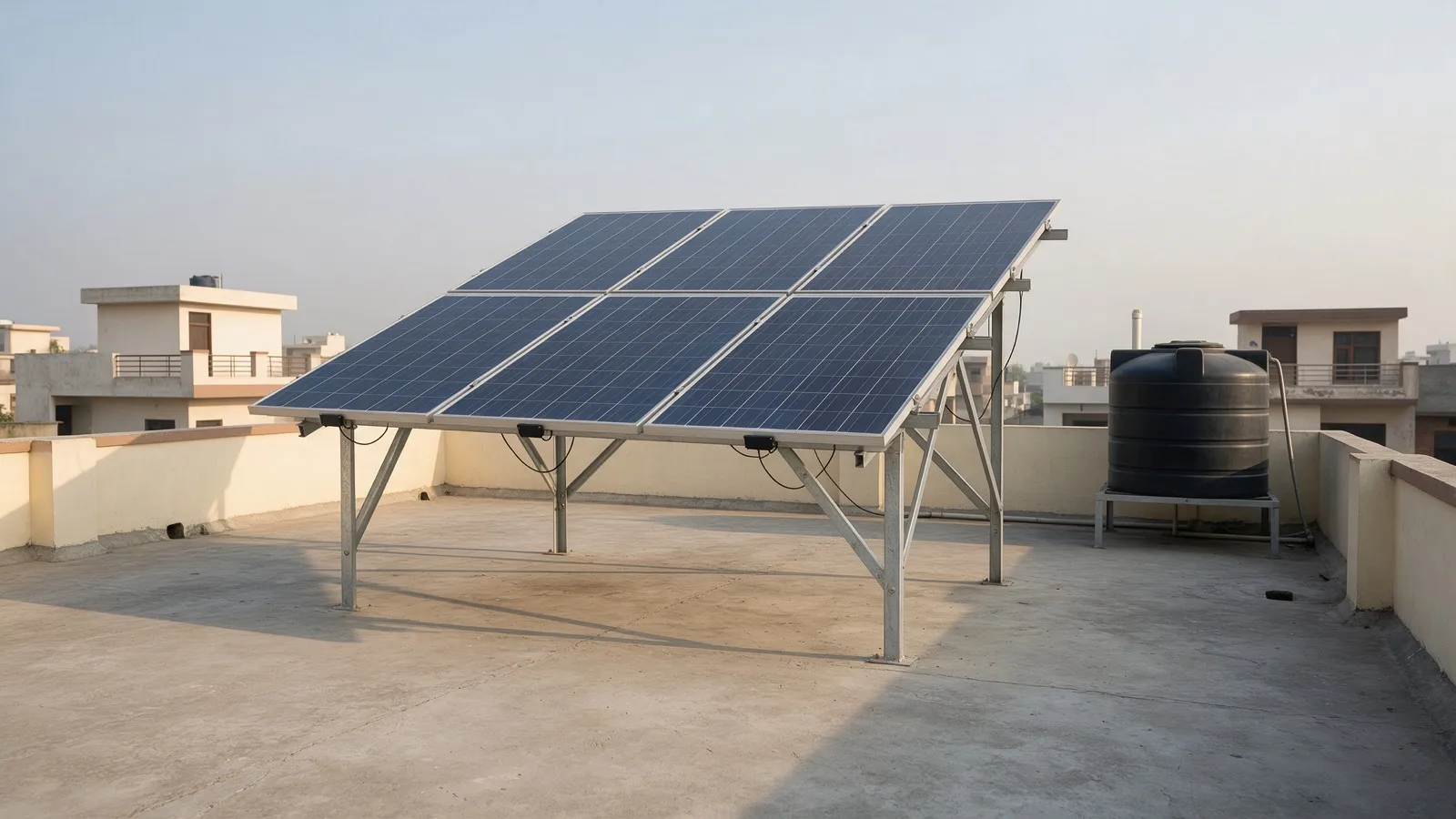 Representative image
A 3 kW on-grid rooftop system for a home in Mohali typically costs ₹1,56,000 to ₹1,98,000 in 2026, including GST, with the Indian-made panels the subsidy requires. After the ₹78,000 PM Surya Ghar subsidy, eligible homes pay about ₹78,000 to ₹1,20,000. That makes 3 kW the size where the subsidy covers the largest share of the price, and for many Punjab homes it is also the right size.
These are market ranges for planning, not a quotation. A firm price depends on your roof and the brands you choose, and it follows a site survey.
What a 3 kW system includes
Why 3 kW gets the most from the subsidy
PM Surya Ghar pays ₹30,000 for each of the first 2 kW and ₹18,000 for the third. A 2 kW system receives ₹60,000. A 3 kW system receives the full ₹78,000, and anything larger receives the same amount. So the subsidy pays for roughly 40 to 50% of a 3 kW system, against about a quarter to a third of a 5 kW one.
To claim it, you must own the home, have the domestic PSPCL connection in your name and install through a registered vendor. Our step-by-step guide covers how to apply for PM Surya Ghar in Punjab.
DCR or non-DCR panels at 3 kW
The subsidy only applies to panels made with Indian cells, known as DCR panels, which cost about ₹9,000 a kW more than other panels. Until 31 March 2027, a home that gives up the subsidy may still use non-DCR panels, at about ₹1,29,000 to ₹1,71,000 for 3 kW with no subsidy.
At this size the choice is clear. DCR panels with the subsidy work out about ₹51,000 cheaper than non-DCR panels without it. Only on much larger homes does the extra panel cost catch up with the subsidy.
When the subsidy is worth taking
The subsidy is paid only on systems built with DCR panels, made with Indian solar cells, which cost about ₹9,000 more for every kW installed. The subsidy stops at ₹78,000 on 3 kW, but the extra panel cost keeps growing with size.
| System size | Extra cost of DCR panels | Subsidy | Cheaper route |
|---|---|---|---|
| 3 kW | ₹27,000 | ₹78,000 | DCR with the subsidy, about ₹51,000 better |
| 5 kW | ₹45,000 | ₹78,000 | DCR with the subsidy, about ₹33,000 better |
| 8 kW | ₹72,000 | ₹78,000 | About the same (DCR ₹6,000 better) |
| 10 kW | ₹90,000 | ₹78,000 | Non-DCR without the subsidy, about ₹12,000 better |
Up to about 8 kW, take the subsidy. From about 9 kW, non-DCR panels without it cost less, an option homes have until 31 March 2027. More on the subsidy page.
Which homes 3 kW suits
A 3 kW system in Mohali makes about 320 to 380 units a month on a shade-free roof, or roughly 11 to 13 units a day, with more in spring and summer and less in December and January. Over a year that is about 3,900 to 4,500 units.
Punjab homes get 300 free units a month, and a general-category home pays its whole energy bill once it goes over. The goal is therefore to keep your net use under 300 units in your busiest month. A 3 kW system does that for a home whose highest month is about 500 to 600 units, which is typical of houses in Mohali, Zirakpur and Kharar running one or two air conditioners in summer. Below about 500 units, a 2 kW system is usually enough. Above about 600, you need 4 kW or more.
You also need:
If your bills are under 600 units on every two-month bill all year, including May and June, you are already within the free units, and solar will save you very little. Our guide on whether solar is worth it with Punjab’s 300 free units explains when it pays and when it does not.
What it saves on a PSPCL bill
Take two general-category homes with a sanctioned load between 2 and 7 kW, at PSPCL’s 2026-27 rates of ₹4.25 a unit up to 300 units and ₹7.05 above that.
| Home A | Home B | |
|---|---|---|
| Monthly use | 550 units every month | 600 units for four summer months, under 300 the rest of the year |
| Energy charges before solar | about ₹3,040 a month | about ₹3,390 in each summer month, nothing in other months |
| Energy charges after 3 kW solar | ₹0 | ₹0 |
| Saving per year | about ₹36,500 | about ₹13,600 |
| Price after subsidy | ₹78,000 to ₹1,20,000 | ₹78,000 to ₹1,20,000 |
| Payback | about 2 to 3.5 years | about 6 to 9 years |
These figures count energy charges only, so they are on the cautious side. When a general-category PSPCL bill stays within Punjab’s free units, the fixed charges and electricity duty go too, which shortens the payback. Home B also gains from net metering: units exported in the bright winter months are carried forward within the October to September settlement period and help cover the summer. Our guide to net metering on a PSPCL bill explains how that credit works.
Try your own figures in our savings calculator, using the units from your highest summer bill. It works out the smallest system that keeps you within the free units, along with the price and payback.
See what solar would save you
Tell us whether it is a home or a business, where it is and what you pay in a month. We work out your units at 2026-27 rates and size the system to your use.
Estimates use energy charges at 2026-27 rates, before fixed charges and duty, and 3.6 to 4.2 units per kW a day. Prices are typical installed ranges including GST, not a quote. Subsidy and price figures checked 12 October 2026.
3 kW or 5 kW?
| 3 kW | 5 kW | |
|---|---|---|
| Price after subsidy | ₹78,000 to ₹1,20,000 | about ₹1.8 lakh to ₹2.5 lakh |
| Units a month | about 320 to 380 | about 540 to 630 |
| Roof space | about 250 to 300 sq ft | about 400 to 500 sq ft |
| Suits a busiest month of | about 500 to 600 units | about 750 to 850 units |
| Subsidy | ₹78,000 | ₹78,000 |
Between the two, a 4 kW system suits a busiest month of about 600 to 750 units. Size from your highest bill, not your average one. A system that is a little small still leaves you paying in the hottest months, while one that is far too large sends most of its extra units to PSPCL at a low settlement rate. The full method is in our guide on what size solar system your home needs, and the larger size is covered in what a 5 kW system costs in Mohali.
GST after the 2025 cut
From 22 September 2025, GST on solar panels fell from 12% to 5%. A complete rooftop installation is normally taxed as one contract, with 70% of the value treated as goods at 5% and 30% as services at 18%, which works out to roughly 8.9% overall. If a quote applies 12% or more to the panels, ask why.
How to compare 3 kW quotes
- Check the panel wattage and count. Five panels of 600 watts and six of 540 watts are both about 3 kW, but the total should be at least 3,000 watts if you want the full subsidy.
- Ask for the make and model of the panels and inverter, and check that the panels are DCR-certified.
- Check what the price includes: structure height, cable lengths, earthing, net metering and the subsidy paperwork.
- Ask for the registered vendor’s name as it will appear on your PM Surya Ghar application.
- Compare warranties: panels, inverter and workmanship are covered separately.
Our free solar quotation checklist lists every point to check before you pay an advance.
Common questions
How many units does a 3 kW solar system produce in Mohali?
About 320 to 380 units a month on a shade-free roof, or roughly 11 to 13 units a day. Output is highest from March to June and lowest in the foggy weeks of December and January.
Is the subsidy on a 3 kW system the full amount?
Yes. A 3 kW system receives the full ₹78,000 under PM Surya Ghar, the same as any larger system. A 2 kW system receives ₹60,000.
Can a 3 kW system run an air conditioner?
An on-grid system does not run appliances directly. It feeds your home and the grid together, and net metering balances the units over the bill. A 3 kW system makes about as many units in a day as one 1.5-ton air conditioner uses running for seven to eight hours. It switches off in a power cut. For backup during cuts you need a hybrid system with a battery, covered on our solar with battery backup page.
What sanctioned load do I need for a 3 kW system?
At least 3 kW, because a home system cannot be larger than its sanctioned load. If yours is lower, the load has to be increased. For systems of up to 10 kW, PSERC's regulations, amended in February 2025, say PSPCL should carry out the increase as part of the solar application. You pay the load-extension charges, so ask what they are.
Our home systems
Each one is sized to your own bills. See the price per kW and what each kW makes.
Core
Small home
Usually 1 to 3 kW
Ask about CoreComfort
Family home
Usually 4 to 5 kW
Ask about ComfortGrand
Kothi or large home
Usually 6 kW and above
Ask about Grand