
Home / Blog / Home solar
Protecting rooftop solar in storms and the monsoon
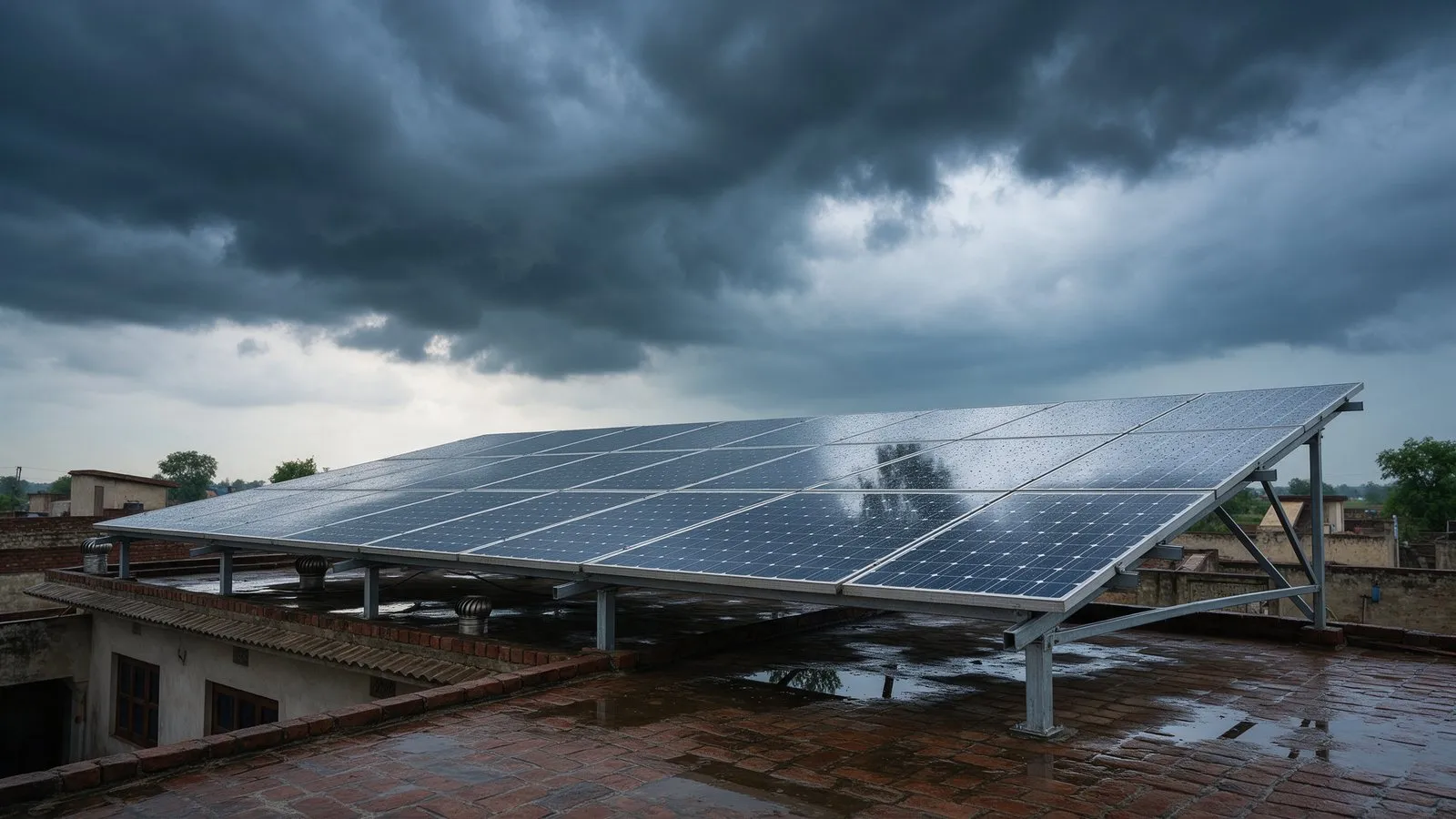 Representative image
The hardest weeks of the year for a rooftop solar system in Tricity are not the monsoon rains but the storms that come before them. Late May and June bring dust storms and sudden squalls with strong gusts, then lightning, then weeks of heavy rain. A well-built system rides through all of it. This guide covers what to check before the season, what to do after a storm, and what to expect from output in the rains.
Before the season: the structure
Wind is the biggest risk. A raised array is a large flat surface held well above the roof, and a gust that gets underneath it pulls upwards on every leg and anchor. Before June:
The structure should have been designed for the local wind speed under IS 875 (Part 3). If you are not sure yours was, ask your installer. Our guide to raised, low and canopy structures explains how height and tilt affect the wind load.
Before the season: lightning and earthing
Lightning is common in Tricity’s pre-monsoon and monsoon storms, and the solar array is usually the highest point on the house.
Before the season: water
A June health check covers all of this. It is one of the four seasonal visits in the 4-Year Care Shield included with our home systems.
During a storm
Stay off the roof. On-grid systems need no action from you. If the power goes off, the inverter disconnects automatically and reconnects when the supply returns. Do not try to switch off the DC side of the system in a storm.
After a storm
From the roof, in daylight and once the storm has passed, look for:
- Panels that have shifted, or clamps that have moved
- Cracked glass or a dent from flying debris
- Cables pulled loose or hanging
- Branches, sheets or debris on or under the panels
- Water inside the protection boxes
Then check the app. If output on the next sunny day is well below the day before the storm, or the inverter shows an error, call your installer. Do not touch a damaged panel or cable. Panels produce voltage whenever there is daylight, even when the grid is off.
Storm, lightning and flood damage is not covered by the manufacturers’ warranties, so photograph any damage for your insurer. Our guide to solar warranties explains what is covered.
Hail
Panels are built to withstand hail. Certified panels are tested by firing ice balls at the glass, and ordinary hailstones rarely break them. Large hail can still crack glass, so check after a hailstorm. A cracked panel should be replaced, because moisture gets into the cells.
What the monsoon does to output
Output falls in July and August, when cloud cover is heaviest. In Tricity, each kW typically makes about 100 to 125 units a month in July and August, against 130 to 160 in May. The rain also washes the panels, which helps. Our guide to why solar produces less has the typical figures for every month.
Net metering smooths the dip. Units banked in the bright spring months are carried forward and set against the monsoon months within the settlement year, as our guide to net metering in Punjab explains.
After the monsoon
The rains leave a film of silt on the panels as they end, and humid air can start rust. A clean and a check for rust and loose bolts in October gets the system ready for the winter months. Our guide to maintenance through the year sets out the full calendar.
Common questions
Can rooftop solar panels survive a storm?
Yes, if the structure is designed for the local wind load and properly anchored, and the bolts are checked each year. Most storm damage comes from loose bolts, weak anchoring or debris blown into the panels, which a pre-monsoon check helps prevent.
Do solar panels attract lightning?
No more than any other tall object on a roof, but the array is usually the highest point on the house, so a lightning arrester with its own earthing and surge protection in the DC and AC boxes are essential. Check them before the monsoon each year.
Do solar panels work in the rain?
Yes, but at much lower output under heavy cloud. In Tricity, July and August typically produce about 100 to 125 units per kW, compared with 130 to 160 in May. Net metering carries forward spring surplus to cover the dip.
Should I switch off my solar system during a storm?
No. An on-grid system disconnects automatically if the power goes off and reconnects when it returns. Stay off the roof during the storm and check the system in daylight afterwards.
Our home systems
Each one is sized to your own bills. See the price per kW and what each kW makes.
Core
Small home
Usually 1 to 3 kW
Ask about CoreComfort
Family home
Usually 4 to 5 kW
Ask about ComfortGrand
Kothi or large home
Usually 6 kW and above
Ask about Grand