
Home / Blog / Home solar
How much does solar produce in each month in Tricity?
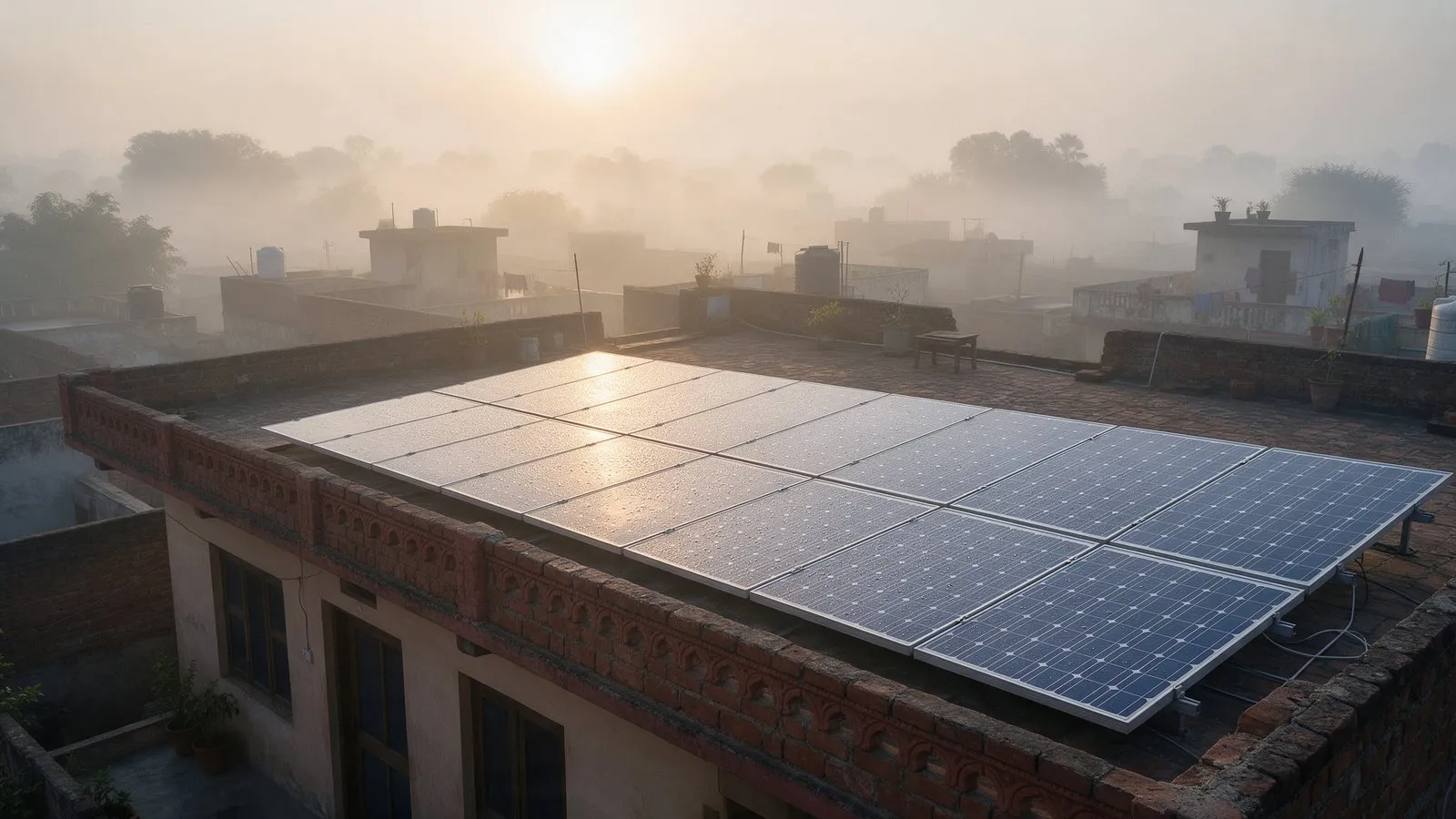 Representative image
A rooftop system in Tricity does not make the same amount of power every month. A 5 kW system can make 450 units in January and 750 in May, and both are normal. Knowing the pattern helps you size a system honestly, read your bills without worry, and spot a real fault when there is one.
Units per kW, month by month
These are our estimates of what each kW of shade-free, south-facing panels makes in Tricity. We worked them out from NASA’s long-term sunlight and temperature data for Mohali, scaled to our usual figure of about 1,440 units per kW a year.
| Month | Typical units per kW | Usual range |
|---|---|---|
| January | 91 | 80 to 100 |
| February | 103 | 95 to 115 |
| March | 137 | 125 to 150 |
| April | 140 | 125 to 155 |
| May | 147 | 130 to 160 |
| June | 128 | 115 to 140 |
| July | 113 | 100 to 125 |
| August | 114 | 105 to 125 |
| September | 121 | 110 to 135 |
| October | 133 | 120 to 145 |
| November | 113 | 100 to 125 |
| December | 99 | 90 to 110 |
Multiply by the size of your system. A 3 kW system makes about 270 to 300 units in December and January, and about 420 to 440 in April and May.
Why the months differ
Dust matters in every season. Panels that are not rinsed in the dusty and smoggy months make noticeably less, which our guide to cleaning solar panels in Tricity explains.
What this means for a Punjab bill
In Punjab, net metering carries surplus units forward from one bill to the next within a settlement year that runs from October to September. The free-unit limit of 300 units a month is then applied to the units you take from the grid after that. So the bright months of autumn and spring bank units that the hot months use.
Here is a 3 kW system for a home using about 280 units a month in winter and 550 to 650 in summer, using the typical figures above:
| Month | Home uses | Panels make | Taken from the grid | Units banked at month end |
|---|---|---|---|---|
| October | 350 | 399 | 0 | 49 |
| November | 280 | 339 | 0 | 108 |
| December | 280 | 297 | 0 | 125 |
| January | 280 | 273 | 0 | 118 |
| February | 280 | 309 | 0 | 147 |
| March | 330 | 411 | 0 | 228 |
| April | 450 | 420 | 0 | 198 |
| May | 600 | 441 | 0 | 39 |
| June | 650 | 384 | 227 | 0 |
| July | 600 | 339 | 261 | 0 |
| August | 550 | 342 | 208 | 0 |
| September | 450 | 363 | 87 | 0 |
The units taken from the grid stay under 300 in every month, so this home stays within Punjab’s free units all year. Without solar it would pay for every unit in each summer month. PSPCL bills every two months, so the limit on each bill is 600 units. Our guide to whether solar is worth it with the 300 free units explains the pattern, and the one on net metering in Punjab explains the bill itself.
Homes in Chandigarh and Panchkula have no free units, so every unit the panels make is saved at the tariff rate, month by month.
Using the table
The direction and tilt of the panels also matter. Panels facing south at around 15° to 25° make close to the most over a year here, as our guide to tilt angle and direction in Mohali and Chandigarh shows.
Common questions
How many units does 1 kW of solar produce in a month in Tricity?
By our estimate, about 91 units in January and 147 in May, and about 1,440 over a full year, for shade-free panels facing south. Cloudy, foggy and dusty spells lower it, so allow for a range around those figures.
Which month gives the most solar power in Punjab?
Usually May, followed by April and March. June is a little lower because of heat, haze and the first monsoon clouds, and December and January are the lowest months.
Does solar work in fog?
Yes, but much less. Fog and smog in December and January can cut a day's output sharply. Over the whole month, a system still makes about two thirds of what it makes in April or May in a normal year.
Do units made in spring help with summer bills?
In Punjab, yes. Surplus units are carried forward within the October to September settlement year, so units banked in spring are set against the extra units a home uses in summer.
Our home systems
Each one is sized to your own bills. See the price per kW and what each kW makes.
Core
Small home
Usually 1 to 3 kW
Ask about CoreComfort
Family home
Usually 4 to 5 kW
Ask about ComfortGrand
Kothi or large home
Usually 6 kW and above
Ask about Grand