
Home / Blog / Home solar
How to clean solar panels in Tricity's dust and smog
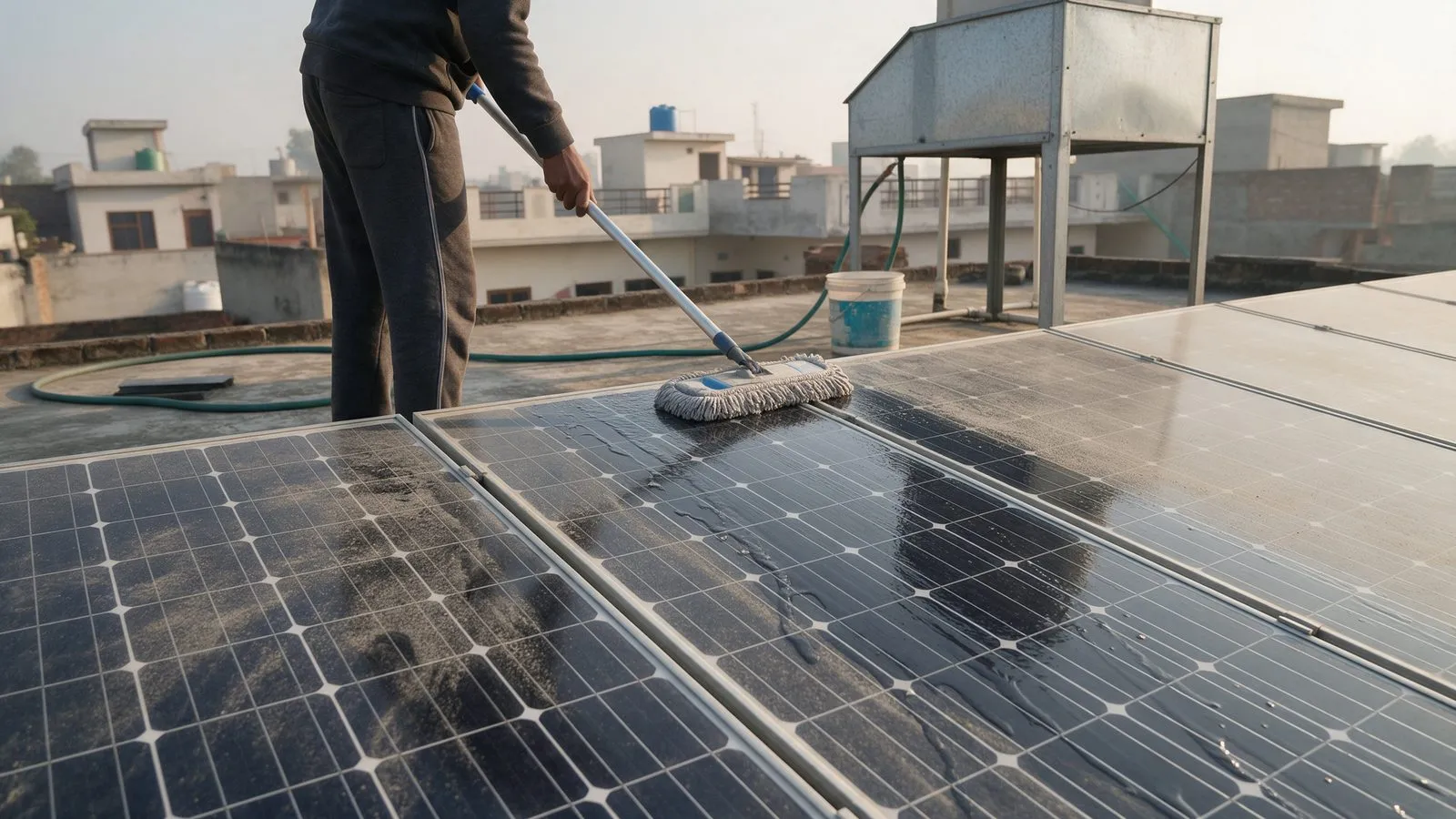 Representative image
Rooftop solar needs very little maintenance, but in Tricity it does need cleaning. From October to February, smog and fine dust settle on the panels, and in May and June dust storms leave a coat of their own. A 2017 study led by Duke University, with panels tested at IIT Gandhinagar, estimated that dust and air pollution cut solar output in north India by 17 to 25%, about half of it from dust settled on the panels. A few minutes with water and a soft brush removes that part. This guide covers when to clean, how to do it safely and what to avoid.
Why dirty panels make less power
Solar panels make electricity from the light that reaches the cells. A layer of dust, soot or bird droppings blocks part of that light. The same research team found that light rain and humid mornings make soiling worse: they turn the dust into a thin film of mud that dries onto the glass. Heavy rain helps, because it washes the panels. Drizzle does not.
You can see the effect in your inverter app. If a clear, sunny day produces noticeably less than a similar day a few weeks earlier, dirty panels are the most common reason.
Every day: the inverter’s app shows how many units your panels made today and what they are producing right now.
Spot a drop: dust and smog lower the output, and the app shows it. A wash with plain water every two weeks or so brings it back.
Faults show up early: if the inverter reports a fault, send us a screenshot on WhatsApp. We find whether the grid, the inverter or a panel is the cause, and arrange the repair or the warranty claim.
When to clean
Clean in the early morning or evening, when the panels are cool. Cold water on hot glass in the afternoon can stress it, and water dries too fast to rinse off cleanly.
How to clean, step by step
- Check from the roof first. Look for bird droppings, leaves or anything stuck in the corners.
- Rinse with plain water from a hose on low pressure, or a bucket, to loosen the dust.
- Wipe gently with a soft brush or microfibre mop on a long handle, working from the top edge down.
- Rinse again to carry the loosened dirt away.
- Dry with a soft squeegee if your water is hard. Hard water with high TDS leaves white spots when it dries, which block light too. Where possible, use RO-purified or soft water for the final rinse.
- Check the result in your inverter app on the next sunny day.
What not to do
Safety on the roof
Raised structures put the top edge of the panels well above head height. Clean from the roof surface with a long-handled mop. Avoid climbing onto the structure, and never lean over a low parapet. If you cannot reach the panels safely from the roof, don’t clean them yourself. Ask your installer about cleaning.
Bird droppings and leaves
Bird droppings are worse than dust, because they block light completely on one spot, and a shaded cell drags down the output of the whole panel. Soften droppings with water for a few minutes, then wipe them off gently. Remove leaves and debris from the corners where the panel meets the frame.
Winter haze is not only dirt
Even perfectly clean panels make less power in December and January. The sun is lower, the days are shorter and fog and haze cut the light reaching the roof. That is normal, and it is already allowed for when a system is sized from a full year of bills. If your output drops sharply after cleaning, or one string of panels produces much less than the rest, the cause is more likely a fault or shading. Call your installer.
A simple routine
| Season | What to do |
|---|---|
| October to February | Clean every 2 to 4 weeks, more often after foggy spells |
| March | Thorough clean before summer |
| April to June | Clean after dust storms |
| July to September | Let the rain clean, and check afterwards |
| Every month | Compare a sunny day’s output in the app with earlier months |
Common questions
How often should I clean solar panels in Mohali or Zirakpur?
Every two to four weeks from October to February, when smog and dust are heaviest, after dust storms in summer, and less often in the monsoon, when rain does most of the cleaning.
Can I use soap or detergent to clean solar panels?
It is best not to. Detergents and chemicals can damage the anti-reflective coating on the glass. Plain water with a soft brush or mop is enough, and the manufacturer's manual lists anything else that is allowed.
Is tap water safe for cleaning solar panels?
Yes, but hard water leaves white spots as it dries. Dry the panels with a soft squeegee, or use RO-purified or soft water for the final rinse.
Why is my solar producing less in winter even after cleaning?
In December and January the sun is lower, days are shorter and haze and fog reduce the light. Lower winter output is normal and is allowed for when the system is sized from a full year of bills. A sudden drop on a clear day may point to a fault, which your installer should check.
Our home systems
Each one is sized to your own bills. See the price per kW and what each kW makes.
Core
Small home
Usually 1 to 3 kW
Ask about CoreComfort
Family home
Usually 4 to 5 kW
Ask about ComfortGrand
Kothi or large home
Usually 6 kW and above
Ask about Grand