
Home / Blog / Home solar
Solar panel tilt angle and direction for Mohali and Chandigarh
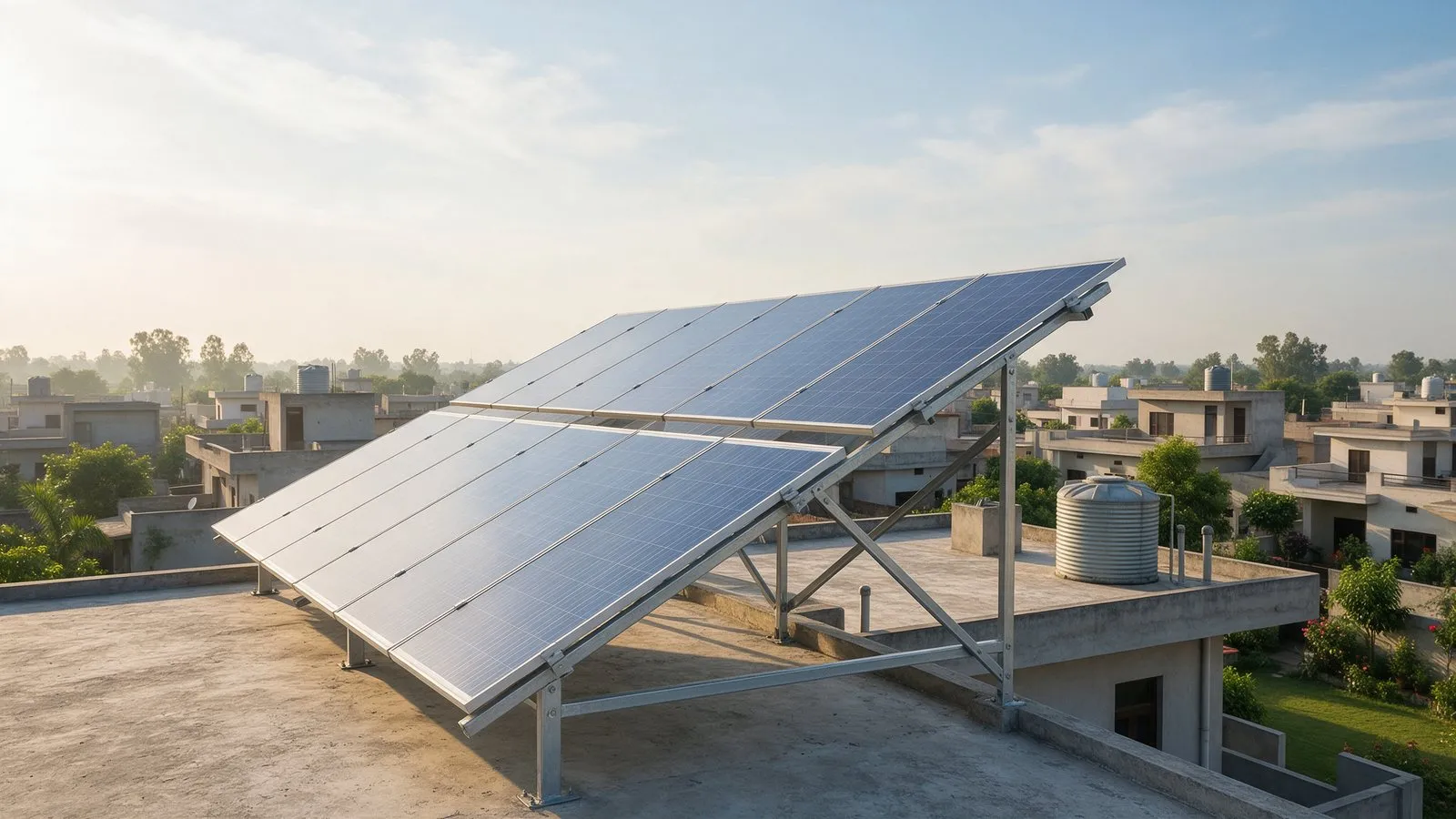 Representative image
Mohali, Chandigarh, Zirakpur, Panchkula and Kharar all sit at about 30.7° north. At that latitude, rooftop solar panels should face due south and be tilted between 15° and 25° from flat. Within that range the sun makes very little difference, so the exact angle on your roof is usually decided by the roof itself: its depth, the shadows on it and how it is laid out.
This guide shows how much output changes with tilt and direction, and why a slightly lower angle often produces more in total.
How much the tilt angle matters
We worked out these figures from NASA’s long-term sunlight averages for Mohali (NASA POWER), using a standard model of sunlight on a tilted surface. They compare the sunlight reaching south-facing panels over a year with the best possible fixed angle.
| Tilt from flat | Sunlight over a year, against the best angle |
|---|---|
| 0° (laid flat) | About 9% less |
| 10° | About 4% less |
| 15° | About 2% less |
| 20° | About 1% less |
| 25° to 30° | The most |
A field study by Punjab Engineering College, which measured panels at seven angles on a Chandigarh rooftop from July 2018 to June 2019, recommends 17°, give or take 2°, facing south. The model puts the peak a little steeper, at about 28°. The difference in a year’s output between the two is only 1 to 2%, because the curve is almost flat near the top. That is why we treat 15° to 25° as one good range and choose within it for each roof.
Why panels should not lie flat
Flat panels catch about 9% less sunlight over a year, and they hold dust, bird droppings and standing rainwater. From about 10° upwards, rain runs off and carries some of the dust with it, which matters in Tricity’s dry months and in the smog season. Our guide to cleaning solar panels in dust and smog covers the rest.
Which direction to face
South is best. The table shows how output falls as panels turn away from it, at a 20° tilt:
| Facing | Sunlight over a year, against due south |
|---|---|
| Due south | The most |
| South-east or south-west | About 4% less |
| East or west | About 11% less |
| North | About 24% less |
Avoid north-facing panels. Where a roof only allows east or west, a low tilt of about 10° brings the loss down to roughly 9%, about the same as laying the panels flat.
Sector roofs in Chandigarh and Mohali
The sector roads in Chandigarh and Mohali do not run north to south. Madhya Marg and Mohali’s Airport Road run about 35° off it, and the sector grid follows. So in most sector houses, no edge of the roof faces due south. The parapets face either south-east or south-west.
If the panels follow the parapet, at a 20° tilt they catch about 3% less sunlight on a south-east edge, or about 5% less on a south-west edge, than panels facing due south. Turning the frame to face due south recovers that, but it leaves triangles of roof unused, and on a small roof it can cost a panel or two.
On a 5 kW system, which makes about 7,200 units a year on our usual estimate, 3% is about 200 units. A single 550 W panel makes about 800. So on most sector roofs, fitting every panel along the parapet produces more in total than turning the frame and losing a panel. Where the roof is large enough to turn the frame without losing panels, we face it due south. Plots in Zirakpur, Kharar and New Chandigarh are laid out differently, and we check the direction with a compass at the survey.
Steeper panels need more space between rows
The steeper the panels, the longer the shadow each row casts on the row behind it. The worst case is a winter morning. On the shortest day, the sun at 9 am is only about 21° above the horizon in Tricity.
For a typical 2.3 m panel mounted upright, these are the gaps needed to keep each row out of the next row’s shadow from 9 am to 3 pm in December:
| Tilt | Height of the raised edge | Gap behind each row | Space per row, front to back |
|---|---|---|---|
| 10° | 0.4 m | 0.75 m | 3.0 m |
| 15° | 0.6 m | 1.1 m | 3.3 m |
| 20° | 0.8 m | 1.5 m | 3.6 m |
| 25° | 1.0 m | 1.8 m | 3.9 m |
| 30° | 1.1 m | 2.2 m | 4.1 m |
A worked example. A roof with 10 m of usable depth from front to back fits three rows at 25°, but only two at 30°. The steeper array gains almost nothing per panel and loses a third of its panels.
Water tanks, stair rooms and parapets cast the same long winter shadows. A raised structure lifts the panels clear of them and keeps the roof usable underneath. The types of structure we build are set out on the home page.
Wind and the height of the frame
On a raised structure, the panels usually sit on one sloping plane. The steeper the plane, the higher its top edge and the more wind load it takes, so the frame, bracing and anchoring must be stronger. The structure should be designed for the local wind speed under IS 875 (Part 3), the Indian standard for wind loads. A lower tilt keeps the frame shorter, lighter and less exposed in summer storms.
Changing the angle through the year
The best angle moves with the seasons: close to flat in May, June and July, and around 55° to 60° in December. Moving the panels between two positions, about 5° in summer and about 50° in winter, gains roughly 5% over a well-chosen fixed angle in our model.
For a 5 kW home system that is about 350 units a year. Earning it needs an adjustable frame and someone on the roof twice a year, and adjustable joints are the first parts of a structure to loosen. For homes, we recommend a fixed frame at the right angle.
What to check in a quotation
- The tilt angle, the direction and the height of the structure are written down.
- The shade check covers winter mornings and afternoons, not just midday.
- Row spacing allows for the December sun, not the June sun.
- The structure is designed for wind loads, especially on a raised frame.
Our quotation checklist lists the other lines to look for, and our guide to sizing a system from your bill explains how many panels your roof needs to hold.
Common questions
What is the best tilt angle for solar panels in Chandigarh?
Face the panels due south and tilt them between 15° and 25°. A Punjab Engineering College field study recommends 17°, give or take 2°, and anything from 15° to 30° comes within about 2% of the best annual output. Within that range, choose the angle that fits the most panels on your roof without shading.
Should solar panels face south or east in Punjab?
South. At a 20° tilt, panels facing east or west catch about 11% less sunlight over a year, and panels facing north about 24% less. South-east and south-west lose about 4%, which is often acceptable on sector roofs where no edge faces due south.
Is it worth changing the tilt angle between summer and winter?
Usually not for a home. Two positions a year add roughly 5% to output, about 350 units a year for a 5 kW system, but they need an adjustable frame and someone on the roof twice a year. A fixed frame at the right angle is simpler and lasts longer.
Do Zirakpur, Panchkula and Kharar need a different angle from Mohali?
No. The whole of Tricity sits within about a tenth of a degree of 30.7° north, so the same range of 15° to 25° facing south applies everywhere. What differs from house to house is the roof: its direction, its depth and the shadows on it.
Our home systems
Each one is sized to your own bills. See the price per kW and what each kW makes.
Core
Small home
Usually 1 to 3 kW
Ask about CoreComfort
Family home
Usually 4 to 5 kW
Ask about ComfortGrand
Kothi or large home
Usually 6 kW and above
Ask about Grand