
Home / Blog / Home solar
Solar panel maintenance through the year in Tricity
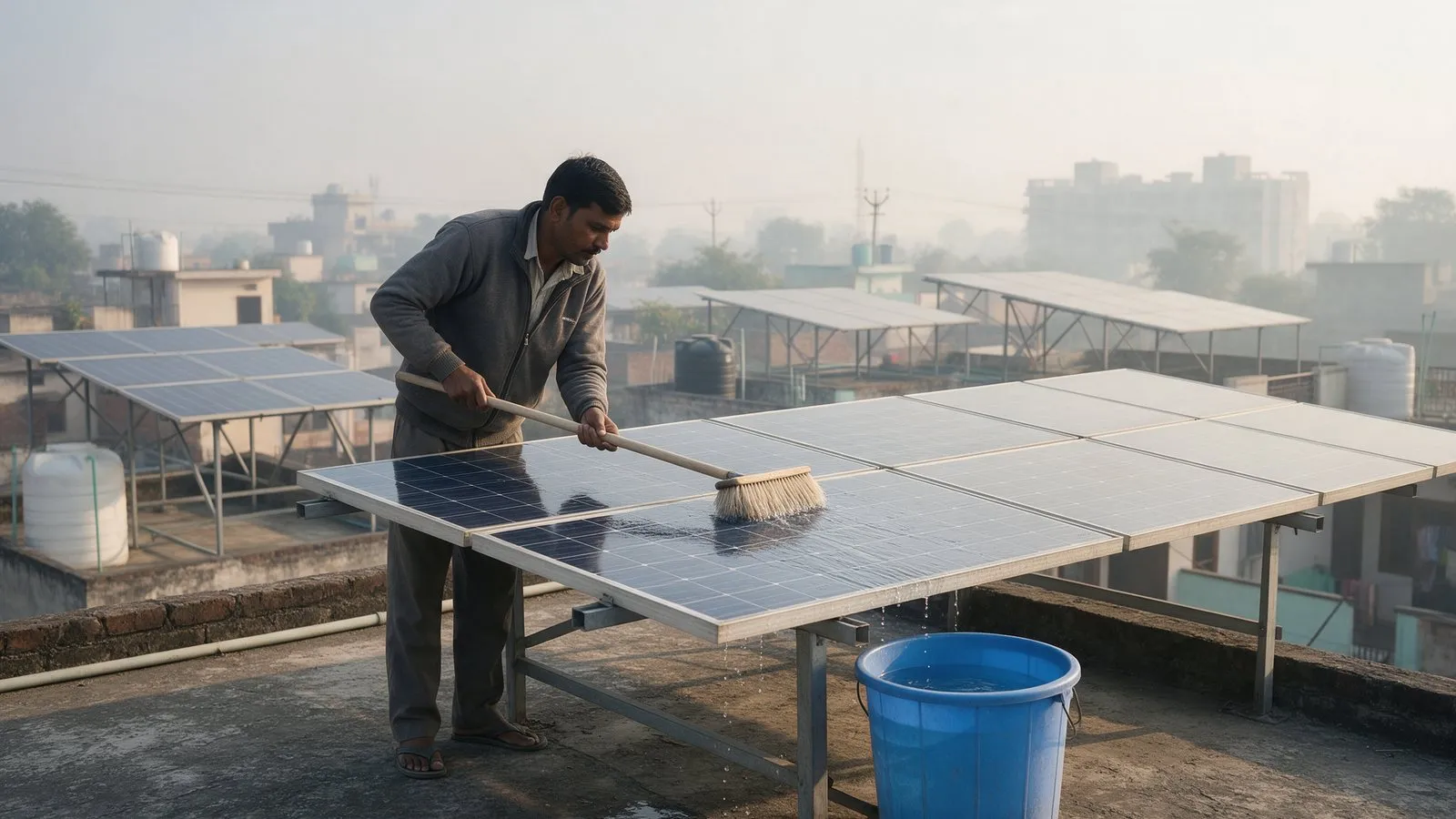 Representative image
A rooftop solar system has no moving parts and needs little attention. What it does need follows Tricity’s seasons: smog and fog in winter, dust storms before summer, then the monsoon. This guide sets out what to do and when, what an owner can do safely, and what should be left to a technician.
The year at a glance
| Months | What the weather does | What to do |
|---|---|---|
| January and February | Fog, smog and short days lower output | Rinse after smoggy spells. Expect lower output, which is normal |
| March | Dust starts, and the strongest sun of the year is coming | A thorough clean. Trim trees that have grown towards the panels. Clear bird nests |
| April and May | Heat and dust storms | Rinse every week or two in dusty spells. Check the frame and panels after each storm |
| June | Pre-monsoon storms and the first rain | A health check: earthing, connections, cables, frame bolts and the roof drains |
| July to September | Heavy rain washes the panels | Check after storms. Make sure water drains away from the structure’s footings |
| October | Silt left by the rain, and the smoke season begins | A post-monsoon clean, and a check for rust and loose bolts |
| November and December | Smog and dust settle fastest | Clean every two to four weeks |
Cleaning
Cleaning is the one job owners do most, and it matters most in the smog and dust months. Use plain water and a soft brush on a long handle, early in the morning or in the evening, never detergents or a pressure washer. Our guide to cleaning solar panels in dust and smog covers it step by step.
Watch the app, not just the panels
The monitoring app is the best maintenance tool you have. Look at it once a week:
Checks before the monsoon
June is the most important check of the year, because the monsoon brings lightning, high winds and water. A technician should look at:
After a storm
From the roof, look for panels that have shifted, cracked glass, cables pulled loose, branches or debris on the panels, and anything that has hit the frame. Do not touch damaged panels or cables. A cracked panel still produces voltage in daylight. Photograph the damage and call your installer. Storm damage is not covered by the manufacturers’ warranties, so it is worth asking your insurer whether the system can be added to your home policy. Our guide to solar warranties explains what is and is not covered.
The inverter
Inverters reduce output when they run hot. Keep the space around the inverter clear, keep its vents free of dust and cobwebs, and do not let anything be stored against it. If it is on an outside wall in full afternoon sun, ask whether a small sunshade can be fitted. Never open the inverter or the protection boxes yourself.
Birds and monkeys
Pigeons nest under raised panels, and their droppings and nesting material collect around the frame and cables. Monkeys, common in parts of Tricity, pull at cables and sit on panels. Bird mesh fitted around the edge of the array keeps pigeons out. Report chewed or pulled cables straight away.
Batteries, for hybrid systems
Lithium batteries need no routine maintenance beyond keeping them cool and ventilated. Tubular batteries need their water level checked and topped up with distilled water every few months, and their terminals kept clean. Our battery comparison covers the differences.
What owners should leave alone
- Opening the inverter, the DC box or the AC box
- Disconnecting or reconnecting the DC cables or connectors
- Climbing onto a raised structure or standing on panels
- Tightening anything electrical
The 4-Year Care Shield
Every home system from Maya Green Power includes the 4-Year Care Shield: four visits a year, timed to these seasons. March is a pre-summer clean, June a pre-monsoon health check with a one-page report, October a post-monsoon clean and rust check, and December a smog-season clean. Between visits, we review your generation each month and call you if it falls more than 15% below what we expected.
Common questions
How often should rooftop solar be serviced?
Panels need cleaning every few weeks in Tricity's dusty and smoggy months, which owners can do themselves. A technician should check the system at least once a year, ideally in June before the monsoon, looking at the earthing, connections, cables and structure.
What maintenance does a solar inverter need?
Very little: keep the area around it clear and the vents free of dust, so it does not overheat, and watch the app for error messages or drops in output. Repairs should be left to the installer or the manufacturer.
Do solar panels need cleaning in the monsoon?
Usually not during heavy rain, which washes them. Light rain and drizzle can leave streaks of dried mud, and the end of the monsoon leaves silt, so a clean in late September or October is worthwhile.
How do I stop pigeons nesting under my solar panels?
Bird mesh fitted around the edge of the array keeps pigeons from getting underneath. Remove existing nests and droppings first, because they hold moisture against the frame and cables.
Our home systems
Each one is sized to your own bills. See the price per kW and what each kW makes.
Core
Small home
Usually 1 to 3 kW
Ask about CoreComfort
Family home
Usually 4 to 5 kW
Ask about ComfortGrand
Kothi or large home
Usually 6 kW and above
Ask about Grand