
Home / Blog / Subsidy and net metering
PM Surya Ghar subsidy in Punjab: how to apply, step by step
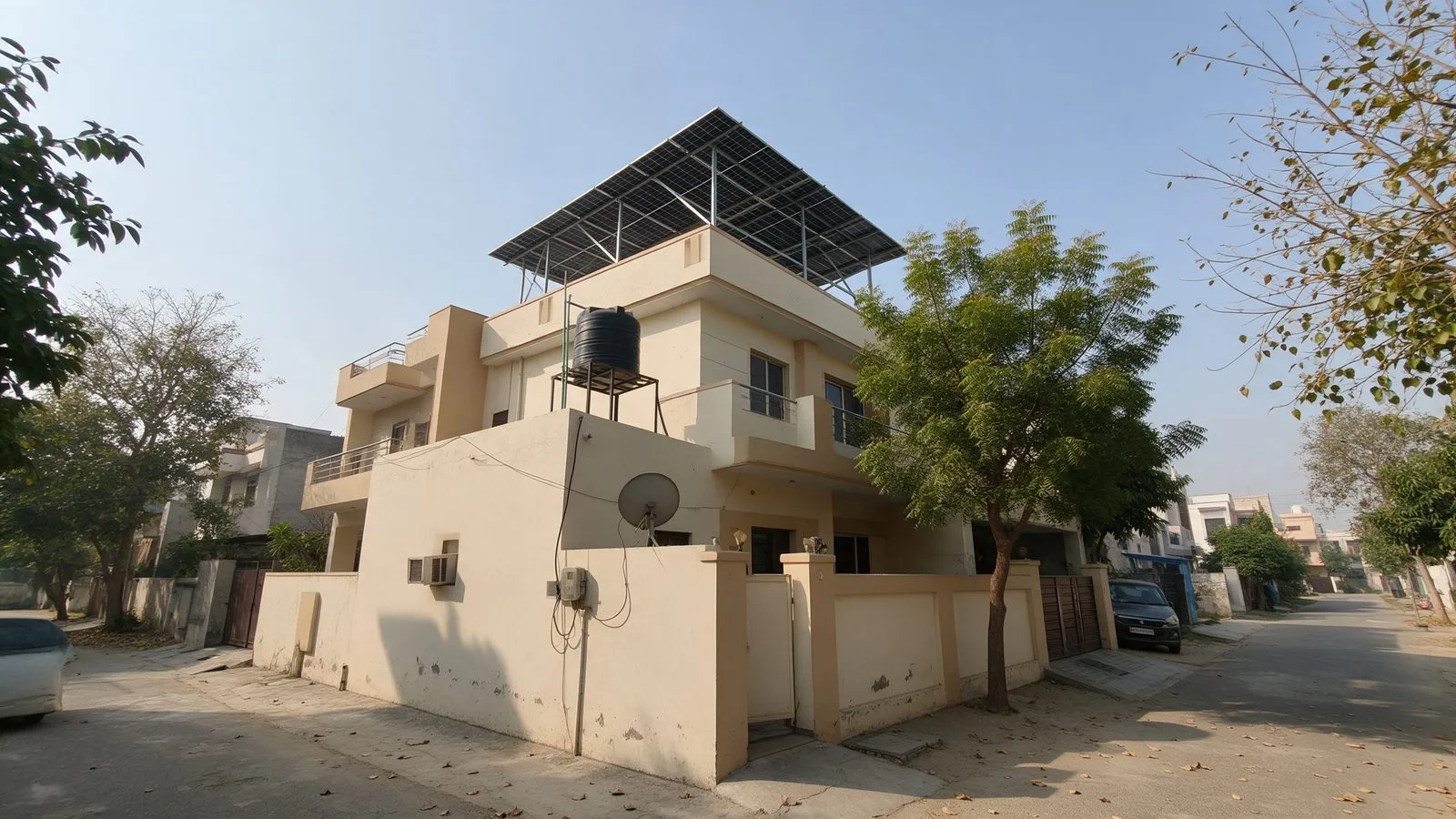 Representative image
The PM Surya Ghar Muft Bijli Yojana pays a one-time central subsidy of up to ₹78,000 towards a rooftop solar system on your home. In Punjab the application runs through the national portal and PSPCL, in a fixed order. Most delays we see come from doing a step too early or from a name that does not match across documents, so this guide sets out the order and the checks that matter.
How much you get
The subsidy depends only on the size of the system, and it stops rising at 3 kW.
| System size | Central subsidy |
|---|---|
| 1 kW | ₹30,000 |
| 2 kW | ₹60,000 |
| 3 kW or more | ₹78,000 |
A 5 kW system receives the same ₹78,000 as a 3 kW one, so plan on this central amount. Check the current figures on the official portal, pmsuryaghar.gov.in, before you commit.
Who can apply
You can apply if all of these are true:
- The house is yours, and you have a roof you can use.
- The domestic PSPCL connection is in your name. If it is still in a parent’s or previous owner’s name, transfer it first.
- You have not received a solar subsidy for this connection before.
- The system is installed by a vendor registered on the national portal, with Indian-made (DCR) panels.
Shops, offices and other commercial connections are not covered. If you live in a flat, the roof belongs to the society, so you will need the society’s no-objection certificate.
The steps, in order
1. Register on the national portal
Go to pmsuryaghar.gov.in and register with your state (Punjab), your electricity company (PSPCL), your PSPCL account number from the bill and the mobile number linked to your Aadhaar. You verify the mobile number with a one-time password.
2. Submit the rooftop solar application
Log in, complete your profile and apply for rooftop solar. The portal fetches your connection details from PSPCL. You add the roof details and the system size you want. Leave the subsidy option selected; there is a box to give up the subsidy, and it is easy to tick by mistake.
3. Wait for PSPCL’s feasibility approval
PSPCL checks that your connection can take the system. The main limit is your sanctioned load, which is printed on your bill: a home system cannot be larger than it. For systems of up to 10 kW, PSERC’s regulations, amended in February 2025, say a complete application is treated as accepted, and PSPCL carries out any load increase it needs, with you paying the load-extension charges. For a bigger system, the load increase comes first.
Do not install anything before this approval. A system fitted before feasibility is approved can lose its subsidy.
4. Choose a registered vendor and install
Once approval comes through, the system is installed by a vendor registered on the portal, using approved DCR panels. The vendor generates a DCR certificate for your panels on the government’s DCR portal, and the panel serial numbers are checked against it automatically. This is why the vendor named on your application must be the one actually responsible for your installation.
5. Upload the installation details
After installation, the system details and geo-tagged photographs go up on the portal, along with the inverter and panel serial numbers.
6. PSPCL inspection and the net meter
PSPCL inspects the installation and replaces your meter with a bi-directional net meter. You sign the net-metering agreement. This step usually takes the longest, because it depends on PSPCL’s inspection schedule.
7. Bank details and payment
Once the system is commissioned on the portal, you submit your bank details with a cancelled cheque or a copy of the passbook. The subsidy is then paid directly into your account, usually within a few weeks.
Documents to keep ready
- A recent electricity bill showing your PSPCL account number
- Your Aadhaar number, and the mobile number linked to it
- Proof that you own the property, such as the sale deed or property tax receipt
- Two or more clear photographs of the roof
- A cancelled cheque or bank passbook in the applicant’s name
- For flats: the society’s or RWA’s no-objection certificate
Mistakes that delay the subsidy
Paying for the rest
Under the scheme, public sector banks lend for home rooftop solar, secured on the system itself with no other collateral. For systems up to 3 kW, the loan is up to ₹2 lakh at the repo rate plus 0.5%, which is 6.00% a year at SBI from 15 October 2026. Each bank sets its own terms, so get the rate in writing from your bank. At SBI the subsidy is credited to the loan account, which cuts the balance straight away.
Is the subsidy worth the paperwork?
For most homes in Punjab, yes. ₹78,000 is a large share of the cost of a home system, and it shortens the payback period by roughly two years. Some homeowners choose to skip it, for example to use non-DCR panels or to avoid the wait. We set out both options with their prices in your proposal.
Punjab homes also get 300 free units a month, which changes how a system should be sized. Our savings calculator works this out from your bill, and the subsidy page covers the scheme in more detail.
When the subsidy is worth taking
The subsidy is paid only on systems built with DCR panels, made with Indian solar cells, which cost about ₹9,000 more for every kW installed. The subsidy stops at ₹78,000 on 3 kW, but the extra panel cost keeps growing with size.
| System size | Extra cost of DCR panels | Subsidy | Cheaper route |
|---|---|---|---|
| 3 kW | ₹27,000 | ₹78,000 | DCR with the subsidy, about ₹51,000 better |
| 5 kW | ₹45,000 | ₹78,000 | DCR with the subsidy, about ₹33,000 better |
| 8 kW | ₹72,000 | ₹78,000 | About the same (DCR ₹6,000 better) |
| 10 kW | ₹90,000 | ₹78,000 | Non-DCR without the subsidy, about ₹12,000 better |
Up to about 8 kW, take the subsidy. From about 9 kW, non-DCR panels without it cost less, an option homes have until 31 March 2027. More on the subsidy page.
How Maya Green Power helps
For homes in Mohali, Zirakpur, Kharar and New Chandigarh, we prepare the application, check your documents and sanctioned load before anything is filed, and follow up with PSPCL through the inspection and net meter. Subsidy systems are installed through a registered vendor, named in your proposal and on your application, and we stay your point of contact throughout.
Common questions
How long does the PM Surya Ghar subsidy take in Punjab?
The roof work itself usually takes a few days. The longest part is PSPCL's inspection and the net meter, which run on PSPCL's schedule. Once the system is commissioned on the portal and your bank details are verified, payment usually follows within a few weeks.
Can I get the subsidy on a 5 kW or 10 kW system?
Yes, but the subsidy stays at ₹78,000. It is calculated on the first 3 kW only, so a larger system receives the same amount as a 3 kW one.
Can I apply if the electricity connection is in my father's name?
Not as it stands. The connection must be in the applicant's name, so the usual route is to transfer the connection first, then apply.
Is there an extra Punjab state subsidy?
Plan on the central subsidy of up to ₹78,000. Some states add their own help on top, as Haryana does through its Saur Urja Protsahan Yojana. PEDA, the Punjab Energy Development Agency, can tell you whether any Punjab scheme applies to your home.
Our home systems
Each one is sized to your own bills. See the price per kW and what each kW makes.
Core
Small home
Usually 1 to 3 kW
Ask about CoreComfort
Family home
Usually 4 to 5 kW
Ask about ComfortGrand
Kothi or large home
Usually 6 kW and above
Ask about Grand