
Home / Blog / Home solar
How much does a 5 kW solar system cost in Mohali in 2026?
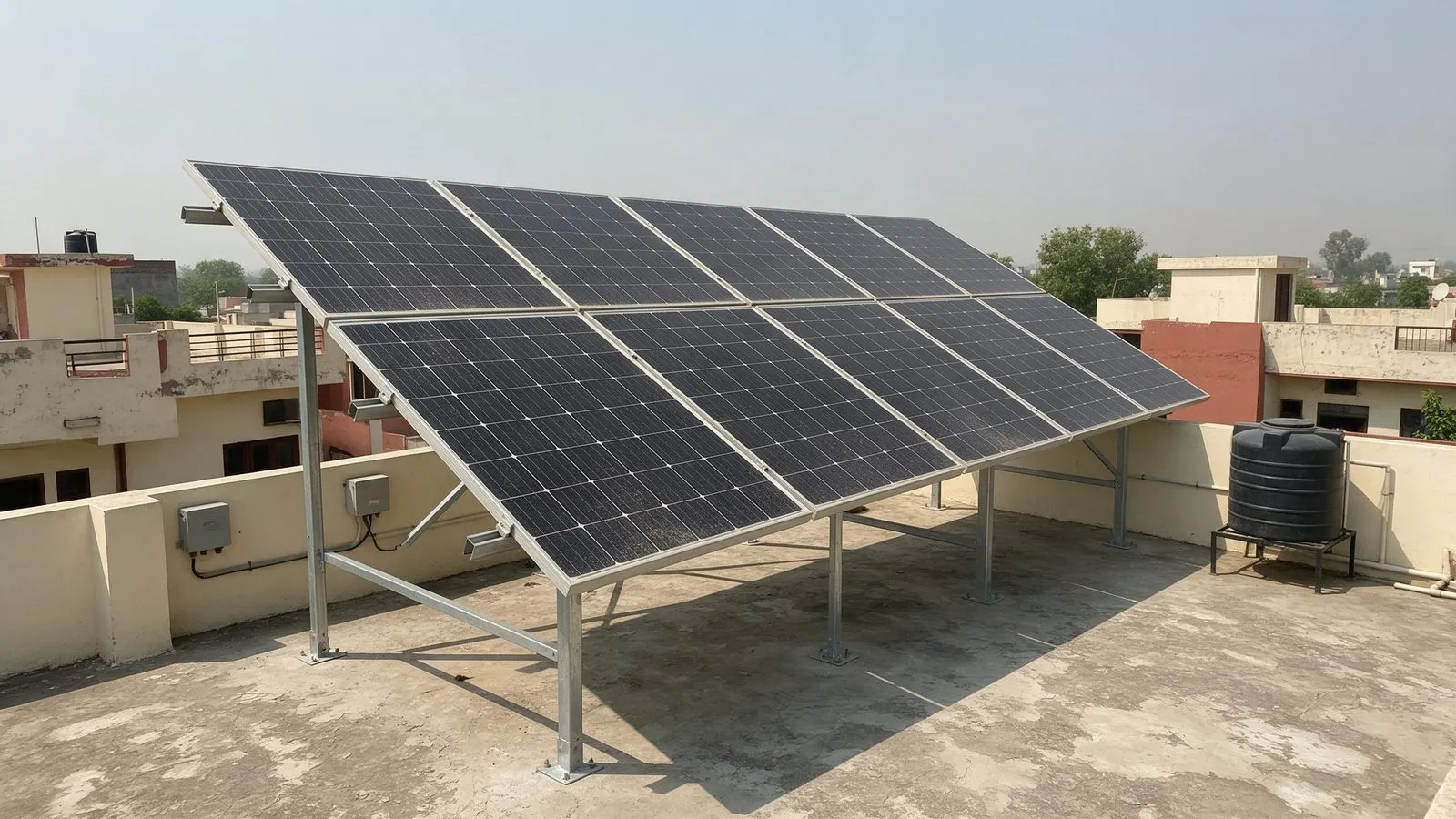 Representative image
A 5 kW on-grid rooftop system for a home in Mohali typically costs ₹2.6 lakh to ₹3.3 lakh in 2026, including GST, with the Indian-made panels the subsidy requires. After the ₹78,000 PM Surya Ghar subsidy, eligible homes pay about ₹1.8 lakh to ₹2.5 lakh. This guide explains where that money goes, what moves the price up or down, and what the system saves on a PSPCL bill.
These are market ranges for planning, not a quotation. A firm price depends on your roof and the brands you choose, and it follows a site survey.
What a 5 kW system includes
What changes the price
DCR or non-DCR panels. The subsidy only applies to Indian-made panels with Domestic Content Requirement (DCR) certification, which cost noticeably more per watt than imported cells. On a 5 kW system the difference is roughly ₹35,000 to ₹45,000. The ₹78,000 subsidy more than covers it, so for eligible homes DCR panels usually work out cheaper overall.
Panel and inverter brands. Established brands with longer warranties and better local service cost more. Your proposal should name the make and model of each component, so you can compare quotes like for like.
Structure height. A raised structure, high enough to keep the roof usable and clear of the water tank’s shadow, uses more steel than panels mounted low on the roof.
The distance to the meter. A long cable run from the roof to the meter adds cable and labour.
A battery. A hybrid system with battery backup for power cuts costs considerably more than an on-grid one. See solar with battery backup.
GST after the 2025 cut
From 22 September 2025, GST on solar panels fell from 12% to 5%. A complete rooftop installation is normally taxed as one contract, with 70% of the value treated as goods at 5% and 30% as services at 18%, which works out to roughly 8.9% overall. If a quote applies 12% or more to the panels, ask why.
The subsidy on a 5 kW system
PM Surya Ghar pays ₹30,000 for each of the first 2 kW and ₹18,000 for the third, so the subsidy stops at ₹78,000. A 5 kW system receives the same amount as a 3 kW one. You must own the home, have the domestic PSPCL connection in your name and use a registered vendor. Our step-by-step guide covers how to apply for PM Surya Ghar in Punjab.
When the subsidy is worth taking
The subsidy is paid only on systems built with DCR panels, made with Indian solar cells, which cost about ₹9,000 more for every kW installed. The subsidy stops at ₹78,000 on 3 kW, but the extra panel cost keeps growing with size.
| System size | Extra cost of DCR panels | Subsidy | Cheaper route |
|---|---|---|---|
| 3 kW | ₹27,000 | ₹78,000 | DCR with the subsidy, about ₹51,000 better |
| 5 kW | ₹45,000 | ₹78,000 | DCR with the subsidy, about ₹33,000 better |
| 8 kW | ₹72,000 | ₹78,000 | About the same (DCR ₹6,000 better) |
| 10 kW | ₹90,000 | ₹78,000 | Non-DCR without the subsidy, about ₹12,000 better |
Up to about 8 kW, take the subsidy. From about 9 kW, non-DCR panels without it cost less, an option homes have until 31 March 2027. More on the subsidy page.
What it saves on a PSPCL bill
In Mohali, a shade-free 5 kW system makes about 540 to 630 units a month, or roughly 6,500 to 7,600 units a year. Summer months produce more and winter months less.
Take a general-category home using 800 units a month, with a sanctioned load between 2 and 7 kW. At PSPCL’s 2026-27 rates, its energy charges are about ₹4,800 a month. A 5 kW system brings its net use below Punjab’s 300 free units, so the energy charges fall to zero.
| Figure | |
|---|---|
| Energy charges before solar | ₹4,800 a month |
| Energy charges after solar | ₹0 |
| Saving per year | about ₹57,600 |
| Price after subsidy | ₹1.8 lakh to ₹2.5 lakh |
| Payback | about 3.1 to 4.3 years |
These figures count energy charges only, so they are on the cautious side. When a general-category PSPCL bill stays within Punjab’s free units, the fixed charges and electricity duty go too, which shortens the payback. A home using more power, or one with a commercial connection that gets no free units, saves more. Try your own numbers in our savings calculator.
See what solar would save you
Tell us whether it is a home or a business, where it is and what you pay in a month. We work out your units at 2026-27 rates and size the system to your use.
Estimates use energy charges at 2026-27 rates, before fixed charges and duty, and 3.6 to 4.2 units per kW a day. Prices are typical installed ranges including GST, not a quote. Subsidy and price figures checked 12 October 2026.
Do you actually need 5 kW?
Not always. Because Punjab homes get 300 free units a month, the right size is the one that keeps your net use under that limit in every billing cycle, including May and June, when air conditioners push consumption up. Using about 108 units per kW a month, which holds even in a weaker month, a home whose busiest month is up to about 500 units needs 2 kW. About 500 to 600 units needs 3 kW, about 600 to 750 needs 4 kW, and about 750 to 850 needs 5 kW. A bigger system than that does not lower the bill further. A home using less than about 750 units may only need 3 or 4 kW, which still receives the full ₹78,000 subsidy and pays back faster.
The roof matters too. A 5 kW system needs about 400 to 500 sq ft of shade-free roof, and your sanctioned load must be at least 5 kW, because a home system cannot be larger than it. If it is lower, PSPCL should process the increase as part of the solar application, as it does for any home system of up to 10 kW.
How to compare quotes
- Ask for the make and model of the panels and inverter, and check that the panels are DCR-certified if you want the subsidy.
- Check the GST rate applied and what the price includes: structure height, cables, earthing, net metering and the subsidy paperwork.
- Ask for the registered vendor’s name as it will appear on your PM Surya Ghar application.
- Compare warranties: panels, inverter and workmanship are covered separately.
Our free solar quotation checklist lists every point to check before you pay an advance.
Common questions
How much roof space does a 5 kW solar system need?
About 400 to 500 sq ft of shade-free roof, at roughly 80 to 100 sq ft for each kW. A raised structure lets you keep using the roof underneath it.
How many units does a 5 kW system produce in Mohali?
About 540 to 630 units a month on a shade-free roof, or roughly 18 to 21 units a day, with more in summer and less in winter.
Will a 5 kW on-grid system work during a power cut?
No. An on-grid system switches off when the grid fails, to protect linemen working on the lines. For backup during power cuts you need a hybrid system with a battery.
Is the subsidy higher for a 5 kW system than for 3 kW?
No. The PM Surya Ghar subsidy is capped at ₹78,000, which a 3 kW system already receives. A larger system saves more only if your use needs it, and it earns no extra subsidy.
Our home systems
Each one is sized to your own bills. See the price per kW and what each kW makes.
Core
Small home
Usually 1 to 3 kW
Ask about CoreComfort
Family home
Usually 4 to 5 kW
Ask about ComfortGrand
Kothi or large home
Usually 6 kW and above
Ask about Grand