
Home / Blog / Buying guide
Parts of a rooftop solar system and what to check in each
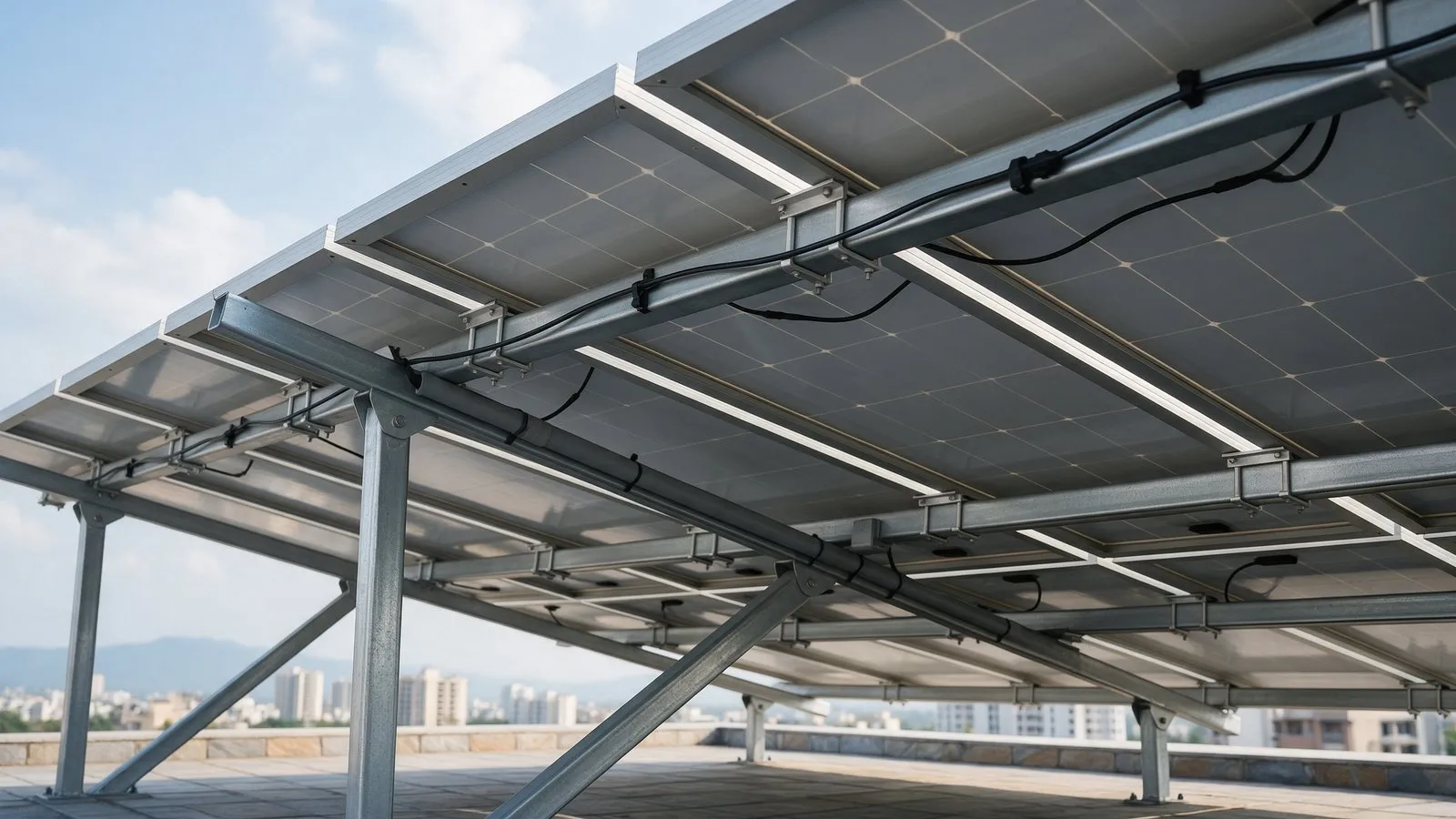 Representative image
A rooftop solar quotation lists a dozen or more parts. The panels and inverter get most of the attention, but whether a system is still safe and working in 25 years depends just as much on the structure, the cables, the protection boxes and the earthing. This guide follows the electricity from the roof to the meter and explains what each part does, what it should be, and what a cheap version leaves out.
How the parts fit together
The panels turn sunlight into direct current (DC). DC cables carry it down to a protection box and on to the inverter, which converts it into alternating current (AC) matched to the grid. The AC passes through a second protection box into your main switchboard, where the house uses it first. Anything the house does not need flows out to the grid through the net meter. Earthing and a lightning arrester protect the whole system.
| Part | What it does |
|---|---|
| Solar panels | Turn sunlight into DC electricity |
| Mounting structure | Holds the panels at the right angle, against wind, for 25 years |
| DC cables and connectors | Carry DC from the panels to the inverter |
| DC distribution box (DCDB) | Lets the panels be switched off, and protects against surges |
| Inverter | Converts DC into AC for the house and the grid |
| AC distribution box (ACDB) | Breaker and surge protection between the inverter and the house |
| Earthing and lightning arrester | Carry fault currents and lightning safely into the ground |
| Net meter and generation meter | Record what you export, import and generate |
| Monitoring | Shows daily output on your phone |
| Battery (hybrid systems only) | Stores energy for power cuts |
Solar panels
Most home panels sold in 2026 are rated between about 540 and 600 watts. Newer TOPCon panels are replacing the older mono PERC type, and bifacial panels, which also collect some light reflected onto their backs, suit raised frames over light-coloured roofs.
What to check:
- The make, exact model and wattage, and the number of panels
- The model is on MNRE’s approved list (ALMM). For the PM Surya Ghar subsidy, the panels must also be DCR, made with Indian cells
- Two separate warranties: a product warranty against defects and a performance warranty on output
- The serial numbers at handover match the quotation
Mounting structure
The structure holds the panels at the chosen tilt and direction through 25 summers of storms. Under PM Surya Ghar, the approved materials are hot-dip galvanised steel or iron and aluminium, and since May 2026 also ZAM, a zinc, aluminium and magnesium coated steel. Steel sections should conform to IS 2062 and galvanising to IS 4759.
A low frame keeps the panels close to the roof. A raised structure lifts them clear of water tanks and parapet shadows and leaves the roof usable underneath, with its legs bolted to concrete footings or anchored into the slab.
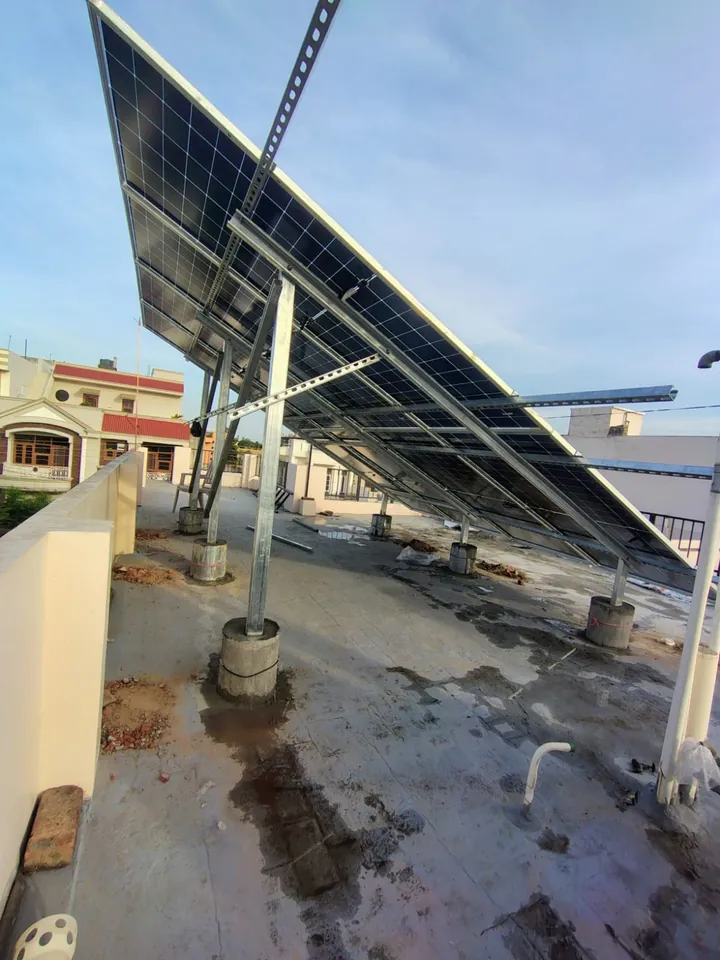
What to check:
- The material, the height above the roof and how it is anchored
- The tilt angle and direction, which our guide to tilt angle and direction in Mohali and Chandigarh explains
- That the structure is designed for wind loads under IS 875 (Part 3), especially a raised frame
- How the roof is sealed where anchors go into it, so it does not leak in the monsoon
DC cables and connectors
DC cables run from the panels to the inverter, much of the way in full sun. They should be single-core solar cable with UV-resistant insulation, usually copper of 4 or 6 sq mm. MNRE’s specification for rooftop systems rules out multicore cable for the DC side and limits the voltage lost in the DC cables to 2%. Thinner cable wastes power as heat, every sunny day.
The panels plug together with weatherproof connectors, usually the MC4 type. Both halves of each joint should be the same make and type. Mixed or badly crimped connectors are a known cause of hot joints and roof fires.
What to check: the cable make and size, that cables run in conduit or trays clipped clear of the roof surface rather than lying loose in water, and that connectors are matched.
DC distribution box
The DC box sits between the panels and the inverter. It contains a DC isolator, so the panels can be safely disconnected for maintenance, a DC surge protection device, and fuses where several strings of panels join. Every part inside must be rated for DC, which is harder to switch off safely than household AC.
Inverter
The inverter converts the panels’ DC into AC at the grid’s voltage and frequency, and constantly adjusts to draw the most power from the panels as light changes. An on-grid inverter also switches itself off in a power cut, so that it never feeds a line PSPCL’s staff are repairing. That is why on-grid solar stops during a power cut; our guide to on-grid and hybrid systems explains the options.
What to check:
- The make, model and rating, with BIS certification. The relevant standards are IS 16221 for safety and IS 16169 for switching off when the grid fails
- The size against the panels. A panel capacity slightly above the inverter rating, such as 5.5 kWp on a 5 kW inverter, is normal. 5 kWp on a 3 kW inverter is undersized and throws away power on sunny days
- Two MPPT inputs if the panels face two directions or are shaded differently, so that each group works at its best
- Where it will be mounted. Inverters reduce output when hot, so a shaded, ventilated spot is better than a sunny wall. An outdoor unit should be rated IP65
- The warranty term in writing, and who replaces the inverter if it fails
AC distribution box
The AC box connects the inverter to your main switchboard. It holds a breaker sized to the inverter’s output, an AC surge protection device and an isolator. From here the solar supply joins the house wiring.
Earthing and lightning arrester
Earthing gives fault currents a safe path into the ground, and the lightning arrester protects the array, which is usually the highest point on the house. MNRE’s specification asks for earth resistance of no more than 5 ohms, and for systems of 10 kW and above, three separate earth pits: one for the DC side, one for the AC side and one for the lightning arrester. Ask how many pits your quote includes, and ask for the measured earth resistance at handover.
Net meter and generation meter
PSPCL replaces your meter with a bi-directional net meter, and under PSERC’s regulations a generation meter records what the panels produce. In Chandigarh and Panchkula, CPDL and UHBVN fit their own. Our guides cover how PSPCL bills export and import units and the documents PSPCL asks for.
Monitoring
Most inverters connect to an app over Wi-Fi or a mobile data logger. The app shows each day’s output, so a fault such as a tripped breaker or a failed string shows up within days instead of on the next bill.
Battery, for hybrid systems
A hybrid system adds a battery and a hybrid inverter so that chosen loads keep running in a power cut. The battery backup page compares the battery types and sizes.
The five-year system warranty for subsidy homes
For homes under PM Surya Ghar, the scheme’s rules for registered vendors require the vendor to give a five-year warranty covering the whole system and to repair faults free of charge for five years from commissioning. This is in addition to the manufacturers’ warranties on the panels and inverter. Ask who will carry it out, and how a fault is reported.
Putting it together
The quotation checklist turns these parts into 20 points to tick, and our guide to comparing solar quotations shows two “5 kW” quotes side by side. If you would like a second opinion, send any quotation to us on WhatsApp and we will check each part against it, free of charge.
Common questions
What are the main parts of a rooftop solar system?
The panels, the mounting structure, the DC cables and connectors, a DC protection box, the inverter, an AC protection box, earthing with a lightning arrester, the net meter and generation meter, and a monitoring app. A hybrid system adds a battery.
Which part of a solar system usually fails first?
Usually the inverter, because its electronics work hard and hot every day. Panels and a properly galvanised structure last much longer. Check the inverter's warranty term, and who replaces it, before you sign.
Does a home solar system need a lightning arrester?
Yes. The array is usually the highest point on the house, and MNRE's specification for rooftop systems includes a lightning arrester with its own earthing. On systems of 10 kW and above it requires three separate earth pits: DC side, AC side and lightning arrester.
Is galvanised steel or aluminium better for a solar structure?
Both are approved under PM Surya Ghar, along with ZAM-coated steel since May 2026. Hot-dip galvanised steel is the usual choice for raised structures because of its strength. Aluminium is lighter and does not rust, and is often used for low frames and sheds, at a higher cost.
Our home systems
Each one is sized to your own bills. See the price per kW and what each kW makes.
Core
Small home
Usually 1 to 3 kW
Ask about CoreComfort
Family home
Usually 4 to 5 kW
Ask about ComfortGrand
Kothi or large home
Usually 6 kW and above
Ask about Grand