
Home / Blog / Buying guide
Questions to ask at a solar site survey
 Representative image
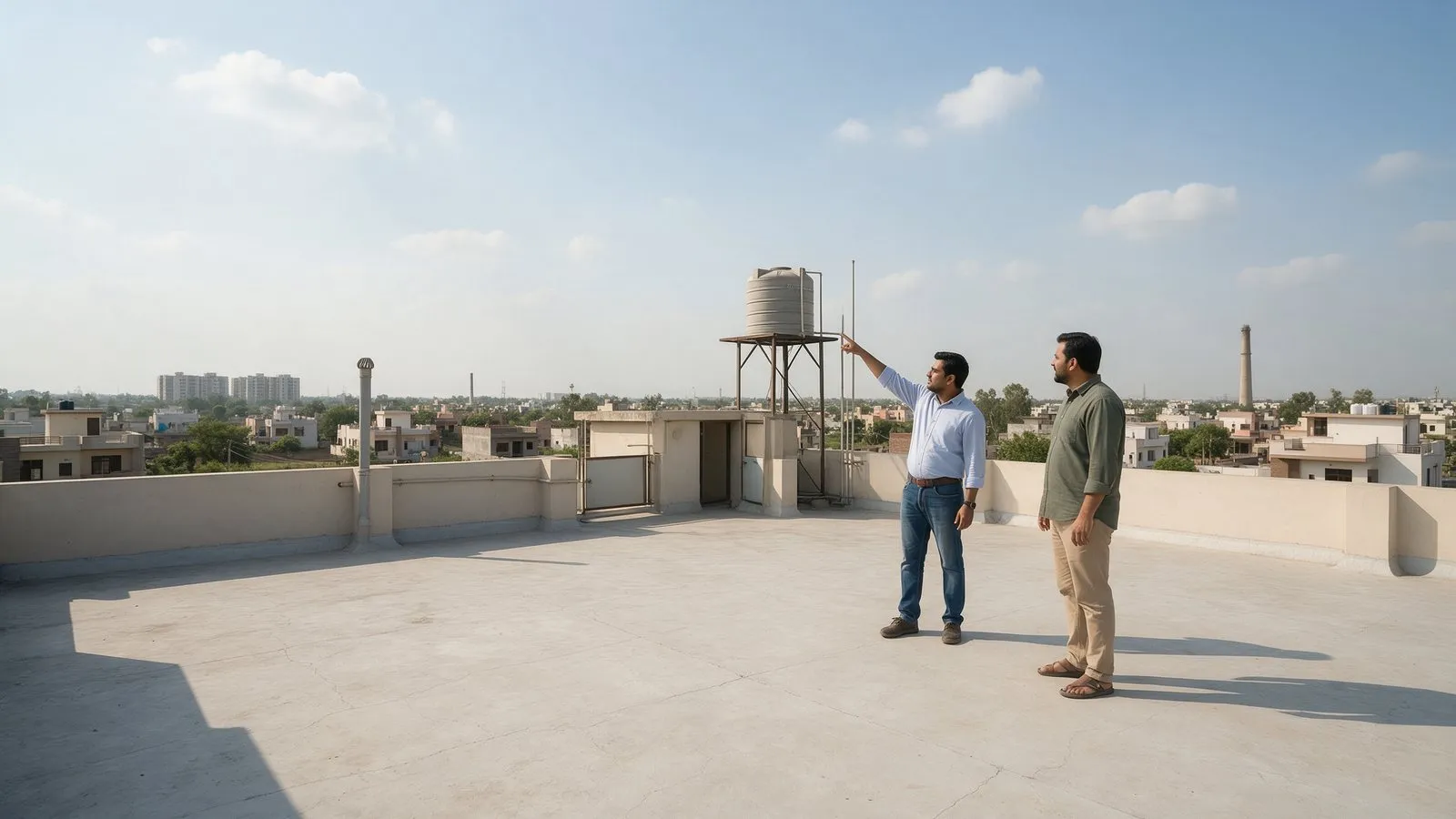
The site survey is where a rooftop solar proposal is won or lost. A good survey turns your bills and your roof into a system that fits both. A rushed one produces a price based on a guess, and the surprises come later, when the frame meets a water tank or the system turns out to be larger than your sanctioned load allows. This guide sets out what a proper survey should cover, and the questions to ask while the surveyor is on your roof.
Have these ready before the visit
What a proper survey checks
A surveyor should spend real time on the roof, not just look at it from the stairs. Expect them to:
- Measure the usable area, allowing for water tanks, stair rooms, solar water heaters and the space needed to walk around and clean the panels. Each kW needs roughly 80 to 100 sq ft of shade-free roof.
- Check shade through the day and through the year. Winter shadows are much longer than summer ones, so a tank that is harmless in June can shade panels all morning in December.
- Note the direction of the roof and plan the tilt. Facing south at around 15° to 25° makes close to the most over a year here.
- Inspect the slab or shed, and the parapet, for the structure and its anchoring.
- Look at the meter, the main switchboard and the earthing, and plan the cable route and where the inverter will go.
- Read the sanctioned load and category from your bill.
Questions to ask the surveyor
About the size
- How did you work out the size from my bills, and what will it do to my bill in summer and winter?
- Is the system within my sanctioned load? If not, how will the load be raised, and what will that cost?
- Above 7 kW, does my connection need to change to three phase?
About the roof 4. How many panels fit, and where exactly will they go? 5. Will anything shade them at any time of year: the tank, the stair room, trees, a neighbour’s building? 6. Will the panels be on a raised, low or canopy frame, and can I still use the roof underneath? 7. How will the frame be fixed, and how will you stop leaks where it is anchored?
About the equipment 8. Which panels and inverter, by make and model? Are the panels DCR, for the subsidy? 9. Where will the inverter go, and is that spot shaded and ventilated? 10. How many earth pits, and is there a lightning arrester?
About the process and after 11. Who handles the application to the electricity board, and the subsidy if I claim it? 12. How long will each step take, and who follows up with the board? 13. Who do I call if something goes wrong, and what does the maintenance cover?
The answers should be specific. “Don’t worry, we’ll handle it” is not an answer to any of them.
Warning signs
- A price given without anyone going onto the roof
- No question about your sanctioned load, or your bills from summer
- A system size that seems to come from the roof area alone, not from your use
- Panels or inverter named only as “tier 1” or “branded”, with no model
- Pressure to sign on the day
After the survey
You should receive a written proposal that matches what was discussed: the size and why, the equipment by make and model, the layout, the structure, the price with each part listed, and the timeline. Our guide to comparing solar quotations and our quotation checklist help you check it line by line, and the guide to how to buy rooftop solar shows where the survey fits in the whole process.
How we survey
Our survey covers everything above, and the proposal shows the layout on your own roof, with the sanctioned load checked before any price is given. If solar will save you little, for example because your bills already stay within Punjab’s free units, we say so. Our guides to raised, low and canopy structures and the parts of a rooftop system explain the choices you will see in the proposal.
Common questions
How long does a solar site survey take?
For a home, usually under an hour on the roof, plus a few minutes at the meter and switchboard. Allow more time for a large or complicated roof, or if the surveyor is checking shade from neighbouring buildings.
What documents should I keep ready for a solar survey?
Your electricity bills for the last twelve months, or at least one summer and one winter bill, showing the account number, sanctioned load and category. For a shared roof, the sale deed's description of it.
Should a solar company give a price without a survey?
Only as an estimate. A firm price depends on the roof, the shade, the structure, the cable route and the sanctioned load, which can only be checked on site.
Why does the surveyor ask about my sanctioned load?
Because a solar system cannot be larger than it. If the system your bills justify is bigger, the load has to be raised, which affects the cost and, above 7 kW, can mean a change to three-phase supply.
Our home systems
Each one is sized to your own bills. See the price per kW and what each kW makes.
Core
Small home
Usually 1 to 3 kW
Ask about CoreComfort
Family home
Usually 4 to 5 kW
Ask about ComfortGrand
Kothi or large home
Usually 6 kW and above
Ask about Grand