
Home / Blog / Buying guide
Upfront payment or EMI: which works better for rooftop solar?
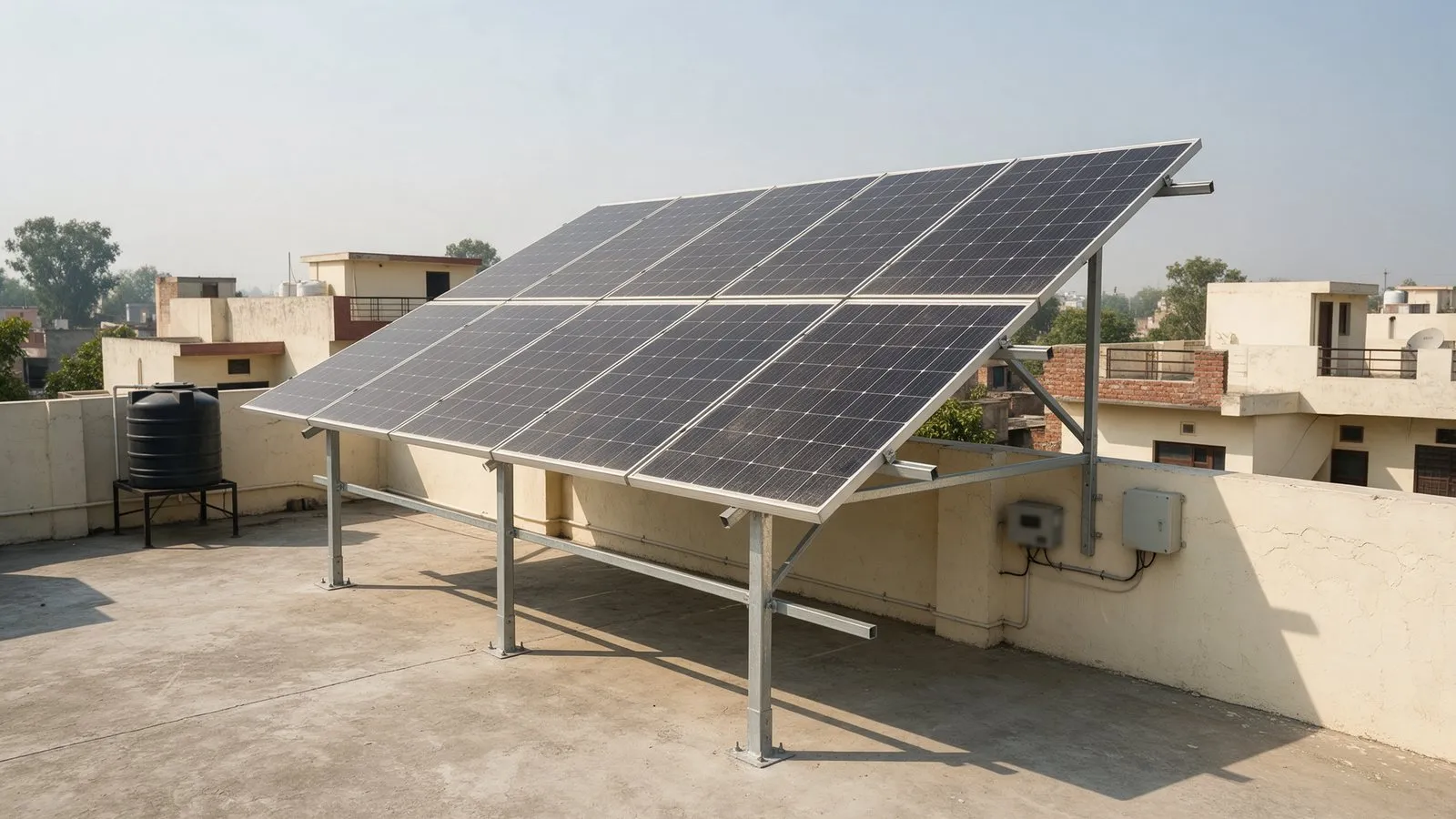 Representative image
“Pay less in EMI than you pay on your bill” is one of the most common lines in solar advertising. Sometimes it is true and a sensible way to buy. Sometimes the low EMI comes from a long tenure, a high rate or a price that has been raised to cover the finance. This guide compares the ways to pay for a home system, shows what each really costs, and explains how to judge an EMI offer.
The four ways to pay
| What it is | What to watch | |
|---|---|---|
| Upfront | Pay the full price from savings | No interest, but money leaves a deposit that may be earning |
| PM Surya Ghar bank loan | Concessional loan from a public sector bank | Best rate for systems up to 3 kW, higher above that |
| Personal loan or card EMI | Ordinary unsecured credit | Rates usually far higher than a solar loan |
| Vendor or finance company EMI | Finance arranged by the seller | The rate, the fees and whether the price has been raised |
Our guide to PM Surya Ghar solar loans explains the bank loan in detail.
Why a lower EMI is not always cheaper
The EMI depends on three things: the amount, the interest rate and the number of months. Stretching the months lowers the EMI and raises the total paid. Here is the same ₹3 lakh borrowed three ways:
| Loan | EMI | Total interest |
|---|---|---|
| 14% for 5 years | About ₹6,980 | About ₹1.19 lakh |
| 10% for 10 years | About ₹3,965 | About ₹1.76 lakh |
| 8.5% for 10 years | About ₹3,720 | About ₹1.46 lakh |
The second loan has an EMI little more than half the first, and it costs more in total. When comparing offers, compare the total amount you will pay, not the monthly figure.
Signs a finance offer needs a closer look
Comparing the EMI with your bill
In Punjab, the comparison needs care. Homes get 300 free units a month, so many pay little or nothing in winter and a lot in summer. A June bill of ₹3,000 does not mean a saving of ₹3,000 a month all year. Compare the EMI with your yearly saving divided by twelve. Our savings calculator gives the yearly figure from your bills.
When paying upfront is better
- You have the money set aside, and it is earning less than the loan would cost
- You are buying a larger system, above 3 kW, where the concessional rate does not apply to all of it
- You want the simplest paperwork and the quickest start
When a loan is better
- Paying upfront would mean breaking a deposit earning more than the loan costs
- Waiting to save up would delay solar by a year or more, which means another year of full summer bills, and for subsidy homes, the risk of missing the scheme’s March 2027 date
- The system is 3 kW or less, where the PM Surya Ghar rate is low and the subsidy can repay a large part of the loan within weeks
A middle way
Many homes pay part upfront and borrow the rest. For a subsidy home, a common pattern is to borrow at the concessional rate, then prepay the subsidy when it arrives, so the loan that remains is small and short.
Start from the full price
Whichever way you pay, start from the full price of the system, including GST, and compare every finance offer against it. Our proposals state that price for each option. Our guide to how to buy rooftop solar sets out the whole process.
Common questions
Is it better to buy solar on EMI or pay cash?
If you have the money and it is earning less than a loan would cost, paying cash is cheaper. A PM Surya Ghar bank loan at the concessional rate is a good option for systems up to 3 kW, especially as the subsidy can repay much of it. Compare the total paid, not just the EMI.
Is zero-interest EMI on solar really free?
Rarely. The cost of the finance is usually built into a higher system price or covered by fees. Ask for the cash price of the same system and compare it with the total you would pay on EMI.
Will my solar EMI be less than my electricity bill?
It depends on your bills. In Punjab, the 300 free units mean savings come mostly in summer, so compare the EMI with your yearly saving divided by twelve rather than with a summer bill.
What interest rate should I expect on a solar loan?
For PM Surya Ghar loans of up to ₹2 lakh for systems up to 3 kW, banks charge the repo rate plus 0.5%, which is 6.00% a year at SBI from 15 October 2026. Larger loans and other lenders charge more, so always ask for the annual rate and the total cost.
Our home systems
Each one is sized to your own bills. See the price per kW and what each kW makes.
Core
Small home
Usually 1 to 3 kW
Ask about CoreComfort
Family home
Usually 4 to 5 kW
Ask about ComfortGrand
Kothi or large home
Usually 6 kW and above
Ask about Grand