
Home / Blog / Buying guide
Choosing a solar inverter: type, size and certification
 Representative image
The panels get most of the attention in a solar quotation, but the inverter does the hardest work. It converts the panels’ direct current into the alternating current your home and the grid use, it decides how much power the panels deliver through the day, it protects the system and the grid, and it is the part most likely to need attention in the system’s life. This guide explains how to choose one.
On-grid or hybrid
The first choice follows from what you want the system to do.
If backup matters, decide at the start. A standard on-grid inverter cannot take a battery later, while a hybrid inverter can be fitted now and the battery added afterwards. Our guides to on-grid or hybrid solar and connecting solar to an existing home inverter cover the choice in detail.
The standards it should meet
MNRE’s technical specification for rooftop systems sets the standards for a grid-connected inverter, including:
The inverter should be registered with the Bureau of Indian Standards (BIS) under these standards. Ask for the BIS registration for the exact model in the quote.
The same specification sets other minimums:
| Requirement | MNRE minimum |
|---|---|
| Efficiency, below 10 kW | More than 90% |
| Efficiency, 10 kW and above | More than 93% with built-in galvanic isolation, more than 97% without |
| Harmonic distortion (THD) | Less than 3% |
| Maximum power point tracking (MPPT) | Built into the inverter |
| Overload capacity | At least 10% |
| Islanding protection | Required |
Good inverters from established makers usually do better than these minimums. The datasheet states the figures, so compare them across quotes.
Sizing it against the panels
The inverter’s rating in kW should match the panels’ rating in kWp closely. An inverter much smaller than the panels cuts off output on bright days, and one much larger costs more without making more. We size the inverter close to the panel rating, with the panels at most a little larger, which suits the hours of strong sun here.
Two more points:
Warranty, service and monitoring
Where to mount it
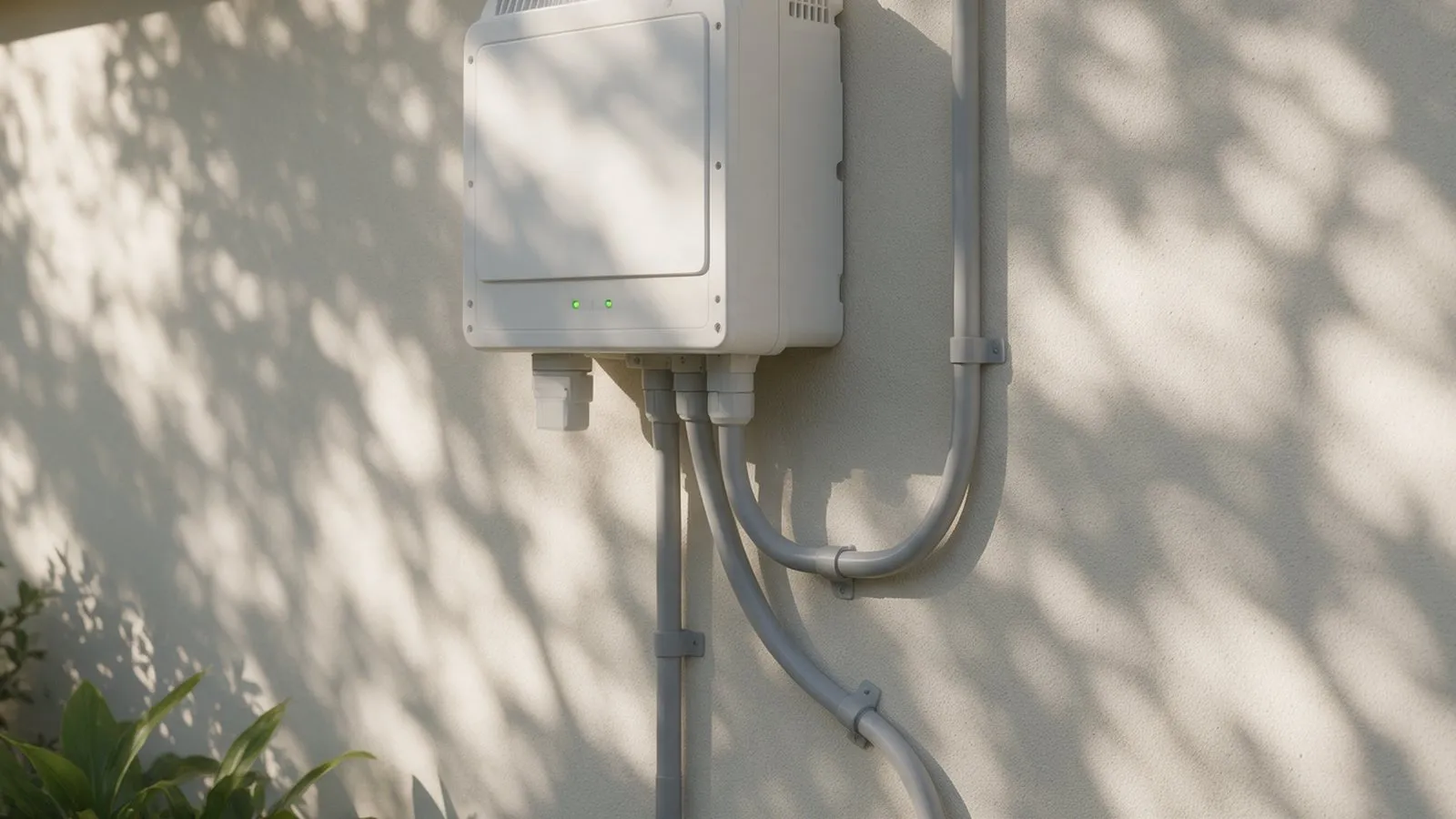
Heat shortens an inverter’s life and can make it reduce its output. Mount it on a wall that is shaded in the afternoon, with space around it for air, out of direct rain, and close enough to the panels and the meter to keep the cable runs short. If it will be outdoors, check that it is rated for outdoor use. A cool stair room or a shaded wall under a raised frame often works well.
What to check in a quotation
- The make, exact model and kW rating, and whether it is on-grid or hybrid
- BIS registration for that model, under IS 16221 and IS 16169
- Efficiency, number of MPPT inputs and single or three phase, from the datasheet
- The warranty in years, and who you call for service
- Where it will be mounted
Our guide to the parts of a rooftop system covers the rest of the equipment, and the one on comparing quotations covers the quote as a whole.
Common questions
What size inverter do I need for a 5 kW solar system?
An inverter of about 5 kW. The inverter should match the panels' rating closely. The panels can be a little larger than the inverter, but a much smaller inverter cuts off output on bright days.
Which certifications should a solar inverter have in India?
BIS registration under IS 16221 for safety and IS 16169 for islanding protection, which MNRE's technical specification for rooftop systems requires. Ask for the registration for the exact model.
How long does a solar inverter last?
Its warranty usually runs 5 to 10 years, far shorter than the panels'. It is the part most likely to need repair or replacement in a system's life, so keep it cool and dust-free, and choose a maker with local service.
Can I add a battery to my on-grid inverter later?
Not to a standard on-grid inverter. If you might want backup, choose a hybrid inverter at the start. It can run without a battery now and take one later.
Our home systems
Each one is sized to your own bills. See the price per kW and what each kW makes.
Core
Small home
Usually 1 to 3 kW
Ask about CoreComfort
Family home
Usually 4 to 5 kW
Ask about ComfortGrand
Kothi or large home
Usually 6 kW and above
Ask about Grand