
Home / Blog / Home solar
Solar for kothis with three or more ACs: sizing and cost
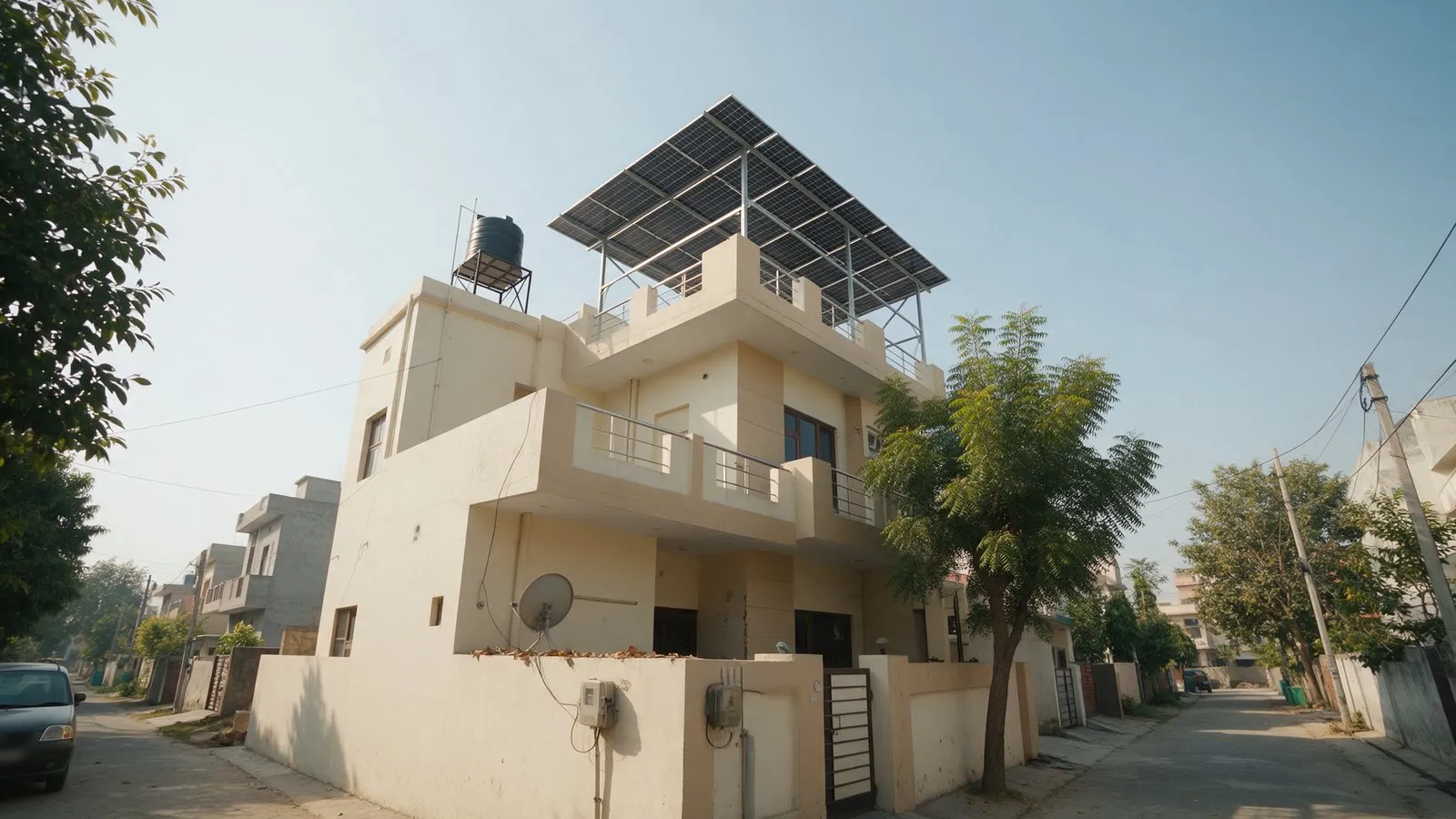 Representative image
A kothi with three or four air conditioners can use 1,200 to 1,600 units in a June month, and on a PSPCL bill that means energy charges of about ₹7,850 to ₹10,650 a month at the 2026-27 rates. Solar for a home like this is a larger system and a larger decision than the standard 3 kW, with a few choices that do not arise for smaller homes. This guide covers the sizing, the cost, whether the subsidy is worth taking at this size, and the roof.
How much a large kothi uses
Each 1.5-ton AC used for about eight hours a day in summer adds roughly 250 to 350 units a month. On top of that come the fridges, lights, fans, the water pump, a geyser in winter and often a second kitchen or a home office. Typical June figures:
Your own bills are the only reliable figure. Collect a full year, because sizing is decided by the peak summer month. Our guide to solar for one or two ACs explains how AC use translates into units.
Two worked examples
Both are general-category PSPCL homes with a sanctioned load above 7 kW, at the 2026-27 rates, showing energy charges before fixed charges and duty. In Tricity, each kW of panels makes roughly 110 to 125 units a month.
Three ACs, 1,200 units in June. Energy charges without solar: about ₹7,850 a month. A 10 kW system brings net use down to roughly 120 units or less, within Punjab’s 300 free units, so the energy charges fall to zero. An 8 kW system gets close, but in a weak month net use can creep over 300, and then the whole net use is charged, about ₹1,750.
Four ACs, 1,600 units in June. Energy charges without solar: about ₹10,650 a month. A 10 kW system cuts that to roughly ₹1,800 to ₹3,050. Reaching the free limit with a margin takes about 13 kW.
For the largest homes, the free limit may be out of reach on the roof available, and that is fine. Cutting a ₹10,650 bill to ₹2,000 to ₹3,000 is still a large saving. Our savings calculator works it out from your own bill.
What a system this size costs
For a home system with DCR panels, 2026 prices run at roughly ₹52,000 to ₹66,000 per kW installed, including GST. Non-DCR panels cost about ₹9,000 less per kW.
| System | With DCR panels | After the ₹78,000 subsidy | With non-DCR panels, no subsidy |
|---|---|---|---|
| 8 kW | ₹4.2 to ₹5.3 lakh | ₹3.4 to ₹4.5 lakh | ₹3.4 to ₹4.6 lakh |
| 10 kW | ₹5.2 to ₹6.6 lakh | ₹4.4 to ₹5.8 lakh | ₹4.3 to ₹5.7 lakh |
| 12 kW | ₹6.2 to ₹7.9 lakh | ₹5.5 to ₹7.1 lakh | ₹5.2 to ₹6.8 lakh |
Prices are confirmed after a survey, because the structure, the roof and the inverter all vary.
Is the subsidy worth it at this size?
Not always. The subsidy stops rising at 3 kW, so a 10 kW system gets the same ₹78,000 as a 3 kW one, but DCR panels cost more on every kW. Above about 9 kW, the extra cost of DCR panels is more than the subsidy, and non-DCR panels without the subsidy come out cheaper.
When the subsidy is worth taking
The subsidy is paid only on systems built with DCR panels, made with Indian solar cells, which cost about ₹9,000 more for every kW installed. The subsidy stops at ₹78,000 on 3 kW, but the extra panel cost keeps growing with size.
| System size | Extra cost of DCR panels | Subsidy | Cheaper route |
|---|---|---|---|
| 3 kW | ₹27,000 | ₹78,000 | DCR with the subsidy, about ₹51,000 better |
| 5 kW | ₹45,000 | ₹78,000 | DCR with the subsidy, about ₹33,000 better |
| 8 kW | ₹72,000 | ₹78,000 | About the same (DCR ₹6,000 better) |
| 10 kW | ₹90,000 | ₹78,000 | Non-DCR without the subsidy, about ₹12,000 better |
Up to about 8 kW, take the subsidy. From about 9 kW, non-DCR panels without it cost less, an option homes have until 31 March 2027. More on the subsidy page.
Homes that give up the subsidy may use non-DCR panels only until 31 March 2027, and the subsidy rates are themselves set only until that date. If you are reading this after March 2027, check the current rules. Our post on the PM Surya Ghar deadline explains the timing.
Sanctioned load, approvals and the 10 kW line
So 10 kW is a natural line. Going above it is worthwhile when the bills justify it, but plan for the extra step. Our guide to the documents PSPCL asks for covers both cases.
Roof space and design
At 80 to 100 sq ft per kW, a 10 kW system needs 800 to 1,000 sq ft of shade-free roof. Large homes often have that, but it is frequently split by stair rooms, water tanks and terraces at different levels. Options include:
Most large kothis have a three-phase connection, and a system of this size normally uses a three-phase inverter.
Backup for a large home
Many kothis already have an inverter and battery bank. An on-grid solar system can run alongside it, which is the cheapest arrangement. Where backup needs have grown, a hybrid system can carry the essential loads in a power cut, but keeping the ACs on backup needs a very large battery. Our guide to how long a solar battery lasts shows the arithmetic.
Common questions
What size solar system does a house with four ACs need?
Usually 10 to 13 kW in Tricity. Four 1.5-ton ACs can push a June bill to 1,400 to 1,800 units. A 10 kW system removes most of the bill, and about 13 kW keeps the peak month within Punjab's 300 free units, if the roof and sanctioned load allow.
How much does a 10 kW solar system cost for a home in Mohali?
Roughly ₹5.2 to ₹6.6 lakh with DCR panels including GST, or ₹4.4 to ₹5.8 lakh after the PM Surya Ghar subsidy. With non-DCR panels and no subsidy, roughly ₹4.3 to ₹5.7 lakh. The final price depends on the structure and the roof.
Should I take the subsidy on a 10 kW system?
Often not. The subsidy is capped at the 3 kW amount, while DCR panels cost more on every kW, so above about 9 kW non-DCR panels without the subsidy usually work out cheaper. Homes may use non-DCR panels this way until 31 March 2027.
How much roof does a 10 kW system need?
About 800 to 1,000 sq ft of shade-free roof, including gaps between rows and walkways. On a kothi, that is often spread over the main roof and a terrace or a canopy over parking.
Our home systems
Each one is sized to your own bills. See the price per kW and what each kW makes.
Core
Small home
Usually 1 to 3 kW
Ask about CoreComfort
Family home
Usually 4 to 5 kW
Ask about ComfortGrand
Kothi or large home
Usually 6 kW and above
Ask about Grand