
Home / Blog / Battery backup
How long will a solar battery last in a power cut?
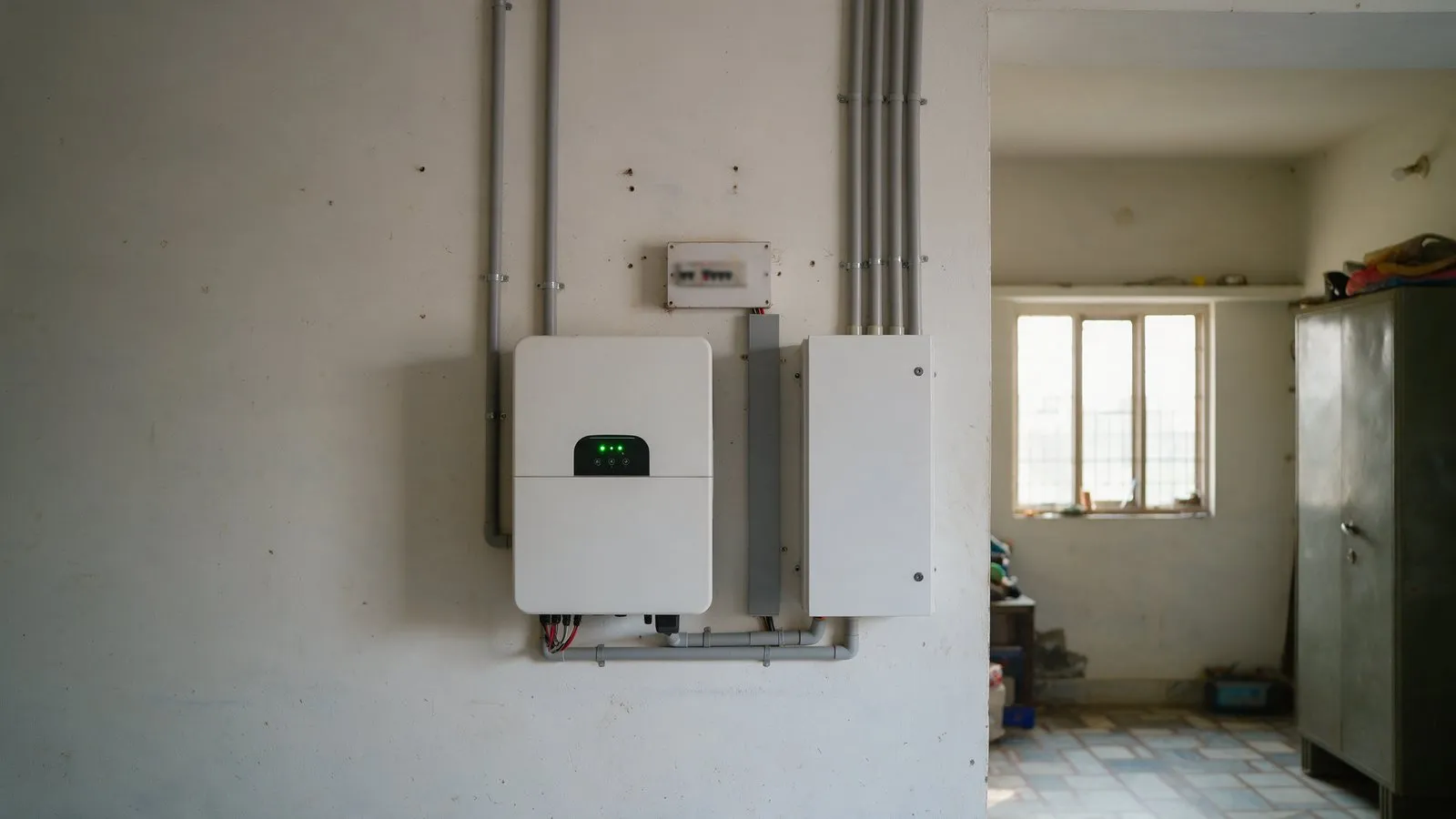 Representative image
How long a battery lasts in a power cut depends on two numbers: how much usable energy it holds, and how much power the house draws from it. Both can be worked out before you buy, and getting them right is the difference between a battery that sees you through a summer evening cut and one that runs out halfway. This guide shows the arithmetic, with typical figures for homes in Tricity.
The formula
Hours of backup ≈ usable battery energy (kWh) × 0.9 ÷ load (kW)
The 0.9 allows for the energy lost in the inverter. Usable energy is not the same as the rated size on the label:
A 5 kWh lithium battery therefore gives about 4.25 kWh of usable energy. Running a 500 watt (0.5 kW) load, that is 4.25 × 0.9 ÷ 0.5, or about 7.5 hours.
What your home draws
The load is the total of everything on the backup circuit at the same time.
| Appliance | Typical draw |
|---|---|
| LED bulb or tube light | 9 to 20 W each |
| Ceiling fan | 50 to 75 W each, or about 30 W for a BLDC fan |
| Refrigerator | 100 to 150 W while the compressor runs, about 40 to 80 W on average |
| Wi-Fi router | About 10 W |
| CCTV, four cameras and recorder | About 30 to 50 W |
| LED television | 40 to 100 W |
| Laptop | 40 to 65 W |
| Desktop computer and monitor | 100 to 200 W |
| 1.5-ton AC | 1,000 to 1,500 W |
| Geyser | About 2,000 W |
A typical evening backup of six lights, four fans, the fridge, the Wi-Fi, CCTV and a television comes to roughly 500 W. Switching to BLDC fans brings it down to about 360 W, which stretches the same battery by about a third.
ACs, geysers and water pumps are normally kept off the backup circuit, because each one draws as much as everything else together.
Hours of backup by battery size
| Battery | Usable energy | At 200 W | At 300 W | At 500 W | At 800 W |
|---|---|---|---|---|---|
| One 150 Ah tubular | About 0.9 kWh | 4 h | 2.5 h | 1.5 h | 1 h |
| Two 150 Ah tubular | About 1.8 kWh | 8 h | 5.5 h | 3 h | 2 h |
| Four 150 Ah tubular | About 3.6 kWh | 16 h | 11 h | 6.5 h | 4 h |
| 5 kWh lithium (LFP) | About 4.25 kWh | 19 h | 13 h | 7.5 h | 5 h |
| 10 kWh lithium (LFP) | About 8.5 kWh | 38 h | 25 h | 15 h | 9.5 h |
These are estimates for a battery in good condition. Old batteries hold less, and heat in summer shortens their life. Our comparison of lithium and tubular batteries explains why the usable shares differ.
Daytime cuts are different with solar
With a hybrid system, the panels keep working during a power cut. In the day they supply the backup circuit directly and recharge the battery at the same time, so a daytime cut drains the battery slowly, or not at all on a sunny day with a modest load. The evening and night are when the battery does its work.
An ordinary on-grid system is different: it switches off in a power cut for safety, so it gives no backup at all. Our guide to on-grid and hybrid solar explains why.
How to size your battery
- List the loads you need in a power cut, and add up their watts.
- Decide the longest cut you want to cover, usually an evening or night cut in summer.
- Multiply the load in kW by the hours, then divide by 0.9 for the inverter. That is the usable energy you need.
- Divide by the usable share (about 0.85 for lithium or 0.5 for tubular) to get the rated capacity to buy.
Example: 500 W for 6 hours is 3 kWh. Divided by 0.9, that is 3.3 kWh usable. For lithium, 3.3 ÷ 0.85 is about 4 kWh rated, so a 5 kWh battery gives a margin. For tubular, 3.3 ÷ 0.5 is about 6.7 kWh, or four 150 Ah batteries.
Check the hybrid inverter’s size too. It must handle the total load on the backup circuit, including the moment a fridge or pump starts, which briefly draws several times its running power.
If you already have an inverter and battery
Many homes in Tricity already have one. If it covers your power cuts adequately, an on-grid solar system can run alongside it: solar cuts the bill, and the existing inverter keeps doing the backup. That is usually the cheapest option. Our battery backup page covers when a hybrid system is worth it.
Common questions
How many hours will a 5 kWh solar battery last?
A 5 kWh lithium battery gives about 4.25 kWh of usable energy, which runs a 500 watt load of lights, fans, a fridge, Wi-Fi and a television for around seven to eight hours, or a 300 watt load for about 13 hours.
Can a solar battery run my AC in a power cut?
It can, but a 1.5-ton AC draws 1,000 to 1,500 watts, two to three times a typical evening backup load. A 5 kWh lithium battery would run one AC for only about three hours, and the hybrid inverter must be larger, so most homes keep ACs off the backup circuit.
Does the battery charge during a power cut?
With a hybrid system, yes, in daylight: the panels supply the backup loads and recharge the battery. At night it can only discharge. An on-grid system without a battery switches off during a cut.
How many batteries do I need for a 1 kW load?
For 4 hours at 1 kW you need about 4.4 kWh of usable energy. That is a 5 to 6 kWh lithium battery, or roughly 9 kWh of tubular batteries, five 150 Ah units. Reducing the load is often cheaper than adding batteries.
Our home systems
Each one is sized to your own bills. See the price per kW and what each kW makes.
Core
Small home
Usually 1 to 3 kW
Ask about CoreComfort
Family home
Usually 4 to 5 kW
Ask about ComfortGrand
Kothi or large home
Usually 6 kW and above
Ask about Grand