
Home / Blog / Home solar
Solar for one or two ACs: can 3 kW or 5 kW run a 1.5-ton AC?
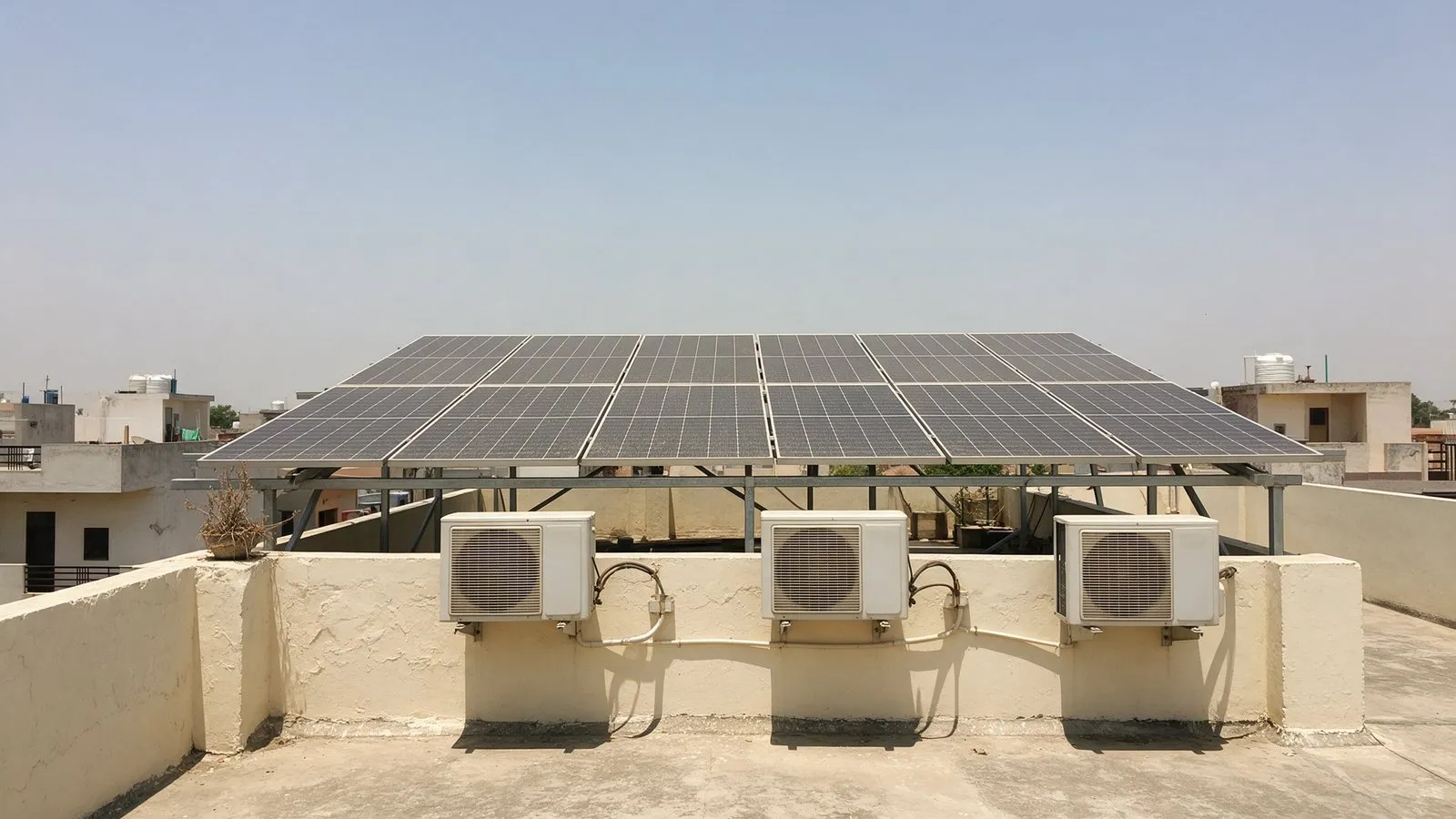 Representative image
Air conditioners are the main reason summer bills in Mohali, Zirakpur and Kharar jump from a few hundred rupees to several thousand. In Punjab they also push many homes over the 300 free units, and once a general-category home crosses that limit, every unit on the bill is charged. So the question we hear most often is a fair one: will a 3 kW or 5 kW solar system cover my ACs?
The short answer: a 3 kW system covers about one 1.5-ton inverter AC used through a Tricity summer, and two ACs need 5 to 6 kW. The rest of this guide shows where those numbers come from, so you can check them against your own bill.
How solar “runs” an AC
An on-grid solar system does not power the AC on its own. The AC runs on the house supply as usual. During the day, the panels supply the house first, so an AC running in the afternoon is largely running on your own solar power. At night it draws from the grid, and the units your panels exported in the day are set against those imports on your bill through net metering.
So the real question is about units: how many units your ACs add in a month, and how many units the panels make in a month.
How many units a 1.5-ton AC uses
A 1.5-ton AC uses roughly 1 to 1.5 units an hour on the hottest days, depending on its star rating, the room and the temperature setting. Inverter models draw less once the room has cooled, and older fixed-speed ACs draw the most. At night and in milder weeks, the figure falls.
Used for about eight hours a day through a summer month, one AC adds roughly 250 to 350 units to the bill. Two ACs add 500 to 700.
The best way to know your own figure is to compare your summer and winter bills. The difference between a June bill and a December bill is mostly the ACs.
What 3 kW and 5 kW make
In Tricity, a shade-free system makes about 3.6 to 4.2 units per kW a day across the year, or roughly 110 to 125 units per kW a month.
| System | Units a month, on average |
|---|---|
| 3 kW | About 320 to 380 |
| 4 kW | About 430 to 500 |
| 5 kW | About 540 to 630 |
| 6 kW | About 650 to 750 |
Set against the AC figures above, 3 kW makes about as many units as one AC uses, and 5 kW about as many as two.
Two worked examples on a PSPCL bill
Both examples are a general-category PSPCL home with a sanctioned load above 2 kW and up to 7 kW, which uses about 250 units a month without the ACs. The figures are energy charges at the 2026-27 rates, before fixed charges and duty.
One AC. In June the home uses about 550 units. Because that is over 300, the whole bill is charged: about ₹3,040 a month in energy charges. A 3 kW system brings net use down to roughly 190 to 230 units, within the free limit, and the energy charges fall to zero.
Two ACs. In June the home uses about 850 units, and the energy charges come to about ₹5,150 a month. A 5 kW system brings net use to roughly 250 to 310 units. In a good month that is within the limit. In a hazy or very hot month it can cross 300, and then the whole net use is charged again, about ₹1,350. A 6 kW system brings net use to 130 to 200 units and keeps the bill at zero with a margin.
This is the trap in Punjab’s free units: being just over the limit costs almost as much as being well over it. That is why we size from the highest-use summer month, not from the yearly average. The free units guide explains the rule in full.
June, without solar: 520 units
Energy charges ₹0Over the limit, so every unit is billed: ₹2,826
The same home with 3 kW of panels
Energy charges ₹0Over the limit: ₹2,826About 360 units from the panels bring net use to 160: ₹0
Sanctioned load and roof space
A home system cannot be larger than its sanctioned load, which is printed on the bill. A 6 kW system needs at least 6 kW of sanctioned load. Homes that have added ACs over the years often find their load is lower than their use, so check it before choosing a size.
Each kW needs roughly 80 to 100 sq ft of shade-free roof, so 5 to 6 kW needs about 450 to 600 sq ft. A raised structure keeps the roof usable underneath, and it shades the roof slab, which reduces the heat reaching the top-floor rooms.
Running an AC in a power cut
An on-grid system switches off during a power cut, so it will not keep the AC running. A hybrid system can, but a 1.5-ton AC draws more than the lights, fans and fridge combined, so the battery and the hybrid inverter both have to be much larger. For most homes it is better value to leave ACs off the backup circuit. Our battery backup page explains the options.
Getting more from the same system
How we size it
We take a full year of your bills, find the peak summer month, and choose the smallest system that keeps that month within the free limit, checked against your sanctioned load and roof. The savings calculator does the same from a single bill, and our guide to what size system your home needs walks through the steps.
Common questions
Can a 3 kW solar system run a 1.5-ton AC?
Over a month, yes. A 3 kW system makes about 320 to 380 units a month in Tricity, which is about what one 1.5-ton AC uses running eight hours a day in summer. During the day the AC runs largely on the panels' output, and at night the units exported earlier are set against the grid power it uses.
How many kW of solar do I need for two ACs?
Usually 5 to 6 kW. A 5 kW system makes about as many units as two 1.5-ton ACs use, but in Punjab a home that ends up just over the 300 free units pays for every unit, so 6 kW gives a safer margin. The exact size depends on the rest of your use and your sanctioned load.
Will my AC work on solar during a power cut?
Not with an on-grid system, which switches off in a power cut for safety. A hybrid system with a battery can run an AC, but the battery and inverter must be much larger, so most homes keep ACs off the backup circuit.
Does the AC's star rating matter if I have solar?
Yes. A more efficient AC uses fewer units, so a smaller system can cover it, or the same system keeps you further inside the free limit. When an old AC needs replacing, a high-rated inverter model is worth the extra cost.
Our home systems
Each one is sized to your own bills. See the price per kW and what each kW makes.
Core
Small home
Usually 1 to 3 kW
Ask about CoreComfort
Family home
Usually 4 to 5 kW
Ask about ComfortGrand
Kothi or large home
Usually 6 kW and above
Ask about Grand