
Home / Blog / Home solar
Charging an electric car or scooter with rooftop solar
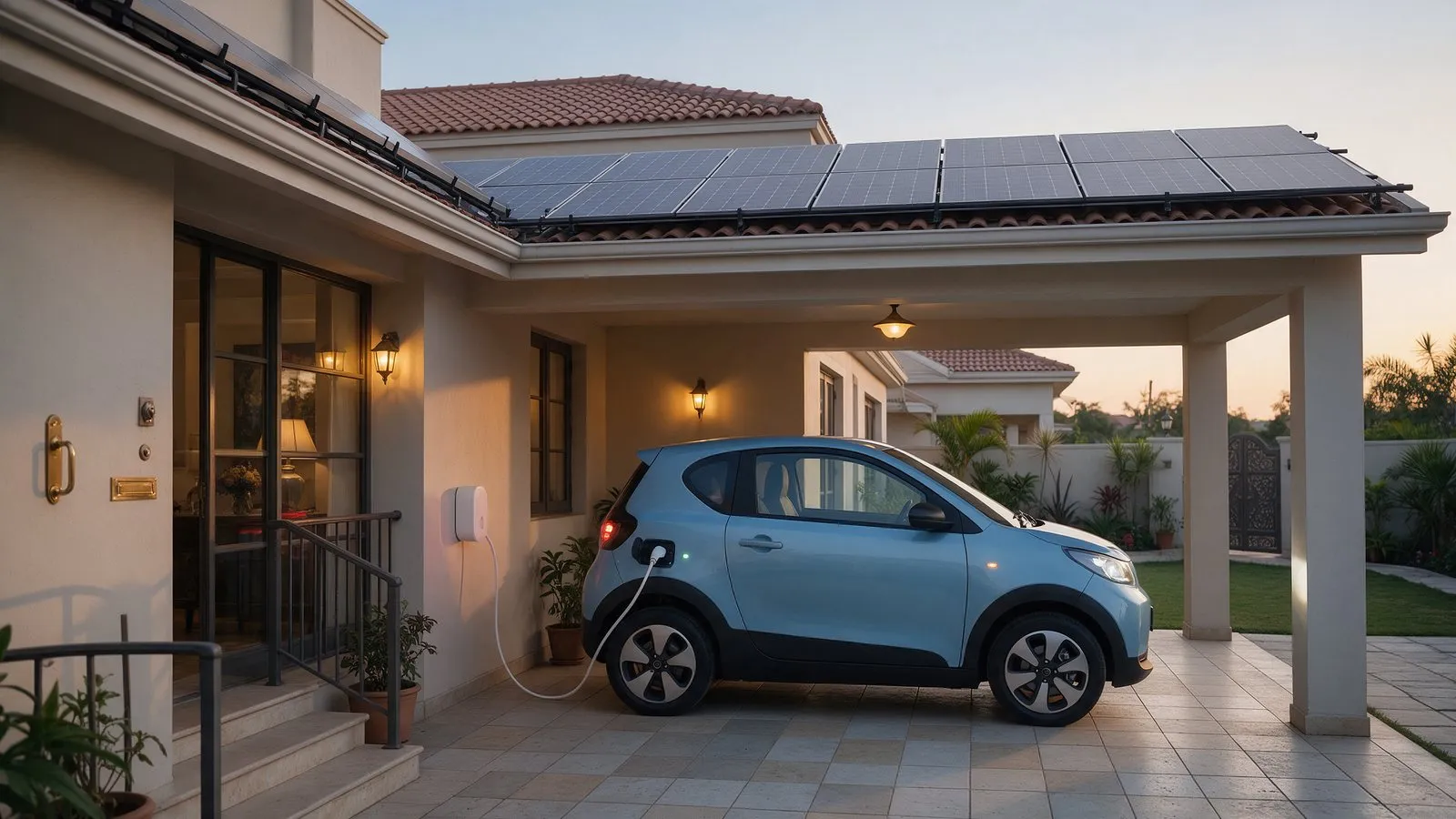 Representative image
An electric car charged at home runs on the same supply as everything else in the house, so it adds to the bill, and in Punjab it can push a home over the 300 free units. Rooftop solar can cover that extra use. This guide works out how many units an electric car or scooter needs, how much solar covers it, and what to plan for if the EV is still a year or two away.
How many units an EV uses
Figures vary with the model, the driving and the season, but as a guide, including the energy lost in charging:
| Daily use | Units a month | Solar needed to cover it |
|---|---|---|
| Scooter, 30 km a day | About 30 | About 0.25 kW |
| Car, 30 km a day | About 140 to 150 | About 1.2 kW |
| Car, 40 km a day | About 190 | About 1.6 kW |
| Car, 50 km a day | About 280 | About 2.3 kW |
In Tricity, each kW of panels makes roughly 110 to 125 units a month, which is how the last column is worked out. A typical car commute in Mohali, Zirakpur or Chandigarh needs about 1.5 to 2 kW of extra panels. A scooter needs barely one panel.
Why it matters more in Punjab
A general-category PSPCL home that stays within 300 units pays no energy charges at all. One that goes over pays for every unit. A home using 270 units a month that adds a car at 180 units goes from paying nothing to about ₹2,300 a month in energy charges at the 2026-27 rates. Adding about 1.5 to 2 kW of solar keeps it within the limit. Our guide to whether solar is worth it with the 300 free units explains the rule.
Day or night charging
Most EVs are charged at night, when the panels make nothing. That still works with net metering: the units your panels export in the day are set against the units the car takes at night, so over the month the solar covers the charging. Charging in the day, when you can, uses the solar power directly.
A home battery is not needed for EV charging, and charging a car from a home battery wastes energy twice. If you have a hybrid system, keep the EV charger off the backup circuit.
The charger and the sanctioned load
Most electric cars in India come with one of two home chargers:
Either way, the charger needs its own circuit from the distribution board, with the right breaker and earth leakage protection, installed by a qualified electrician. Never charge from an extension board.
A 7.2 kW charger running at the same time as two ACs can take a house past its sanctioned load. Check the load on your bill before the charger is installed, and apply for an increase if needed. A bigger sanctioned load also allows a bigger solar system, because a home system cannot exceed it.
Planning for an EV you do not have yet
If an electric car is likely in the next few years, decide now how to allow for it:
For a subsidy home, remember that the PM Surya Ghar subsidy stops rising at 3 kW and the subsidy rates are set until 31 March 2027. Our guide to what size system your home needs covers sizing in full.
A canopy over the parking
Where the car is parked in an open driveway or courtyard, a solar canopy over it gives shade and makes power from space that would otherwise do nothing. It costs more than panels on the roof, so it makes most sense where the roof is already full.
Common questions
How many solar panels do I need to charge an electric car?
For about 40 km of city driving a day, around 1.5 to 2 kW of extra panels, or three to four 550 W panels. A shorter commute needs less. Your own daily distance and car decide the figure.
Can I charge my EV directly from solar panels?
With an on-grid system, the car charges from the house supply, and the solar covers it through net metering over the month. Charging in daylight uses the solar power directly. Charging at night is covered by the units the panels exported during the day.
Do I need to increase my sanctioned load for an EV charger?
Often, for a 7.2 kW wall box in a home that already runs ACs. Add the charger to your existing loads and compare with the sanctioned load on your bill. A higher load also allows a larger solar system.
How much solar does an electric scooter need?
Very little. A scooter ridden 30 km a day uses about 30 units a month, which a quarter of a kW of panels covers, so most solar systems absorb it without any change.
Our home systems
Each one is sized to your own bills. See the price per kW and what each kW makes.
Core
Small home
Usually 1 to 3 kW
Ask about CoreComfort
Family home
Usually 4 to 5 kW
Ask about ComfortGrand
Kothi or large home
Usually 6 kW and above
Ask about Grand