
Home / Blog / Commercial solar
Solar for small factories in Mohali's Industrial Area
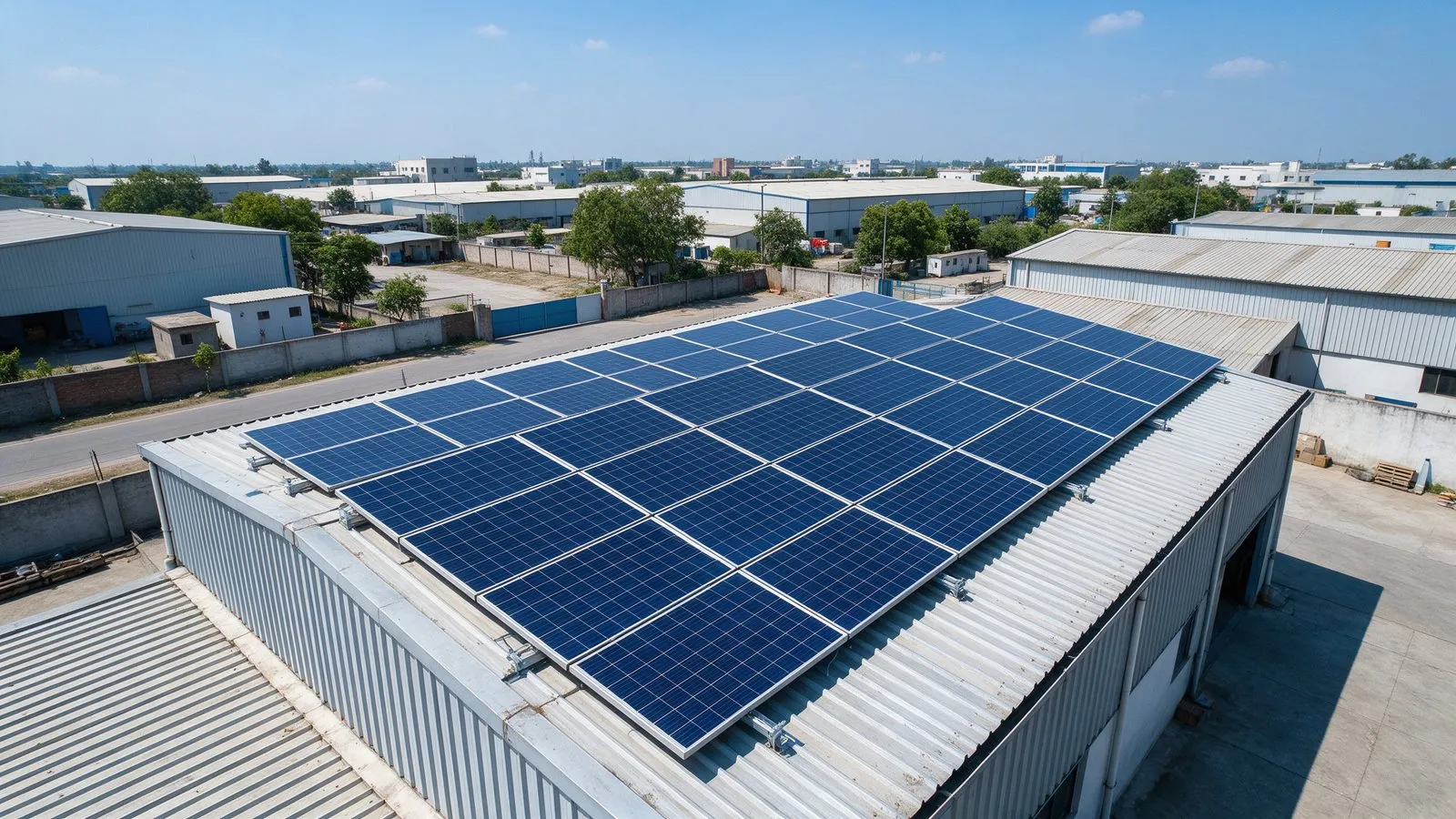 Representative image
A factory shed is close to an ideal place for solar: a large roof with nothing on it, machines that run through the working day, and no free units. Small and medium units in Mohali’s Industrial Area, and along the roads towards Zirakpur and Derabassi, can cut a large share of their daytime bill. But industrial tariffs in Punjab are lower than commercial ones, so the payback is a little longer, and time-of-day billing changes the arithmetic for larger connections. This guide sets it out.
What a factory pays PSPCL in 2026-27
Industrial connections are billed per kVAh under PSPCL’s schedule of tariff, by contract demand:
| Category | Contract demand | Energy charge | Fixed charge |
|---|---|---|---|
| Small power (SP) | Up to 50 kVA | ₹5.70 a kVAh | ₹100 a kVA |
| Medium supply (MS) | Above 50 kVA, up to 100 kVA | ₹5.83 a kVAh | ₹130 a kVA |
| Large supply (LS), general | Above 100 kVA, up to 1,000 kVA | ₹5.90 a kVAh | ₹210 a kVA |
| Large supply (LS), general | Above 1,000 kVA | ₹6.00 a kVAh | ₹280 a kVA |
Fuel and power purchase adjustments come on top. A unit that uses power only between 10 pm and 6 am can opt for a night rate of ₹5.50 a kVAh, which suits night shifts but not solar.
Time-of-day billing for medium and large units
All MS and LS connections are billed on PSPCL’s time-of-day tariff. The daytime hours, 6 am to 6 pm, are charged at the normal rate all year. Between 16 June and 15 October, 6 pm to 10 pm costs ₹2.00 a kVAh more, and the night hours carry a rebate from mid-October to mid-June.
Under PSERC’s rules, a factory on time-of-day billing has its solar units set first against its use in the same time block, and any surplus is treated as made in the next lower-priced block. So solar takes out daytime units at the normal rate, but cannot offset the evening surcharge. For a single-shift factory that runs in daylight, that costs little, because most of its use is in the hours the panels produce.
What solar saves: two examples
These use PSPCL’s 2026-27 rates, our estimate of about 1,440 units per kW a year in Tricity, and a typical 2026 price of ₹45,000 to ₹60,000 per kW for a business system, including GST, counting energy charges only.
Our calculator gives the figure for your own bill:
See what solar would save you
Tell us whether it is a home or a business, where it is and what you pay in a month. We work out your units at 2026-27 rates and size the system to your use.
Estimates use energy charges at 2026-27 rates, before fixed charges and duty, and 3.6 to 4.2 units per kW a day. Prices are typical installed ranges including GST, not a quote. Subsidy and price figures checked 12 October 2026.
Choosing the arrangement
PSERC’s rules give a factory three ways to connect a rooftop system:
For a factory whose machines use most of the output in daylight, net metering is usually the simpler choice, because Sundays and holidays still count.
Shed roofs, sizing and panels
Panchkula
Factories in Panchkula’s industrial area are on UHBVN. Connections up to 50 kW pay ₹6.45 to ₹6.80 a kVAh, and supply above 50 kW at 11 kV is ₹6.95 a kVAh with a fixed charge of ₹290 a kVA in 2026-27. Those higher rates shorten the payback compared with Punjab.
How we work with factories
We read twelve months of bills, including the time-of-day breakdown, walk the shed roof and check its condition, and size the system to the working pattern. Our guides to solar for hotels and restaurants and schools and coaching centres show the same approach for other businesses, and our commercial solar page covers business systems in general.
Common questions
What is the industrial electricity tariff in Punjab in 2026-27?
Per kVAh: ₹5.70 for small power up to 50 kVA, ₹5.83 for medium supply up to 100 kVA, and ₹5.90 for large supply up to 1,000 kVA, with fixed charges of ₹100, ₹130 and ₹210 a kVA. Medium and large units are billed on the time-of-day tariff.
How long does solar take to pay back for a factory in Mohali?
Roughly 5.5 to 7.5 years for a small or medium unit using most of the output in daylight, at 2026 prices and PSPCL's industrial rates. Commercial premises pay back faster because their rates are higher.
Can a factory install solar without exporting to the grid?
Yes. Since PSERC's amendment of April 2026, a system can be connected behind the meter, sized up to the sanctioned load or contract demand, with PSPCL's prior approval and a generation meter. Any power that reaches the grid is neither paid for nor credited.
Does solar reduce the evening peak surcharge for industry?
No. Under PSERC's rules, solar units are first set against use in the same time block, and surplus counts as made in the next lower-priced block, so daytime solar cannot offset the ₹2.00 a kVAh evening surcharge between 16 June and 15 October.
Our business systems
Each one is sized to your own bills. See the price per kW and what each kW makes.
Shopfront
Shops, clinics and offices
Usually 5 to 20 kW
Ask about ShopfrontCampus
Schools, hotels and larger offices
Usually 20 to 50 kW
Ask about CampusWorks
Factories and warehouses
Usually 50 kW and above
Ask about Works