
Home / Blog / Commercial solar
Solar for shops and clinics in Zirakpur: savings and payback
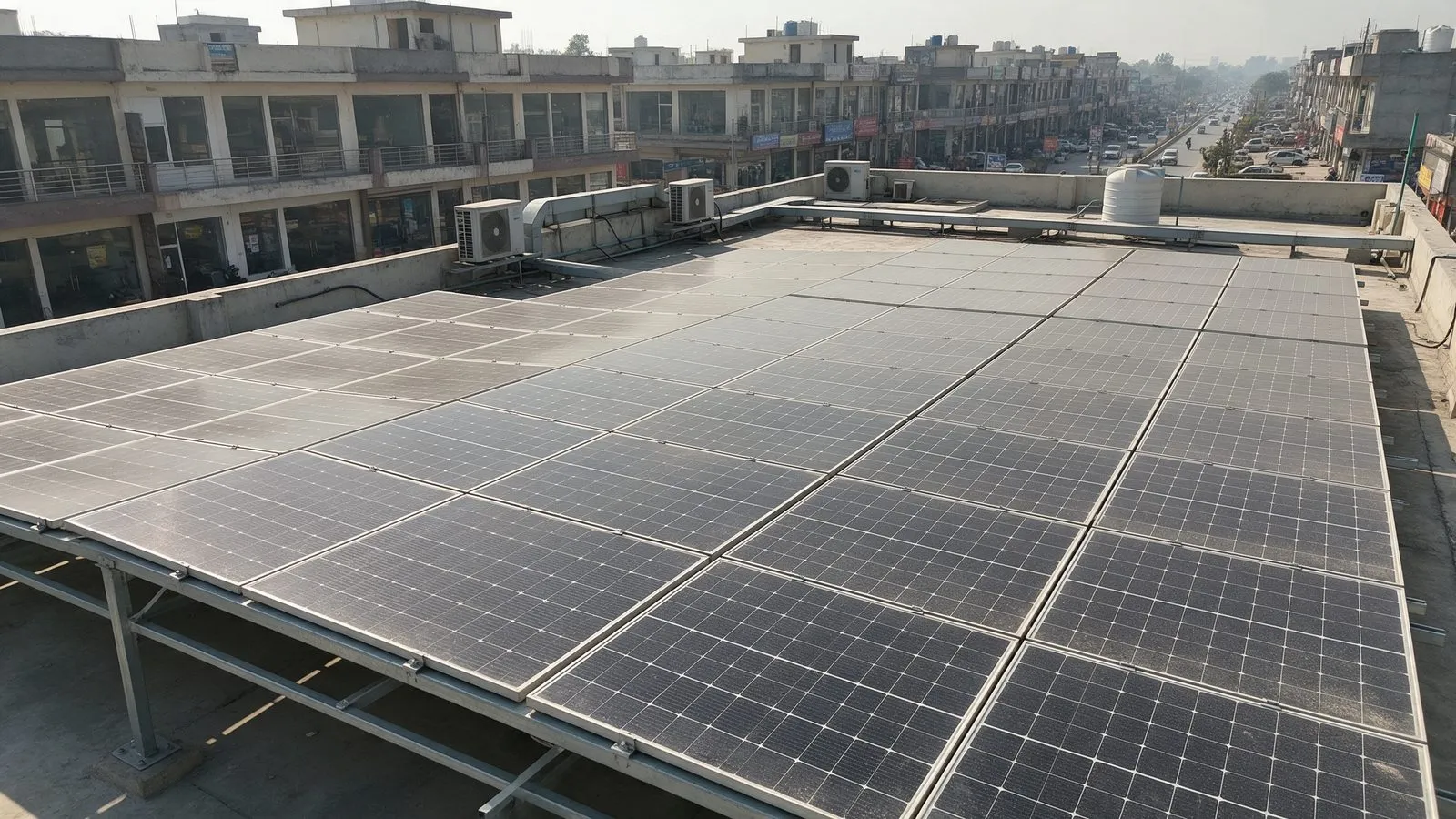 Representative image
Shops, showrooms and clinics in Zirakpur are among the best fits for rooftop solar in Tricity. They use most of their electricity in daylight, when panels produce, and unlike homes they get no free units, so every unit the panels make is a unit not bought from PSPCL. This guide works through the savings and payback for typical Zirakpur businesses, and the points to check before you commit.
Why daytime businesses save the most
Solar output peaks between roughly 10 am and 4 pm. That is when a showroom on Patiala Road runs its air conditioning and lighting, when a clinic’s equipment and fridges are working, and when an office on VIP Road is full. Most of the power is used on site, straight away, replacing units you would otherwise buy.
On days you are closed, the panels keep producing and the surplus goes to the grid through the net meter. Those units are set against what you use on working days.
- The shop's power use
- Solar output
- Solar used in the shop, replacing units you would buy
An illustration for a shop open from about 10 am to 8 pm, not to scale.
What a business pays PSPCL in 2026-27
For a non-residential connection with a sanctioned load of up to 20 kW, PSPCL’s energy charge in 2026-27 is:
Fixed charges and electricity duty come on top. Solar reduces the units you buy. It does not reduce the fixed charge on your sanctioned load.
Two worked examples
These use PSPCL’s 2026-27 rates, generation of 3.6 to 4.2 units per kW a day, and a typical 2026 price for business systems of ₹45,000 to ₹60,000 per kW including GST. Your own figures depend on your bills, roof and working days.
A clinic using 1,000 units a month
| Figure | |
|---|---|
| Energy charges before solar | about ₹6,600 a month |
| Suggested system | 8 kW |
| Saving per year | about ₹69,000 to ₹79,000 |
| Installed price | ₹3.6 lakh to ₹4.8 lakh |
| Payback | about 4.5 to 7 years |
A showroom using 2,000 units a month
| Figure | |
|---|---|
| Energy charges before solar | about ₹13,700 a month |
| Suggested system | 17 kW |
| Saving per year | about ₹1.52 lakh to ₹1.64 lakh |
| Installed price | ₹7.65 lakh to ₹10.2 lakh |
| Payback | about 4.7 to 6.7 years |
These paybacks are before tax benefits, which shorten them further for most businesses.
See what solar would save you
Tell us whether it is a home or a business, where it is and what you pay in a month. We work out your units at 2026-27 rates and size the system to your use.
Estimates use energy charges at 2026-27 rates, before fixed charges and duty, and 3.6 to 4.2 units per kW a day. Prices are typical installed ranges including GST, not a quote. Subsidy and price figures checked 12 October 2026.
Tax: depreciation and GST credit
A business recovers part of the cost through tax:
We provide the invoice break-up and technical details your CA needs.
Points to check in Zirakpur
Who owns the roof? Many shops and clinics in Zirakpur are in SCO buildings, where the roof may belong to the top-floor owner or be shared between floors. Confirm your right to use the roof in writing before anything else.
Is the premises rented? Solar is still possible with the owner’s written consent. Check that the electricity connection is in your name, and compare the remaining lease period with the payback period. If the lease is short, it may make more sense for the owner to install the system.
Sanctioned load. Since PSERC’s amendment of April 2026, a system on a shop, clinic or other non-domestic connection can be as large as the sanctioned load or contract demand, up to 500 kW. The earlier limit of 70% no longer applies. If the system your bills justify is larger, the load has to be increased. For systems of up to 10 kW, PSPCL carries out the increase with the solar application, and you pay the load-extension charges.
Shade. Taller neighbouring buildings, hoardings and water tanks can shade part of a commercial roof. Shade is the main thing we check at the survey.
Working days. A business open six or seven days a week uses more of its own generation directly and gets the best return. Size the system to working-day use rather than to the whole roof.
Power cuts and generators
An on-grid system switches off when the grid fails, to protect linemen working on the lines. If you run a diesel generator during cuts, the solar system can be set up to work alongside it with an additional controller, which reduces how much diesel you burn. If billing, lighting and CCTV must stay on without a generator, consider a hybrid system with a battery. Our guide to on-grid or hybrid solar for power cuts explains the choice.
No subsidy for businesses
The PM Surya Ghar subsidy is for homes only. A business recovers its investment through lower bills and tax benefits instead, which is why the paybacks above compare well with a home system even without the subsidy.
Next step
Send us your last 12 months of electricity bills, your working hours and a few roof photographs, and we will work out the system size, savings and payback for your premises, with every assumption written out for your CA. Our office is on Patiala Road in Zirakpur, so a site survey is quick to arrange. See solar for businesses and solar in Zirakpur, or try the savings calculator.
Common questions
How much does a 10 kW commercial solar system cost?
A typical 2026 price for a 10 kW on-grid business system is about ₹4.5 lakh to ₹6 lakh including GST, depending on the brands, the structure your roof needs and the cable run. A firm price follows a site survey.
What happens to solar power on Sundays when my shop is closed?
It is exported to the grid through the net meter and set against the units you use on working days, under PSPCL's net-metering rules. Sizing the system to working-day use gives the best return.
Can I install solar on a rented shop?
Yes, with the owner's written consent. Check that the electricity connection is in your name and that the remaining lease is longer than the payback period.
Do shops and clinics get the PM Surya Ghar subsidy?
No. The subsidy is only for residential connections. Businesses benefit instead from lower bills, depreciation on the solar plant and, where eligible, GST input credit.
Our business systems
Each one is sized to your own bills. See the price per kW and what each kW makes.
Shopfront
Shops, clinics and offices
Usually 5 to 20 kW
Ask about ShopfrontCampus
Schools, hotels and larger offices
Usually 20 to 50 kW
Ask about CampusWorks
Factories and warehouses
Usually 50 kW and above
Ask about Works