
Home / Blog / Commercial solar
Solar for hotels, restaurants and banquet halls in Zirakpur
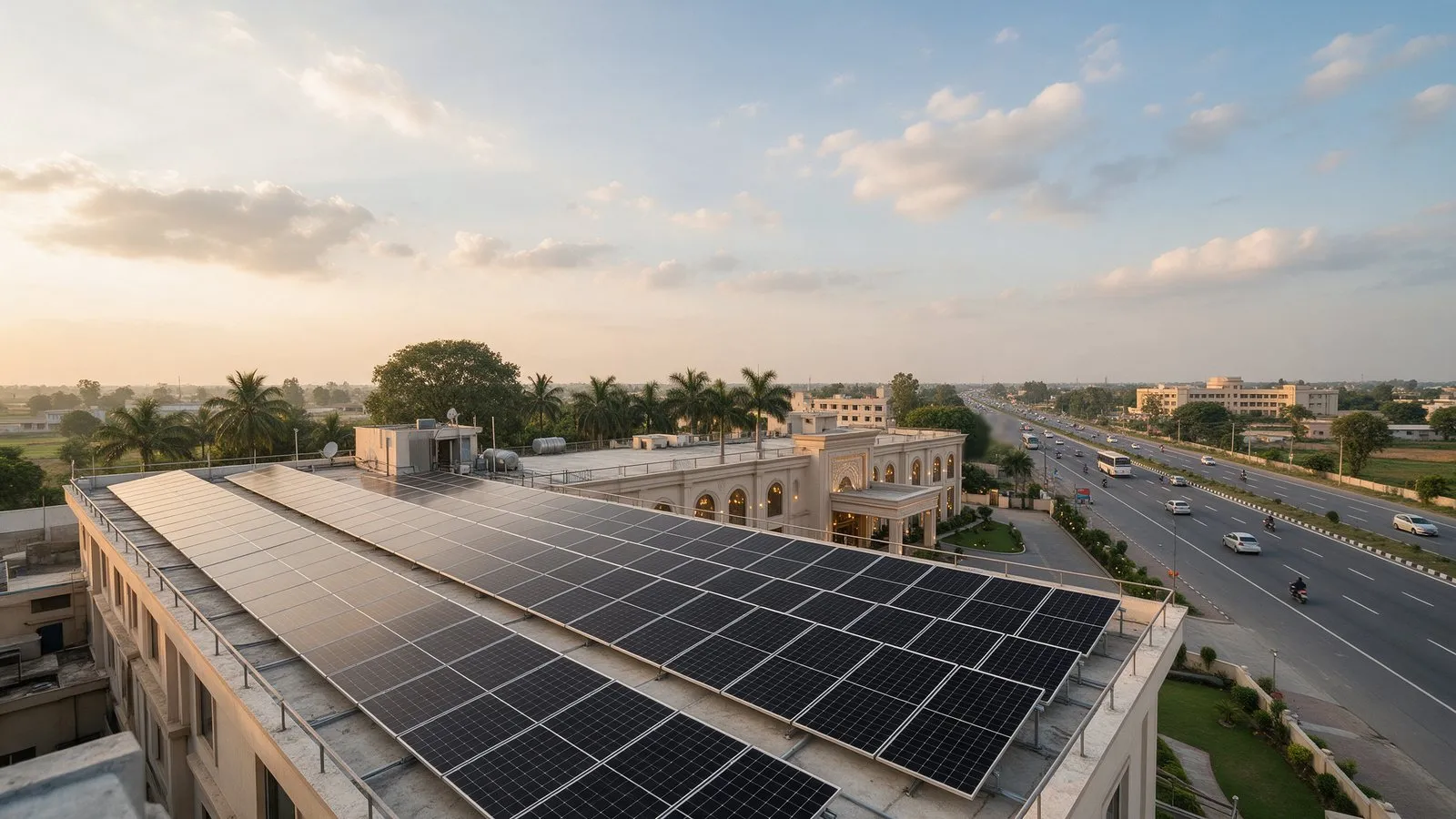 Representative image
The hotels, restaurants and banquet halls along the highways through Zirakpur run large electricity bills: air conditioning for guests and halls, kitchen exhaust, cold rooms, lifts, laundry and lighting. They pay commercial rates with no free units, and most have flat roofs. Rooftop solar can cut those bills substantially, but how much depends on when the building uses its power, because larger connections are billed by the time of day. This guide explains the tariff, the timing and the sizing.
What hospitality businesses pay PSPCL in 2026-27
Hotels, motels, restaurants, guest houses and marriage palaces are billed on PSPCL’s non-residential (NRS) tariff:
| Load | Energy charge | Fixed charge |
|---|---|---|
| Up to 7 kW | ₹6.10 a unit up to 500 units, ₹7.10 above | ₹70 a kW |
| Above 7 kW, up to 20 kW | ₹6.10 a unit up to 500 units, ₹7.10 above | ₹100 a kW |
| Above 20 kW, up to 100 kVA | ₹6.25 a kVAh | ₹130 a kVA |
| Above 100 kVA | ₹6.45 a kVAh | ₹140 a kVA |
Marriage palaces pay the fixed charge on only 25% of their sanctioned load or contract demand.
Time-of-day billing above 100 kVA
A connection with a contract demand above 100 kVA is billed on PSPCL’s time-of-day tariff:
| Period | 6 am to 6 pm | 6 pm to 10 pm | 10 pm to 6 am |
|---|---|---|---|
| 16 June to 15 October | Normal rate | Normal rate plus ₹2.00 a kVAh | Normal rate |
| 16 October to 31 March | Normal rate | Normal rate | Normal rate less ₹1.00 a kVAh |
| 1 April to 15 June | Normal rate | Normal rate | Normal rate less ₹0.50 a kVAh |
This matters for solar because of how PSERC’s rules net the units. For a consumer on time-of-day billing, the units the panels make in a time block are first set against the units used in the same block. A surplus is then treated as if it was made in the next lower-priced block. So solar made during the day reduces daytime use at the normal rate, but it cannot be set against the expensive evening hours in the monsoon months. Banked units are used against lower-priced hours instead.
The practical result: solar pays best for the power a hotel or restaurant uses in daylight, and least for a hall that is busy mainly in the evenings.
Three kinds of business, three answers
These examples use PSPCL’s 2026-27 rates, our estimate of about 1,440 units per kW a year, and a typical 2026 price of ₹45,000 to ₹60,000 per kW for a business system, and count energy charges only. Our calculator works it out for your bill:
See what solar would save you
Tell us whether it is a home or a business, where it is and what you pay in a month. We work out your units at 2026-27 rates and size the system to your use.
Estimates use energy charges at 2026-27 rates, before fixed charges and duty, and 3.6 to 4.2 units per kW a day. Prices are typical installed ranges including GST, not a quote. Subsidy and price figures checked 12 October 2026.
Chandigarh and Panchkula
Planning points
How we work with hotels and halls
We read twelve months of bills, including the time-of-day breakdown on larger connections, survey the roof and size the system to the daytime use. Our guides to solar for schools and coaching centres and shops and clinics show the same approach for other businesses, and our commercial solar page covers business systems in general.
Common questions
Which electricity tariff does a hotel pay in Punjab?
PSPCL's non-residential (NRS) tariff. In 2026-27 that is ₹6.25 a kVAh for a load from 20 kVA up to 100 kVA, and ₹6.45 above 100 kVA, where time-of-day billing also applies. Smaller connections pay ₹6.10 a unit up to 500 units a month and ₹7.10 above.
Does solar reduce the evening peak charge on a time-of-day bill?
No. Under PSERC's rules, solar units are first set against use in the same time block, and any surplus is treated as made in the next lower-priced block. So daytime solar cannot offset the ₹2.00 a kVAh evening surcharge from 16 June to 15 October.
Is rooftop solar worth it for a banquet hall?
It can be, but each kW saves less than in a hotel or restaurant, because halls are busy mainly on function days and in the evenings. Size the system to the hall's yearly use, since surplus left at the end of the settlement year earns only about ₹2.23 a unit.
How much does a 50 kW solar system cost for a hotel?
Roughly ₹22.5 lakh to ₹30 lakh in 2026, including GST, depending on the structure and the roof. Used mainly in daytime on PSPCL's tariff above 100 kVA, it saves roughly ₹4.6 lakh a year.
Our business systems
Each one is sized to your own bills. See the price per kW and what each kW makes.
Shopfront
Shops, clinics and offices
Usually 5 to 20 kW
Ask about ShopfrontCampus
Schools, hotels and larger offices
Usually 20 to 50 kW
Ask about CampusWorks
Factories and warehouses
Usually 50 kW and above
Ask about Works