
Home / Blog / Commercial solar
Rooftop solar for schools and coaching centres in Tricity
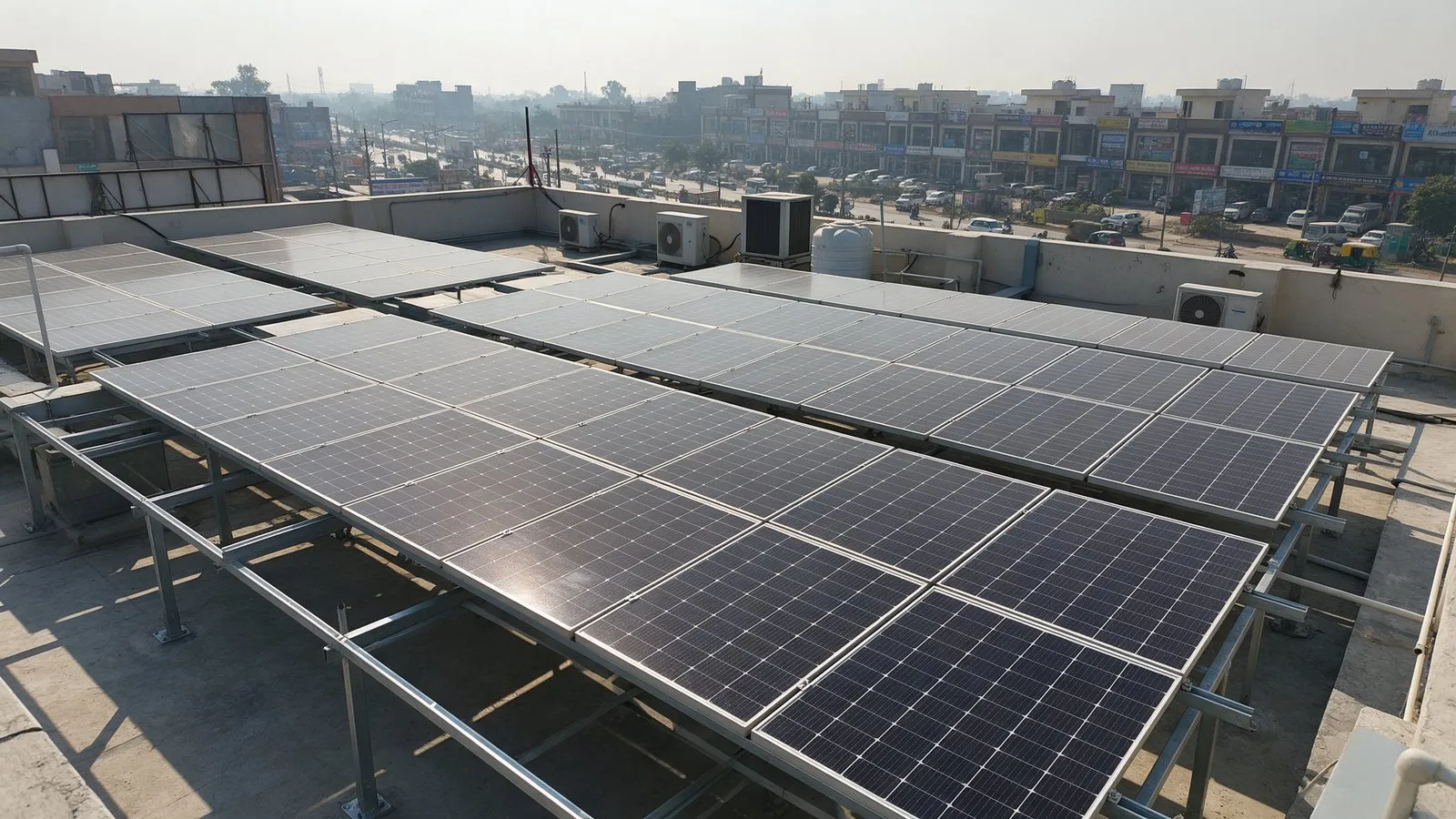 Representative image
Schools and coaching centres are among the best fits for rooftop solar. They use most of their power in daylight, when the panels produce. They usually have large flat roofs. And unlike homes in Punjab, they get no free units, so every unit the panels make is a unit not bought. This guide explains what they pay, what solar saves and what to plan for.
What a school or coaching centre pays in 2026-27
The tariff depends on who runs the institution and where it is.
In Punjab (PSPCL). Under PSERC’s schedule of tariff, government and government-aided schools and colleges are billed on the domestic tariff. Private unaided schools, colleges and universities are billed on the non-residential (NRS) tariff, as are commercial premises such as most coaching centres. The NRS rates for 2026-27 are:
| Load | Energy charge | Fixed charge |
|---|---|---|
| Up to 7 kW | ₹6.10 a unit up to 500 units, ₹7.10 above | ₹70 a kW |
| Above 7 kW, up to 20 kW | ₹6.10 a unit up to 500 units, ₹7.10 above | ₹100 a kW |
| Above 20 kW, up to 100 kVA | ₹6.25 a kVAh | ₹130 a kVA |
| Above 100 kVA | ₹6.45 a kVAh | ₹140 a kVA |
In Chandigarh (CPDL). JERC’s tariff for 2026-27 bills non-government schools, colleges and coaching institutes at ₹4.60, ₹4.80 and then ₹5.75 a kVAh for the first 100, the next 100 and the remaining units in a month. Government educational institutions pay ₹5.55 a kVAh.
In Panchkula (UHBVN). Non-domestic connections up to 50 kW pay ₹6.45 a kVAh up to 10 kW, ₹6.80 for 10 to 20 kW and ₹6.60 for 20 to 50 kW.
Fixed charges and fuel adjustments come on top in each case. Solar reduces the units you buy; it does not reduce the fixed charge.
What solar saves: two examples
These use PSPCL’s 2026-27 rates, our estimate of about 1,440 units per kW a year in Tricity, and a typical 2026 price of ₹45,000 to ₹60,000 per kW for a business system, including GST. They count energy charges only.
Our calculator gives the figure for your own bill:
See what solar would save you
Tell us whether it is a home or a business, where it is and what you pay in a month. We work out your units at 2026-27 rates and size the system to your use.
Estimates use energy charges at 2026-27 rates, before fixed charges and duty, and 3.6 to 4.2 units per kW a day. Prices are typical installed ranges including GST, not a quote. Subsidy and price figures checked 12 October 2026.
Holidays and Sundays
A school’s roof keeps producing through Sundays, holidays and the summer vacation, when the building uses little. With net metering those units are not lost. They are exported and set against the units the school uses later, within PSPCL’s settlement year from October to September. Credit still left at the end of September is paid at 75% of PSERC’s feed-in tariff, about ₹2.23 a unit in 2026-27, far less than the school pays for one. So size the system to the school’s yearly use, not to fill the roof.
Size, approvals and panels
A lesson as well as a saving
A solar system on a school roof is also a teaching resource. The inverter’s daily figures can be shown on a display in a corridor and used in science classes, which costs little to plan for at the start.
How we work with schools
We read twelve months of bills, survey the roof, check the sanctioned load and category, and size the system to the school’s yearly use, with the timetable and holidays in mind. Our commercial solar page covers business systems, and our guide to solar for shops and clinics shows the same approach for smaller premises.
Common questions
Which tariff does a private school pay in Punjab?
Private unaided schools, colleges and universities are on PSPCL's non-residential (NRS) tariff: ₹6.25 a kVAh for loads from 20 kVA up to 100 kVA in 2026-27, and ₹6.45 above 100 kVA. Government and government-aided schools are on the domestic tariff.
Do schools get the PM Surya Ghar subsidy?
No. PM Surya Ghar is for homes, and for housing societies' common facilities. Schools and coaching centres pay for their systems without the subsidy, and save on bills at commercial rates instead.
What happens to solar units during the summer vacation?
With net metering, units the roof makes while the school is closed are exported and set against the units it uses later in PSPCL's October to September settlement year. Credit left at the end is paid at about ₹2.23 a unit in 2026-27, so size the system to yearly use.
How much does a 40 kW solar system for a school cost?
Roughly ₹18 lakh to ₹24 lakh in 2026, including GST, depending on the structure, the panels and the cable runs. On a PSPCL non-residential tariff it typically pays for itself in 5 to 7 years.
Our business systems
Each one is sized to your own bills. See the price per kW and what each kW makes.
Shopfront
Shops, clinics and offices
Usually 5 to 20 kW
Ask about ShopfrontCampus
Schools, hotels and larger offices
Usually 20 to 50 kW
Ask about CampusWorks
Factories and warehouses
Usually 50 kW and above
Ask about Works