
Home / Blog / Buying guide
TOPCon, mono PERC or bifacial: which solar panel to choose in 2026?
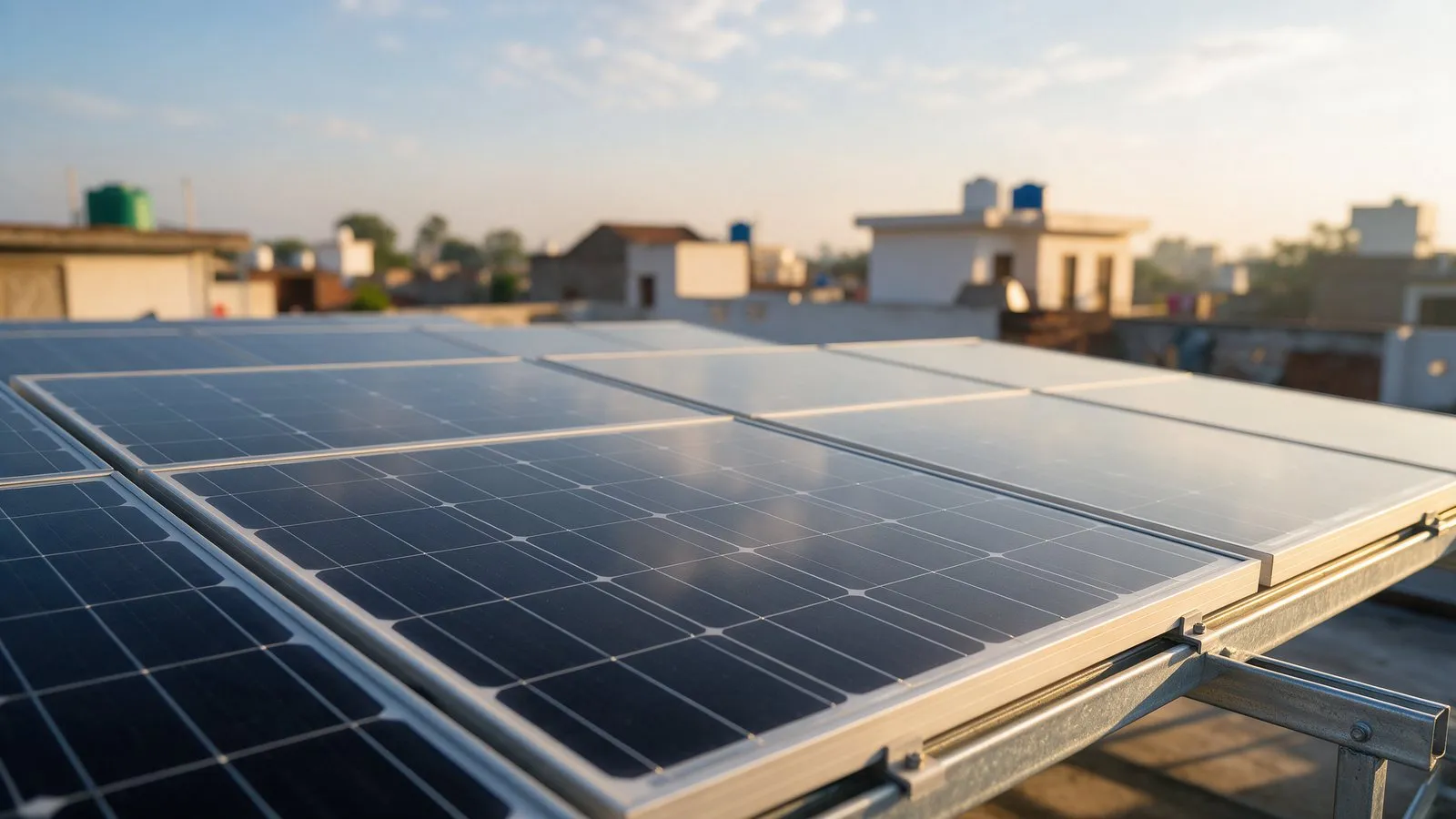 Representative image
Most solar quotations in 2026 describe the panels as mono PERC or TOPCon, and some add the word bifacial. The labels describe how the cells inside are made, and they make a real but modest difference to how much a system produces over 25 years. This guide explains what each type is, how they behave in a Tricity summer, and how to choose between them, including for a home claiming the PM Surya Ghar subsidy.
The three terms
Mono PERC is the older of the two main cell designs. It has been the standard rooftop panel for most of the last decade, it is mature and well understood, and it is usually the cheapest per watt. Many of the DCR panels made with Indian cells for subsidy homes are still PERC in 2026.
TOPCon is the newer design. It is made on a different type of silicon wafer and converts a little more sunlight into electricity, loses less output in heat and ages more slowly. Manufacturers worldwide have moved most of their new production to TOPCon, and Indian cell makers are following.
Bifacial describes the construction of the panel, not the cell. A bifacial panel has a transparent back, usually glass, so it also collects light reflected onto its underside. Both PERC and TOPCon panels can be bifacial.
How they compare
These are typical figures from manufacturers’ datasheets. Individual models vary, so always read the datasheet of the exact model you are quoted.
| Mono PERC | TOPCon | |
|---|---|---|
| Panel efficiency | About 21% to 22% | About 22% to 23.5% |
| Output lost for each °C of heat above 25°C | About 0.34% to 0.35% | About 0.30% |
| Typical first-year ageing | About 2% | About 1% |
| Typical ageing after that | About 0.55% a year | About 0.4% a year |
| Price per watt | Lowest | Usually a few percent higher |
What heat does on a Tricity roof
Panels are rated at a cell temperature of 25°C. On a May afternoon in Mohali, with the air at 42°C, the cells on a roof can run at 65°C or more, 40 degrees above the rating. At that temperature a PERC panel produces about 14% less than its rated output and a TOPCon panel about 12% less.
That 2% gap applies only in the hottest hours. Over a full year in Tricity it adds up to roughly 1% more output from TOPCon. It matters more here than in a cooler climate, but it is not a reason on its own to pay much more.
What ageing does over 25 years
All panels lose a little output each year. Using the typical figures above, a PERC panel is guaranteed to keep about 85% of its rated output after 25 years, and a TOPCon panel about 89%. Averaged over the whole 25 years, the TOPCon panel produces about 3% more.
Together with the heat advantage, TOPCon produces roughly 4% more energy over the life of the system than a PERC panel of the same wattage. As a rough rule, if TOPCon adds less than about 4% to the price of the whole system, it is likely to pay for itself.
Where bifacial panels help
The back of a bifacial panel collects light reflected from whatever is underneath it. How much it adds depends on two things:
So bifacial panels earn their place on a raised structure or canopy over a light roof, where the gain can be a few percent. On a low frame over a dark roof, the gain is small. Bifacial panels are also heavier because of the glass back, so the structure must be designed for them. Our guide to structures shows the types we build.
Choosing for a subsidy home
The PM Surya Ghar subsidy needs DCR panels, made with Indian cells, from a model on MNRE’s approved list (ALMM). That narrows the choice to what Indian cell makers produce, which in 2026 means both PERC and a growing number of TOPCon models. Our guide on the parts of a rooftop solar system explains how to check a model against the list.
In practice:
Established brands of the same type perform within a few percent of one another. The warranty terms, local service and whether the model qualifies for the subsidy usually matter more than the brand name. Our brands page explains how we choose equipment.
What to look for on the datasheet
Our quotation checklist covers the rest of the quotation.
Common questions
Is TOPCon better than mono PERC?
Yes, modestly. TOPCon panels are slightly more efficient, lose less output in heat and age more slowly, which adds up to roughly 4% more energy over 25 years for the same wattage. Whether that is worth it depends on the price difference for the whole system.
Are bifacial panels worth it on a house roof?
On a raised structure or canopy over a light-coloured roof, often yes, because the back of the panel collects reflected light. On a low frame over a dark roof, the extra output is small and usually not worth a higher price.
Can I get the PM Surya Ghar subsidy with TOPCon panels?
Yes, if the model is DCR, made with Indian cells, and listed on MNRE's approved list (ALMM). The subsidy depends on the panels being Indian-made and approved, not on the cell type.
Which solar panel brand is best?
No single brand is best for every home. Established brands of the same type perform within a few percent of each other, so compare the datasheet, the warranty terms, local service support and whether the model qualifies for the subsidy.
Our home systems
Each one is sized to your own bills. See the price per kW and what each kW makes.
Core
Small home
Usually 1 to 3 kW
Ask about CoreComfort
Family home
Usually 4 to 5 kW
Ask about ComfortGrand
Kothi or large home
Usually 6 kW and above
Ask about Grand