
Rooftop solar for homes in Mohali, Zirakpur and Kharar
For independent houses and kothis, a grid-connected (on-grid) system is normally the most cost-effective choice. It has the lowest cost per kW, delivers the largest reduction in the electricity bill, and is the system type supported by the PM Surya Ghar subsidy. This page explains how to size a residential system and how it operates with your PSPCL connection.
What size solar system do you need?
Find "units consumed" on your electricity bill. PSPCL bills every two months, so halve that number, then move the slider to it. A summer bill gives the most useful figure, because air conditioning raises consumption.
A rough guide based on about 4 units a day per kW in Punjab. Your proposal uses your own bills, sanctioned load and roof.
- Suggested system
- 4 kW
- Shade-free roof
- about 330 to 400 sq ft
- Units it should make
- about 480 a month
3 kW, 5 kW or 10 kW: a quick sizing guide
System size is determined by the units you consume, not the bill amount. In Punjab, 1 kW of panels generates approximately 4 units a day averaged over the year, with higher output in summer and lower output in winter fog. A 3 kW system therefore generates around 350 units a month.
The table is an initial guide. Your proposal is based on twelve months of your own bills, your sanctioned load and a survey of your roof.
Figures are approximate and change with panel type, tilt, shade and weather.
| Units used per month | System size | Shade-free roof |
|---|---|---|
| Up to 350 | 3 kW | About 250 to 300 sq ft |
| 350 to 500 | 4 kW | About 330 to 400 sq ft |
| 500 to 600 | 5 kW | About 400 to 500 sq ft |
| 600 to 1,200 | 6 to 10 kW | About 500 to 1,000 sq ft |
How an on-grid system works with your PSPCL meter
Solar panels generate DC power. An inverter, normally installed near the meter, converts it to the same AC power supplied by the grid. The house consumes solar power first, and all appliances, including air conditioners, operate exactly as before.
When generation exceeds consumption, which is common in the afternoon, the surplus is exported to the grid. PSPCL replaces the existing meter with a net meter that records units in both directions, and the bill is raised for imported units less exported units.
At night and in poor weather the house draws from the grid as usual. Under current PSPCL rules, surplus units from high-generation months are carried forward, which offsets lower winter output.
An on-grid system shuts down during a power cut, as a mandatory safety feature. Where outages are frequent, a hybrid system should be considered. See solar with battery backup.
Sizing around Punjab's 300 free units
Domestic PSPCL connections receive 300 free units a month, and this is central to how we size a residential system. Where net metering keeps billed units within the free limit, the bill remains at or near zero, and additional capacity beyond that point adds cost without adding savings.
In some cases this results in a smaller system than a standard quotation would suggest. Sizing is based on summer bills, when the limit is most likely to be exceeded. The free-unit rule is explained on the home page.
Standard homes and large homes
3 to 5 kW, on-grid
The standard configuration for an independent house with one or two air conditioners. A 3 kW system comprises five or six panels. It is eligible for the PM Surya Ghar subsidy, subject to the scheme's rules, and we manage the net-metering application with PSPCL.
5 to 10 kW, on-grid or hybrid
For kothis and larger houses running several air conditioners through the summer. The system is sized to the actual load, with battery storage available where power cuts are a concern. PSPCL generally does not approve a system larger than the sanctioned load, so a load enhancement may be required first. We verify this from the bill at the outset.
Get a price for your house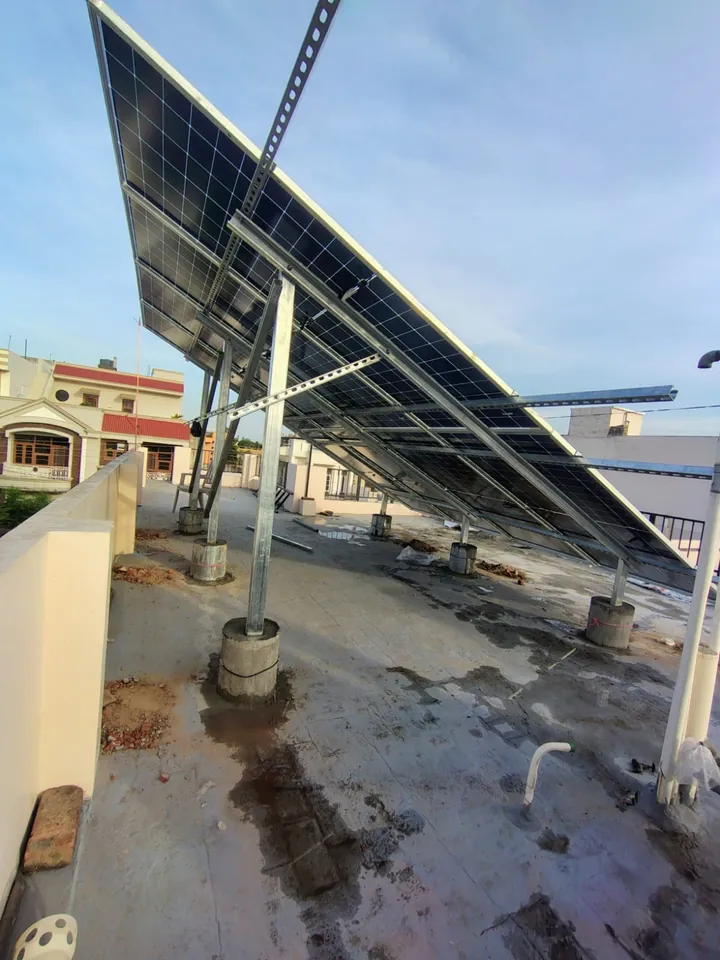
Roof assessment
Most houses in the region have a flat RCC roof, which is well suited to solar. Panels are normally mounted on an elevated galvanised steel structure, which keeps the roof usable underneath.
Shading has a significant effect on output. A water tank or parapet that shades part of one panel for a few hours reduces the output of every panel connected with it. Our survey therefore assesses shading from tanks, stair rooms, trees and neighbouring buildings, together with the structural condition of the roof. Where a roof is not suitable, we advise the customer accordingly.
What goes into a home system
- Solar panels. Most carry a performance warranty of 25 years or more. Your proposal names the make and model.
- An inverter. It converts the power and shows you what the system is making, usually through a phone app.
- The mounting structure. Galvanised steel, anchored to the roof and designed for local wind loads.
- Cables and safety switches. DC and AC cable, a distribution box, and protection against surges and faults.
- Earthing and a lightning arrester. Essential protection for the equipment and the building, and part of every installation.
- The net meter. Fitted by PSPCL after their inspection.
We can source panels and inverters from several brands. For subsidy eligibility, see how PM Surya Ghar works.
Frequently asked questions
Can I run my ACs on solar?
Yes. With an on-grid system the house draws from the panels and the grid together, so an AC runs exactly as it does now. What changes is the bill. On a summer afternoon a 5 kW system can cover two or three ACs on its own, and at night the grid takes over.
How much maintenance does it need?
Very little. Wash the dust off the panels with plain water every couple of weeks, more often in the dry months and after a dust storm. Do it early in the morning or in the evening, when the glass is cool. There are no moving parts, and the app shows you if the output drops.
Does solar work in winter fog and on cloudy days?
It works, but it makes less. December and January are the lowest months here and May is the highest. Sizing from a full year of bills accounts for this, and the units carried forward from sunny months help cover the winter.
Can I add more panels later?
Often, yes, if the inverter and your sanctioned load have room for them. If you expect to add an air conditioner, an EV charger or another floor, let us know at the design stage so that the inverter is specified with that capacity in mind.
I live in a flat. Can I get rooftop solar?
Only if you have rights to a part of the roof and your own meter. We currently undertake independent houses and kothis. Housing societies considering solar for lifts and common-area lighting are welcome to contact us to discuss requirements.
Request a free solar assessment
Send a photograph of your electricity bill on WhatsApp. We will respond with an indicative system size and advise whether battery backup is justified for your property.