
Home / Services / Commercial solar
Commercial rooftop solar in Mohali, Chandigarh and Panchkula
Rooftop solar for shops, clinics, schools, offices and warehouses whose electricity consumption is concentrated in daytime hours. We analyse twelve months of bills and provide a recommended system size, projected savings and a payback range, with every assumption documented for review by your chartered accountant.
Why solar suits daytime businesses
Solar generation peaks between approximately 10 am and 4 pm, the same hours in which a shop, school or clinic draws the most power for air conditioning, lighting and equipment. Most of the energy generated is therefore consumed on site, directly replacing purchased units.
Commercial connections receive no free units, so every unit generated reduces the bill from the first month. On days the premises are closed, exported units are recorded by the net meter and set against later consumption.
- 10 to 50 kW, on-grid
- RCC roofs and metal sheds
- Equipment chosen for your site from several brands
- Commissioning report, warranty file and service after handover
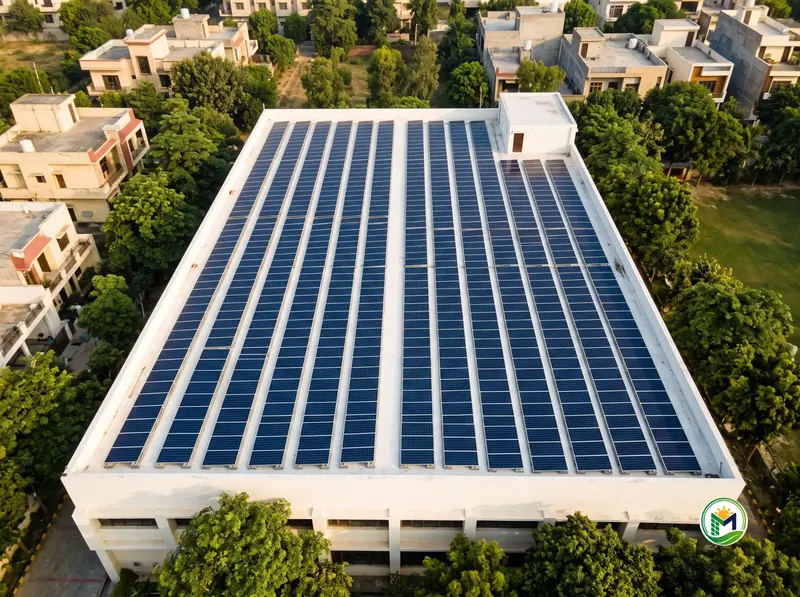
Factors that determine payback
Payback varies from one building to another, so we do not publish a single figure. Our assessment considers the following factors before a system size is recommended.
- Share of daytime consumption. A school that closes at 3 pm and a restaurant that peaks at 9 pm obtain very different returns from the same system.
- Tariff and fixed charges. Solar reduces the units purchased. It does not reduce the fixed charge on the sanctioned load.
- Operating days. Six or seven working days a week allow more of the generation to be consumed directly.
- Roof conditions. Shading from neighbouring buildings, hoardings and water tanks reduces output, and a roof requiring an elevated structure increases cost.
- Method of financing. Outright purchase, bank finance and tax depreciation each affect the return.
As a guide, each kW of panels generates about 120 units a month in this region, averaged over the year, and requires 80 to 100 sq ft of shade-free roof. A 20 kW system generates around 2,400 units a month and occupies 1,700 to 2,000 sq ft.
The proposal presents savings and payback as a range, together with the tariff, generation and annual tariff escalation assumed. Assumptions can be revised with your chartered accountant and the projection reissued.
Sectors we serve
- Shops and showrooms
- Clinics and hospitals
- Schools and coaching institutes
- Offices
- Warehouses and small units
- Hotels, restaurants and PGs
Information we require
- Electricity bills for the last 12 months
- Your sanctioned load and tariff category, which are printed on the bill
- Roof photographs, or a convenient time for a site visit
- Your working hours and days, including Sundays if you open
- Whether you run a generator or an inverter during power cuts
RCC roofs and metal sheds
On a flat RCC roof, panels are mounted on a galvanised steel structure, elevated where the roof must remain accessible for AC outdoor units and water tanks.
On a metal shed, panels are clamped along the slope of the sheeting, which requires less steel. Before quoting for a shed, we assess the age and condition of the sheeting and the supporting frame, since the roof must remain serviceable for the 25-year life of the panels.
Tax, finance and service areas
The PM Surya Ghar subsidy applies to residential connections only. A business recovers its investment through lower electricity bills and through depreciation on the solar plant, which income tax rules allow at a higher rate than most equipment. Your chartered accountant can advise on depreciation and GST input credit, and we provide the invoice break-up and technical details required.
For financed projects, we provide the quotation and documentation that banks and NBFCs require for a solar loan. Loan terms are determined by the lender.
We undertake commercial projects in Mohali, Zirakpur, Kharar and New Chandigarh, and in Chandigarh and Panchkula. Punjab, Chandigarh and Haryana each have their own electricity department and net-metering regulations, which we confirm for your connection before quoting.
Frequently asked questions
What happens to the solar power on Sundays and holidays?
It is exported to the grid. The net meter records exported units, which are set against units consumed on working days under the net-metering rules for your connection. A system sized to working-day consumption gives the best return.
Will solar run my shop during a power cut?
An on-grid system switches off when the grid goes down. Where a generator is installed, the solar system can be configured to operate alongside it with an additional controller. Where lighting, billing and CCTV must remain on without a generator, consider a hybrid system with a battery.
My premises are rented. Can I still put up solar?
Yes, with the written consent of the owner. Two points should be checked first: the name in which the electricity connection is held, and the remaining lease period relative to the payback period. Where the lease is short, it may be more suitable for the owner to install the system.
Can I install more than my sanctioned load?
Generally not. The electricity department links the size it will approve to your sanctioned load. Where the sanctioned load is lower than the system required, a load enhancement can be applied for first. We identify this at the assessment stage.
Do you take projects bigger than 50 kW?
Our current project range is 10 to 50 kW. For larger requirements, please contact us to discuss the scope, and we will advise whether it is a project we can deliver.
Request a free solar assessment
Send a photograph of your electricity bill on WhatsApp. We will respond with an indicative system size and advise whether battery backup is justified for your property.